

I was reading Psalm 77 recently, and verse 19 struck me, “Your way was through the sea, your path through the great waters; yet your footprints were unseen.” (ESV).
As I reflected on this verse, I thought of the many times God was at work in my life, but I probably hadn’t registered it because it did not come in a more dramatic fashion. Times when He had strolled in silently rather than thundered in theatrically.
Incidentally, the verse preceding this one (verse 18) says, “Your thunder was heard in the whirlwind, your lightning lit up the world; the earth trembled and quaked.” (NIV). That’s the kind of action that catches our attention, isn’t it? The thunder, the lightening, the fanfare.
But what about the quiet footprints and handprints? If you think about it, walking bare feet is highly unlikely to make much noise. Not only that, unless one is walking in sand, mud, wet paint or something similar, it is highly unlikely that we will see their prints. The same applies to hand and finger prints. That does not mean that these prints aren’t there though. One person can go through a room and say there are no prints in it. Conversely, a detective looking for clues will probably see a hundred different prints all over. The question therefore is, are we looking?
It reminds me of the passage in 1 Kings 19:11-13 (ESV), where God was not in the “great and strong wind which tore the mountains and broke in pieces the rocks before the Lord”, or in the earthquake afterwards, or in the subsequent fire. But, after the fire, there was the sound of a low whisper. “And when Elijah heard it, he wrapped his face in his cloak and went out and stood at the entrance of the cave. And behold, there came a voice to him and said, “What are you doing here, Elijah?”” I sometimes feel like this is God’s favourite modus operandi, or at least one of them.
Thinking of this made me recall a lesson I learnt from a recent sermon on the story of Ruth and Naomi. In Ruth 1:19b-21, Naomi understandably laments the tragedy that has befallen her:
“When they came to Bethlehem, the entire town was excited by their arrival. “Is it really Naomi?” the women asked. “Don’t call me Naomi,” she responded. “Instead, call me Mara, for the Almighty has made life very bitter for me. I went away full, but the Lord has brought me home empty. Why call me Naomi when the Lord has caused me to suffer and the Almighty has sent such tragedy upon me?”” (NLT).
However, just before this, something remarkable had taken place. Ruth had shown her incredible devotion and loyalty. Naomi had given Ruth permission to go back to her people, “But Ruth replied, “Don’t ask me to leave you and turn back. Wherever you go, I will go; wherever you live, I will live. Your people will be my people, and your God will be my God. Wherever you die, I will die, and there I will be buried. May the Lord punish me severely if I allow anything but death to separate us!” When Naomi saw that Ruth was determined to go with her, she said nothing more.”
As such, Naomi would have had Ruth by her side at this point, but what did Naomi say? “The Lord has brought me home empty.” Now we know the story of Ruth and how God orchestrated events in a ‘behind-the-scenes’ fashion to restore Naomi’s joy and give her a family again. However Naomi would not have known all that at the time. Neither would she have known that Ruth resolutely staying by her side would be the first among many actions that God would use to restore her. Are we similarly dismissing the Ruths beside us and calling our lives empty?
Incidentally, the book of Ruth does not record God speaking or acting directly, but when we look closer, we can see His ‘unseen’ handprints at work, from some strategic ‘coincidences’, to commands He had put in place long before, which were thankfully being obeyed, about caring for widows, orphans, foreigners and those in less fortunate circumstances. “When you are harvesting in your field and you overlook a sheaf, do not go back to get it. Leave it for the foreigner, the fatherless and the widow, so that the LORD your God may bless you in all the work of your hands.” (Deuteronomy 24:19, NIV).
“When you harvest the crops of your land, do not harvest the grain along the edges of your fields, and do not pick up what the harvesters drop. 10It is the same with your grape crop—do not strip every last bunch of grapes from the vines, and do not pick up the grapes that fall to the ground. Leave them for the poor and the foreigners living among you. I am the LORD your God.” (Leviticus 19:9-10, NLT).
It also made me think about the popular poem, ‘Footprints in the sand’, included below:
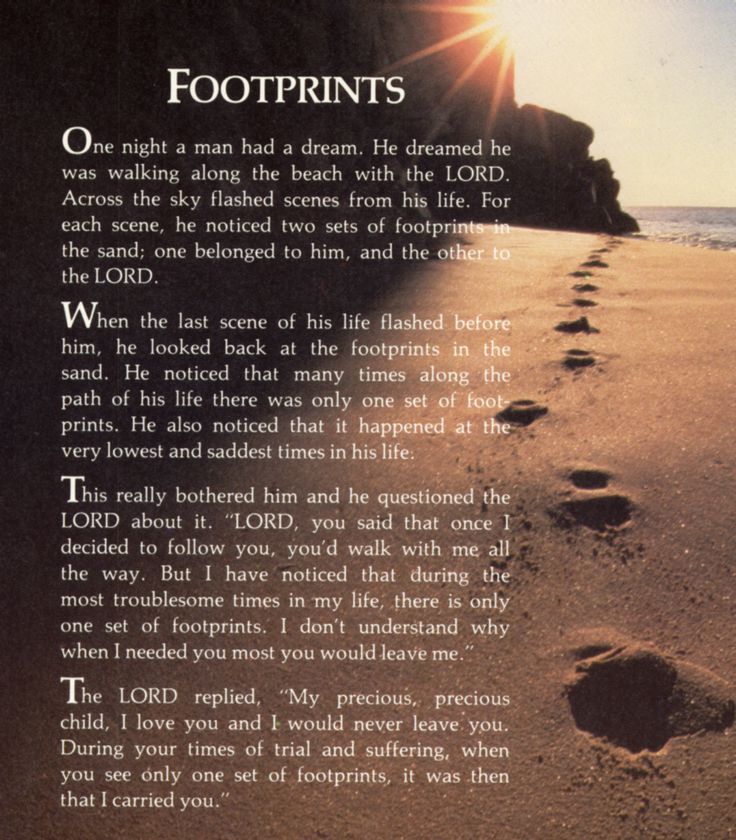
Sometimes, we don’t realise God is at work because we have not yet taken the time to reflect on situations, to observe His handprints, to see His footprints, to realise that He was the one who carried us through. It is important to ask ourselves, are we prone to dismissing the blessings we receive as mere coincidences, or do we take the time to acknowledge and thank God for these blessings?
Where has God been quietly at work in your life? Where has He made a way through the sea, and a path through great waters that had threatened to drown us, to swallow us, to destroy us? Where has God lifted up a standard against the enemy when he tried to come in like a flood? (Isaiah 59:19). Can we recall times when God was with us as we went through ‘deep waters’? Times when we went through rivers of difficulty but did not drown? Or when we walked through the fire and were not burnt or consumed? (Isaiah 43:2). And all the days when we laid down, slept and woke up, because God sustained us? (Psalm 3:5). Are we taking the time to ponder on God’s works and to meditate on His mighty deeds in our lives and in our world? (Psalm 77:12).
I pray that as we reflect on this, we will set aside some time to meditate, to dwell on His works in our lives, the obvious and seemingly obscure, the big and seemingly small, the roaring thunders and the quiet footsteps. As we do so, may we learn to exalt and magnify God in the areas where we have made Him too small in our hearts and eyes, and may praise, gratitude, joy, hope and wonder bubble up in us again and again. Amen and Amen.



Leave a comment