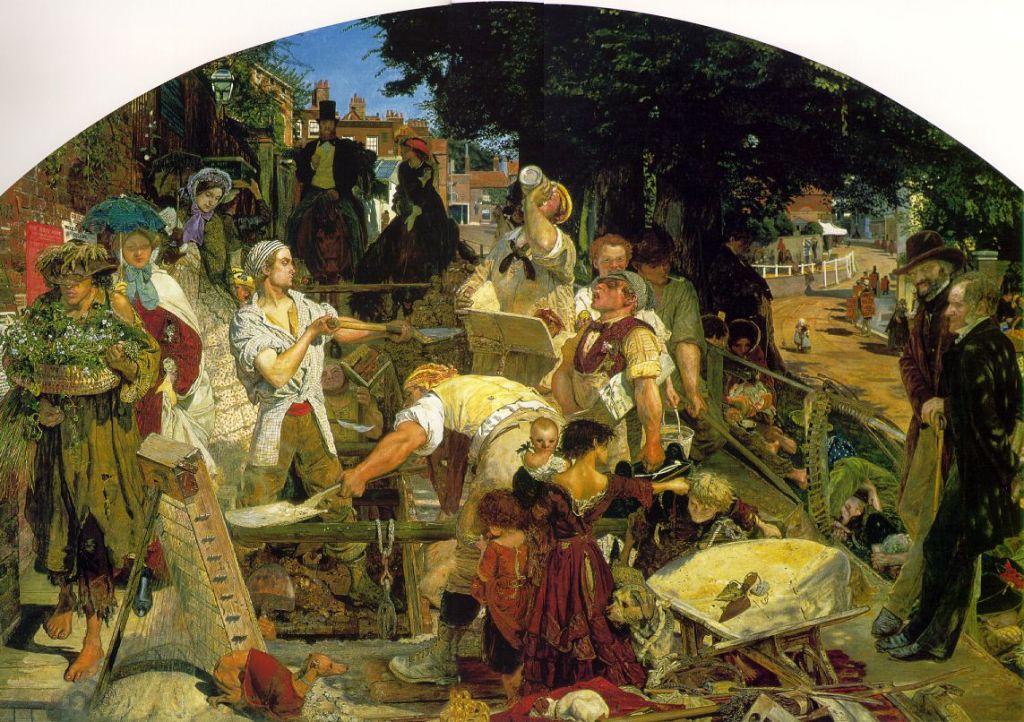
Listening to radio when growing up, I found it interesting that some radio stations would play secular songs from Monday to Saturday, while Sunday was the day for playing Christian songs. I found that interesting, and wondered what stopped them from playing Christian songs on other days of the week. Why the dichotomy between Sunday and the rest of the week?
As I recall that, I wonder, does that same dichotomy exist in our lives? Is Sunday for God, and Monday to Saturday for…us? Or the world?
What if that dichotomy did not exist though? What if God was in our every day? What if our work made us better followers of Jesus, and being followers of Jesus made us better at our work? Imagine a life lived in total worship to God… on Sundays, Mondays, Tuesdays, Wednesdays, Thursdays, Fridays, Saturdays.
As I studied the Bible, I realised there are several examples of how people’s previous or present work, skills, training etc potentially helped them fulfil God’s calling on their lives. For some, it helped them to get to know God, serve Him, to have faith in Him. Likewise, there are also many examples of how God’s Spirit made people much better at their work et al than they could have ever been in their limited human strength.
I’ll outline a few of the former to start with.
Nehemiah’s work as the king’s cupbearer gave him access to the king. This access paved the way for him to rebuild the walls of Jerusalem, as the king provided him with letters to secure safe passage during his travels (akin to a modern day visa); a letter to secure the materials needed to build not just the walls; but somewhere for Nehemiah to live; and army officers and cavalry for his security (Nehemiah 2:1-9).
The wise men used what would be worldly or secular means to find out that a King had been born, and not only that, where He could be worshipped. In Matthew 2:1-2 (NLT), we read that “Jesus was born in Bethlehem in Judea, during the reign of King Herod. About that time some wise men from Eastern lands arrived in Jerusalem, asking, “Where is the newborn king of the Jews? We saw his star as it rose, and we have come to worship Him.” We know that God did not want His people using such means to obtain direction (Deuteronomy 4:19; Isaiah 47:13; 44:25). However, these men were not Jews. They probably did not know God, so God used what they knew from their work (of studying the stars) to lead them to Himself!
In my post ‘Called’, I wrote that “He called fishermen to become fishers of men. The wiring was already there, but it was now serving a different purpose. They knew fishing, they knew what catching fish entailed. They knew how to sit and wait patiently for a catch. They knew how disappointing it was to ‘toil all night’ and yet not catch anything. They knew that not every fish that was caught would make it to a dining table to serve its purpose and bless someone’s stomach. They knew that some may possibly escape the net.” They knew how to handle a fish that had been caught, understanding that it was not yet ready to fulfil its ‘purpose’, but needed to be prepared first. All of which are things they would have likely encountered as fishers of men, but on a greater and more challenging level. At least fish didn’t beat them up when they were trying to secure a catch!
Matthew 8:5-10 (NLT) tells us the story of the Roman Centurion: “When Jesus returned to Capernaum, a Roman officer came and pleaded with him, “Lord, my young servant lies in bed, paralyzed and in terrible pain.” Jesus said, “I will come and heal him.” But the officer said, “Lord, I am not worthy to have you come into my home. Just say the word from where you are, and my servant will be healed. I know this because I am under the authority of my superior officers, and I have authority over my soldiers. I only need to say, ‘Go,’ and they go, or ‘Come,’ and they come. And if I say to my slaves, ‘Do this,’ they do it.” When Jesus heard this, he was amazed. Turning to those who were following him, he said, “I tell you the truth, I haven’t seen faith like this in all Israel!”
The Roman centurion understood how authority worked because of his work. This knowledge, combined with what he knew about Jesus, bolstered his faith to ask Jesus to heal from a distance, something which was highly unusual at the time. It was so unusual that Jesus Himself was amazed.
Joseph of Arimathea, a rich man, a prominent member of the Council, one who had access to Pilate (Matthew 27:57-60, Mark 15:43, John 19:38-42), was able to not only request and obtain Jesus’ body, but to also provide seventy-five pounds of perfumed ointment, the cloth needed to wrap Jesus’ body, and a new tomb that had never been used. In summary, he bankrolled Jesus burial, and he did so with speed. This speed was essential at the time because Jesus needed to be buried on that same Friday, as Saturday was the Sabbath, and Sunday was too late! (Luke 24:1-3).
Paul’s training, his ability to speak certain languages, and even his Roman citizenship helped him spread the gospel to Gentiles and people in ‘high places’. It helped save him from trouble encountered sometimes in the course of sharing the gospel (Acts 22, 25, 26).
God can use anything to teach us, to reach us, to speak to us, even things that seem worldly. You might have heard people say “God doesn’t need our ability but our availability”. While I do understand the spirit of that quote, I do believe that God can use both our availability and ability, simply because He is not restricted in what He chooses to use. So yes, He might not strictly need it, but He can certainly use it.
There is a mutuality to this though, as it is not just us serving God with the seeming secular aspects of our lives. I say seeming, because for a Christian, even the secular can become sacred, by that I mean offered up to God, if we choose to let it be so. When God said we should make our lives a living sacrifice, He did not specify which part of our lives should be offered as a sacrifice. Our entire lives should be a living sacrifice, and that should manifest in our work too. As Martin Luther stated, “The Christian shoemaker does his duty not by putting little crosses on the shoes, but by making good shoes, because God is interested in good craftsmanship.”
We can worship God through our work by doing the things God does, the things Jesus did on Earth. A series I once listened to highlighted some of the ways in which our work glorifies God: by bringing order, bringing joy, making things more beautiful, making provision, releasing potential, and creating a context where people can flourish. One of the reasons this stood out to me is because it goes beyond our traditional mindset of what work involves and incorporates every form of work, whether paid or unpaid. As such, whether you are a teacher, a stay at home or working parent, a CEO of a global conglomerate with a billion pound turnover, a nurse, a surgeon, a cleaner, a street sweeper, a waste collector, a prime minister, a volunteer at a charity, a musician, an artist, a writer, a student, an accountant, an auditor, a shopkeeper, your work is incorporated in these. And as Colossians 3:23 (NIV) notes, in “whatever you do, work at it with all your heart, as working for the Lord, not for human masters.” Or as the BSB says, work at it “with your whole being”. Ephesians 6:7 (NLT) also exhorts us to “work with enthusiasm, as though you were working for the Lord rather than for people.”
As Christians, it is also important to remember that we have the mind of Christ (1 Corinthians 2:16). God has promised to give us wisdom (James 1:5), and this wisdom from God can help us to do our work exceptionally well, and/or to do well in our studies, if we are studying.
Wisdom from God not only paved the way for Joseph to get the position as the Prime Minister of Egypt, it also enabled Joseph to plan for a famine ahead and save so many people from starvation (Genesis 41). If Joseph interpreted the dream, but then flopped after getting the job, I doubt Pharoah would have taken kindly to it. Thank God for His wisdom manifesting in Joseph!
In, Exodus 35:30-35 (NLT), “Moses told the people of Israel, “The Lord has specifically chosen Bezalel son of Uri, grandson of Hur, of the tribe of Judah. The Lord has filled Bezalel with the Spirit of God, giving him great wisdom, ability, and expertise in all kinds of crafts. He is a master craftsman, expert in working with gold, silver, and bronze. He is skilled in engraving and mounting gemstones and in carving wood. He is a master at every craft. And the Lord has given both him and Oholiab son of Ahisamach, of the tribe of Dan, the ability to teach their skills to others. The Lord has given them special skills as engravers, designers, embroiderers in blue, purple, and scarlet thread on fine linen cloth, and weavers. They excel as craftsmen and as designers.” Exodus 36 goes on to detail some of what they were able to create thanks to the wonderful gifts God blessed them with.
1 Chronicles 5:18-22 records that the armies of Reuben, Gad, and the half-tribe of Manasseh, had 44,760 capable warriors, “all skilled in combat and armed with shields, swords and bows” (v.18). However, when they were at war against the Hagrites, verse 20 records that “They cried out to God during the battle, and he answered their prayer because they trusted in him. So the Hagrites and all their allies were defeated.” In other words, there is a level where skill and equipment alone is no longer sufficient for victory, and those tribes were wise to recognise it. Hannah also recognised it when she said “it is not by strength that one prevails” (1 Samuel 2:9). Psalm 20:7 (ESV) states, “Some trust in chariots and some in horses, but we trust in the name of the LORD our God.”
This does not mean that we don’t equip ourselves with ‘chariots or horses’, i.e. the tools needed for our work, or that we don’t upskill ourselves, or value our roles, no. It means we do all that with the full knowledge that ultimately, it is not those things that we are leaning on, but God. It means that our identity is not wrapped up in the strength of our skill and wealth of our resources or our job titles, but our identity is wrapped up solely in who we are in God. This is what enables us to stand firm even when everything else is taken away. This is also what gave Paul the confidence to say “I know both how to be abased, and I know how to abound” in Philippians 4:12.
We have the example of Daniel as well. In Daniel 1:17 (NLT), we read that “God gave these four young men an unusual aptitude for understanding every aspect of literature and wisdom. And God gave Daniel the special ability to interpret the meanings of visions and dreams.” Daniel became known as the go-to guy to know the things others couldn’t decipher. The then queen mother’s testimony of him is recorded in Daniel 5:11-12 (NLT): “There is a man in your kingdom who has within him the spirit of the holy gods. During Nebuchadnezzar’s reign, this man was found to have insight, understanding, and wisdom like that of the gods. Your predecessor, the king—your predecessor King Nebuchadnezzar—made him chief over all the magicians, enchanters, astrologers, and fortune-tellers of Babylon. This man Daniel, whom the king named Belteshazzar, has exceptional ability and is filled with divine knowledge and understanding. He can interpret dreams, explain riddles, and solve difficult problems. Call for Daniel, and he will tell you what the writing means.”” What a character and job reference!
Instructions from Jesus also enabled Simon Peter, a seasoned fisherman, to have the largest catch he had ever seen in his career (Luke 5:1-11). The Bible records that “they caught such a large number of fish that their nets began to break.” Simon’s years of experience and learning had not been able to produce the results that one instruction from Jesus did.
This wisdom, knowledge, skill, insight is still available to us today, if we spend time with God, seek Him, and ask Him for it. The Bible contains pages and pages of wisdom that, with the help of the Holy Spirit, we can apply to do our work exceedingly well. Even the ability to influence people (for good), a key skill for leadership, is a skill that God can give. God can give us insights needed to know what clients and/or our leaders need and want, beyond what they can even articulate. Proverbs 15:11 (NLT) notes that “Even Death and Destruction hold no secrets from the LORD. How much more does he know the human heart!” Proverbs 21:1 (ESV) states that “the king’s heart is a stream of water in the hand of the LORD; he turns it wherever He will.”
That said, even on a basic level, the brains we have, the intelligence we have, the skills we have, are all a gift from God at the end of the day, and should all be used in service to Him.
And that service to God is what we need to keep in mind. Above all, it is doing God’s will, i.e. “what is pleasing in the Lord’s sight” that God is most interested in. In 2 Chronicles 2:26, we read that Uzziah started off well. “He did what was pleasing in the Lord’s sight, just as his father, Amaziah, had done. Uzziah sought God during the days of Zechariah, who taught him to fear God. And as long as the king sought guidance from the Lord, God gave him success” (vs 4-5).
Reading through the chapter, we read that he won lots of wars, did a lot of construction – towers, forts and such. He dug water cisterns, cared for his farms, had an army of well-trained warriors. His army was well organised and well provided for. One could say he was doing a pretty good job of running the country, from a secular perspective. The economy was doing well, citizens were safe, life was good. Verse 15b notes that “his fame spread far and wide, for the Lord gave him marvellous help, and he became very powerful.”
Unfortunately, verse 16 records that “but when he had become powerful, he also became proud, which led to his downfall…” He was warned against doing something to offend God, overstepping his remit by burning incense, which only priests were allowed to (similar to what King Saul did in 1 Samuel 13). This was a grave offence in God’s eyes as it demonstrated a lack of reverence for that which was holy. The high priest told Uzziah, “The LORD God will not honour you for this!” (Verse 18b).
Uzziah did not listen and ended up being struck with leprosy. Ultimately, despite all his achievements in office, he lost his honour as a king in the last days of his life. His son was put in charge of the royal palace, and Uzziah lived in isolation in a separate house. Even when he died and was buried, he did not make it to the royal cemetery of the kings of Judah. “His grave was in a nearby burial field belonging to the kings, for the people said, “He had leprosy” (v. 23). Sadly it wasn’t just King Uzziah that suffered such a fate. 2 Chronicles is littered with examples of so many kings, and what stood out in the records was not necessarily the infrastructure they built, but whether or not they served the Lord and did what was right in His eyes. It is also stark reminder that once pride seeps in, we are skating on very thin ice. When that happens, repentance is essential (2 Chronicles 32:24-26).
This is such an important lesson for us, that while it is important to do our jobs well, doing a job as unto the Lord also involves honouring God as you do it. It involves humility, and a daily acknowledgement that we need God to function. We need God to do the work we do better than the best of our abilities, because we have a God who is ABLE, “through his mighty power at work within us, to accomplish infinitely more than we might ask or think” (Ephesians 3:20, NLT). Crucially, in all we do, may we never lose our reverence for God and all that pertains to Him.
I pray that was we reflect on this, and as we start a new season or school year, or continue in our existing roles, we will remember that God wants our all, and our all needs God to function the way God desires us to. May we not settle for mediocrity, but tap into the abundant grace, wisdom, insight, discernment, revelation, strength, courage, and wherewithal needed to do all we do, all of which is available in God. This is what will truly enable us to work as unto God and for God, to become the masterpieces that God created us to be. In all this, may we never forget to hinge our identity in God and God alone. For it is He who stands faithful and shines brightly, even when everything else falls and fades away. Amen and Amen.
Image source here.

 LivLearns.Life
Leave a reply to Emmanuel: The God Who Meets Us Right Where We Are. – LivLearns.Life Cancel reply