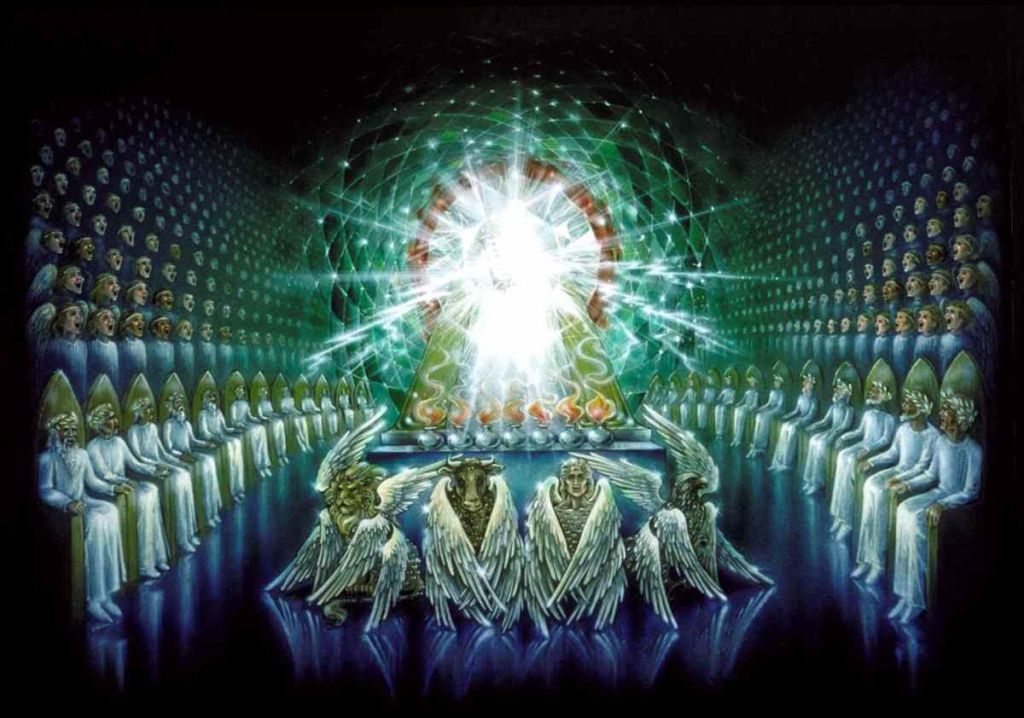
“…And they rest not day and night, saying, Holy, holy, holy, Lord God Almighty, which was, and is, and is to come” (Revelations 4:8, KJV).
“In the year that King Uzziah died, I saw the Lord, high and exalted, seated on a throne; and the train of his robe filled the temple. Above him were seraphim, each with six wings: With two wings they covered their faces, with two they covered their feet, and with two they were flying. And they were calling to one another: “Holy, holy, holy is the Lord Almighty; the whole earth is full of his glory” – Isaiah 6:1-3 (NIV).
Happy New Year! I was listening to a worship ministration by Nathaniel Bassey recently, and there was something he said that struck me: God is also love, God is also full of grace and truth, but the angels don’t cry grace, grace, grace, or love, love, love, but instead they say holy, holy, holy. He surmised that it is probably because every time you say that God is holy, you are declaring that He is every other thing – He is good, merciful, kind, loving, gracious, worthy.
Why is God’s holiness so essential, and what does it mean? Sam Storms surmises, “The holiness of God only secondarily refers to His moral purity, His righteousness of character. It primarily points to His infinite otherness. To say that God is holy is to say that He is transcendentally separate. Holiness is not one attribute among many. It is not like grace or power or knowledge or wrath. Everything about God is holy. Each attribute partakes of divine holiness.” As such, God has indeed set Himself apart to be good, merciful, kind, loving, gracious, worthy.
God is holy, He is set apart from us. It is not so much that he is on one edge of a room and we are on another, it is more that we are not even in the same room or realm as He is when it comes to holiness. It is a difficult, if not impossible concept to grasp, the utter awe-inspiring holiness of our God. The challenge we have as humans is that we have limited understanding, so how do we even try to understand a Being so holy, so infinite, within the limits of our corrupted and finite minds? As Arthur Pink puts it, “An ineffably holy God, who has the utmost abhorrence of sin, was never invented by any of Adam’s descendants.”
Not only is God holy, He calls us to be holy. It feels unreal that He expects this from us, mere humans. But indeed expect it He does, because He Himself has paid the price that allows us do so. Leviticus 11:44 states “For I am the LORD your God. Consecrate yourselves therefore, and be holy, for I am holy.” Hebrews 12:14 (NLT) says “Work at living in peace with everyone, and work at living a holy life, for those who are not holy will not see the Lord.” See also 1 Corinthians 1:2, 1 Peter 1:15-16. To consecrate is to formally declare that something or someone is set aside for a particular purpose. Charles Spurgeon notes that “unless our faith makes us pine after holiness, it is no better than the faith of devils, and perhaps it is not even so good as that.”
As we start this new year, I have decided to formally declare this decision to consecrate myself to be holy, set apart for God, to be a living sacrifice offered daily. And if by chance I crawl off the altar, to crawl back again, plead for His mercy and grace, and re-sacrifice myself, as Romans 12:1 appeals to us “by the mercies of God, to present our bodies as a living sacrifice, holy and acceptable to God, which is our spiritual worship.” It would be a true blessing if you could join me in this. I attempt to do so not because I’m worthy, qualified or capable on my own, but because Jesus is. Jesus has paid the price that allows me even dare to think I can consecrate myself for a holy God to use me. 1 Corinthians 6:20 states: “For God bought you with a high price. So you must honour God with your body.” 1 Corinthians 1:30b also states “Christ made us right with God; He made us pure and holy, and He freed us from sin.” When God looks upon us, it is not our unholy nature that He registers, for he cannot look at iniquity. What He sees is the pure and holy blood of His Son, blood that makes scarlet red sins whiter than freshly fallen snow (Isaiah 1:18, 1 John 1:7).
May we not fall into the trap of thinking that it is because of our works, rather than God’s mercy, that we are justified. Jesus illustrates this in the parable of two men in Luke 18:9-14. One said “I don’t sin ‘big sins’, I fast twice a week, and I pay my tithes”. The other, with his face bowed low, said “God be merciful to me, a sinner”. Only one went down to his house justified before God.
James 1:27 reminds us that “Religion that is pure and undefiled before God, the Father, is this: to visit orphans and widows in their affliction, and to keep oneself unstained from the world.” In other words, it is to emulate God’s attributes and do the good we have seen the Father and Son do; and to set ourselves apart from the world. It is to honour and worship God with our bodies as stated, and with our minds, thoughts, speech, actions, keeping them unsullied by the world’s pollutive power (Colossians 3:2, Philippians 4:8, 2 Corinthians 10:5, Colossians 4:6). “Worship is the submission of all our nature to God. It is the quickening of conscience by His holiness, the nourishment of the mind with His truth, the purifying of the imagination of His beauty, the opening of the heart to His love, the surrender of the will to His purpose”, as William Temple eloquently puts it.
We love and worship God with our all, all our heart, soul and strength (Deuteronomy 6:5). To be honest, even our humanly “all” is not even close to enough, but we love Him because He first loved us (1 John 4:19). R.C. Sproul notes, “How can we love a holy God? The simplest answer I can give to this vital question is that we can’t. Loving a holy God is beyond our moral power. The only kind of God we can love by our sinful nature is an unholy god, an idol made by our own hands. Unless we are born of the Spirit of God, unless God sheds His holy love in our hearts, unless He stoops in His grace to change our hearts, we will not love Him.”
We love and worship God practically by putting His will, His desires, His stamp of approval first in our lives. We set ourselves apart wholly for Him to use as He pleases, because He is the Potter and we are the clay (Isaiah 64:8). We consecrate ourselves on the altar of His mercy and abstain from anything God Himself will abstain from, because we are His temples and His Spirit dwells in us (1 Corinthians 3:16). Just like we won’t take a young child to see an X-rated movie, so we won’t do things with our lives that God won’t want to do. After all, He did come in the form of an innocent child when He made His magnificent entry into our world. We behave like we are superman and sin is kryptonite. Habakkuk 1:13 (BSB) reminds us that God’s eyes are too pure to look upon evil, and He cannot tolerate wrongdoing.” Yet, Habakkuk also asks “So why do You tolerate the faithless? Why are You silent while the wicked swallow up those more righteous than themselves?” C.S. Lewis answers this brilliantly: “God is not proud. He will have us even though we have shown that we prefer everything else to Him.” Isn’t that just utterly humbling? This is why God’s love is overwhelming and reckless. As the Psalmist says in Psalm 8:4, “What is man that You are mindful of him?” On our own, we are unworthy, whether we realise it or not, and yet He will still have us!
The more we spend time in God’s presence and witness His power, the more conscious we are of our unworthiness, and the more we desire His mercy. Isaiah’s response to His vision of God was to say “Woe is me, for I am ruined, because I am a man of unclean lips dwelling among a people of unclean lips; for my eyes have seen the King, the LORD of Hosts” (Isaiah 6:5). Simon Peter was also acutely aware of his unworthiness after His encounter with Jesus and the miraculous fishing expedition. “When Simon Peter realised what had happened, he fell to his knees before Jesus and said, “Oh, Lord, please leave me—I’m such a sinful man.” (Luke 5:8, NLT). The beauty of this story is that Jesus doesn’t heed to Simon’s request to stay away. Instead, Jesus comforts Simon and gives Him a significant calling. Thankfully Simon and the disciples obey straight away, setting themselves apart for God’s use with immediate effect (vs 10-11).
The start of a new year feels like the ideal time to reflect on God’s holiness, and consecrate ourselves for His use, to set ourselves apart, to be holy, for He is Holy. Like Simon Peter, we can leave all behind in the old year and follow Jesus completely and unapologetically. I pray that as we take this step to consecrate ourselves, emboldened by Jesus’ sacrifice, we will not falter. If however we do, may we remember that God’s mercies are new every morning, and that God is far more merciful than we are sinful. I pray that God will lead us in His wisdom to people who can hold us accountable; that He will enable us to prayerfully seek His presence and guidance; and that we will listen and obey as He guides our steps away from the path of evil to the path of the just, a path that shines brighter and brighter unto the perfect day*.
Have a blessed and consecrated 2023!
*Proverbs 4:18
P.S: As we reflect on God’s holiness and desire to consecrate ourselves, there are some beautiful worship songs I will recommend:
Lord You’re Holy by Helen Baylor https://www.youtube.com/watch?v=92BjIF2ptXg
You Are Holy by Nathaniel Bassey https://www.youtube.com/watch?v=rzZXiL488KY
Song: Purify My Heart (link here https://www.youtube.com/watch?v=RNCkYP_OchQ
Image source here.


Leave a comment