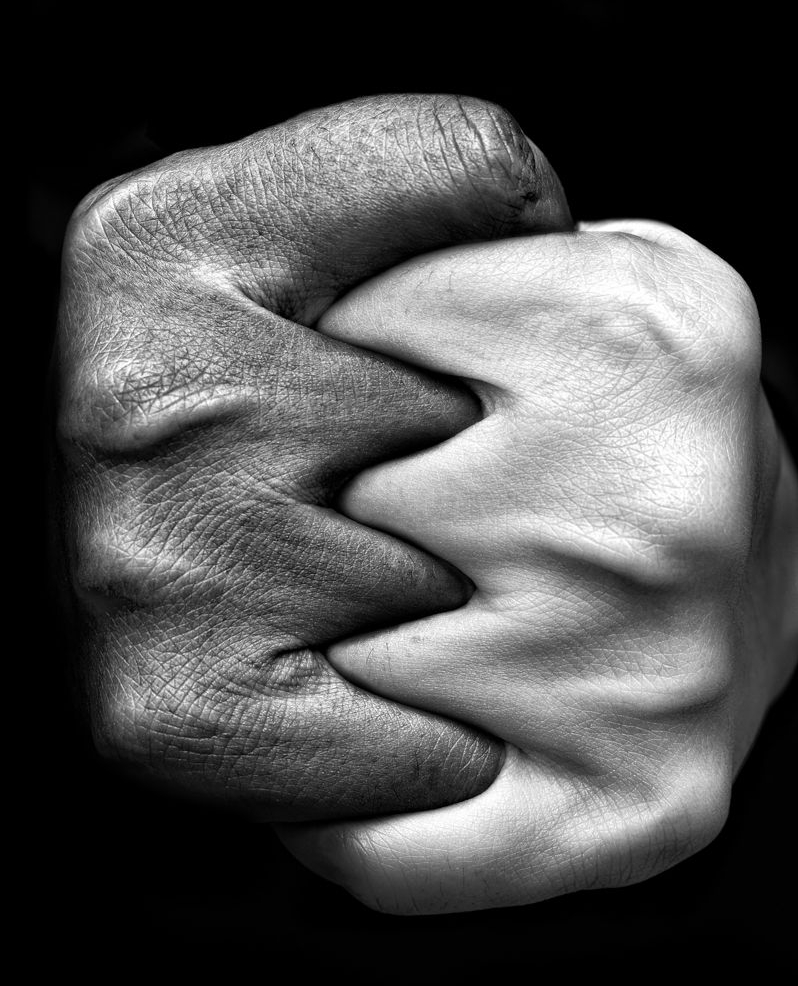
I am mixed race. I am both black and white. 50-50; 100-100. Take your pick. I have lived a significant amount of my life in a predominantly black country. And I was seen as a “white person”. I was called oyibo, white person, whitey, Unfortunate European etc. I have also lived a significant amount of my life in a predominantly white country. And I am seen as a black person, and usually labelled as such. I can’t count the number of people who have been surprised that my mother, who is white, is my actual mother. (Thankfully, nobody has called me an unfortunate African yet :).
Recently, my son was describing a character, and he mentioned they had “middle skin colour”. My curiosity was piqued, so I asked him “what is middle skin colour?” And his reply, in a very matter of fact tone, was “oh, you know, like our skin colour”. I had to smile at his response. We have discussed skin colour etc, and he is aware of his dual heritage, so I found the way he described it really interesting, as it does indeed feel like you are in the middle sometimes. People may think this is confusing. And it can seem that way. But to me, I feel it gives me a vantage point, as I have experienced life as a perceived white person, and as a perceived black person. And in a sense, I am both.
I’m not sure if all that is going on is actually bringing about more unity or more division. Initially, it felt like the former, but these days it is beginning to look more like the latter, and this makes me sad. No race has the monopoly on evil. Should a whole race really be judged based on the actions of a few? Or based on the actions of their ancestors? Isn’t that stereotyping at its worst? And, if this is the case, where do we draw the line? Would you like your children or grandchildren to be punished for your wrongdoing? Do the descendants of William Wilberforce and his supporters get a pass? What about the white slaves? How do we decide? What about the blacks who were complicit in the slave trade – the ones who agreed to sell their fellow blacks for some gunpowder and brandy?
Do we really want to crush ourselves under the weight of wrongs we had nothing to do with? Should we then crush others under the weight of wrongs they had nothing to do with either? Changing the past is not one of the options available to us. However, learning from the past, changing the present and creating a better future are available options, and that’s all we can work towards.
Regarding stereotypes, I don’t know if there is any one of us that can truthfully say we haven’t stereotyped before, whether it is by race, gender, age, nationality, religion, political affiliations… It’s all part of human behaviour. Negative stereotypes can be harmful. But it is not restricted to one race. As a “white” person, my morals have been questioned, because, apparently, said people believe that white people have loose morals. Really? On the other side, I’ve had the comment and expression of surprise because I speak good English. Again, really? For full disclosure, I have also been the recipient of positive stereotypes on both sides (but I didn’t have an issue with them – Double standards, I know. Sorry. As they say “who no like better thing?”).
As humans, we naturally gravitate towards people that look like us. Even babies do that (You can read more here). Unlike the heading though, I don’t think babies are racist, I think they are human, and more comfortable with the familiar. On average, black people are more likely to be friends with, marry, or employ blacks. White people are more likely to be friends with, marry, or employ whites. Yes, there are exceptions. After all, my very existence is due to one. The exceptions are rising, but it still remains true.
However, when group W has significantly more opportunities than group B, this obviously leads to a problem for group B. Since group W members will naturally gravitate towards giving opportunities to people in their own circle, people in group B are less likely to get the said benefits of such opportunities. Naturally, this leads to frustration, disappointment, anger. I have seen this happen in so many different groups, so it’s not just restricted to blacks and whites.
All the “-isms”? Stereotypes? Racial prejudice? Unfortunately, they exist everywhere. I have experienced them on all sides, and my experience is not unique. Humans have the same tendencies everywhere, tendencies to do good, and to do evil. I have not necessarily found that skin colour influences those tendencies. We keep fighting injustices, and new ones keep popping up. Civil unrest is as old as time. As a black person, you may think that when blacks have equal or even more power, life would be so much easier and you will have more opportunities, since racism won’t be an issue. Well, in my experience, that hasn’t been the case at all. Get ready to fight a whole new line up of “-isms” – tribalism, nepotism, “state-ism”, “region-ism”, you name it. And tribalism for instance is not better than racism. From experience, it hurts just as much. Lives have also been lost. The negative stereotyping is rife. If you are not from certain tribes, or if you don’t know the “right people”, you will lose out on opportunities (or may not even be aware that they exist at all!). Even if your skin colour is exactly the same shade as the person dishing out the opportunities. Even getting into University can be a challenge. You will see government cabinets so skewed towards one tribe, you would be forgiven for thinking that no other tribes exist in that country. There are leaders who will rather spend public funds on golden furniture than on providing for people who are literally starving to death, or dying from treatable/preventable diseases. Skin colour? Same.
Hair is such a big issue in the black community, so I have to talk about it. You would think, as a black person, that your natural hair is more likely to be accepted among fellow blacks. Sadly you may be wrong. Because I didn’t like wearing weaves or braids, I was repeatedly told to go and “make my hair”, and “do something with my hair”, far more in a predominantly black country, than in a white country. In fact, no white person has ever made a negative remark to me about my hair. You may say, “but they may be thinking it”. However, I’m not the thought police. My black friend, who has beautiful natural black hair, started a job in an African country (majority black). She was scolded by a Black African woman for coming to the office with natural hair. Not only that, she was sent out of the office, told to go and do something with her hair, and not come into the office with “that hair” again. Now, I know we may say there is a whole history behind the black hair issue, preference for straight hair, media representation etc, but still, really?
Unfortunately, it also shows that more power in the hands of those who look like us does not eliminate some of the problems we may think it will. Humans have a natural bent towards self-preservation and preservation of their kind, whether it is tribalistic appointments in Africa, or the ‘Old Boys’ Network’ in the West. Some people’s definition of their “kind” can be very narrow, regardless of race. However, others, thankfully, have a much broader definition.
As such, it is not hopeless. The issue is, how can we broaden our definition of “our kind”? How can we combat negative stereotypes? What doesn’t work? What works? What can those who have been on the receiving end of such injustices do?
Cardinal James Gibbons said “reform must come from within, not from without. You cannot legislate for virtue”. This rings so true. The 1965 race relations act in the UK outlawed discrimination on the “grounds of colour, race, or ethnic or national origins”. Great move. But, this is where the government’s power tails off. Why? Because you cannot legislate the heart. The very obvious acts of racism may have gone down, replaced in some cases by the subtle and less obvious acts. Sure you can’t obviously discriminate on grounds of race. So, the landlord or employer takes down his “No Irish, No Blacks, No Dogs” sign. A job offer is advertised. A Black Person, BP, enquires about the job offer over the phone. Employer does not know BP’s race. Employer seems keen. CV is sent. Interview invitation is sent back. BP goes for the interview. Employer sees BP is black. Employer knows they won’t employ BP, but can’t send BP back, because, you know, “the law”. So Employer interviews BP, interview goes really well, Employer promises to get back to BP. Employer either never does, or calls BP to say “unfortunately you weren’t successful”. BP tries Employer B, C, D… Rinse and repeat. Rinse and repeat. If you were BP, would you consider all the time wasted more progressive than when you knew straight up that you were never going to get the job as a black person, and so you could move on and focus on those who would actually consider you? If you have a non-white name, you may be spared the drama, as you get eliminated at the CV stage (read here). Again, it’s a heart issue. Even if the government forces someone to employ you, would you really want to work for a racist at heart? Your employer would probably be smart enough not to do or say anything overtly racist, but the micro-aggressions may drive you mad, until one day, you decide you’ve had enough and quietly quit. Or you blow up, and then they can fire you for misconduct. Problem solved or not? (Alternatively, to be a bit positive, you could impress said employer so much, they have a complete change of heart!). Still, it’s a heart issue and should be dealt with as such.
The same applies to renting a property. The landlord may either outrightly ignore your application, or do the whole song and dance of inviting you to view the property, guide you through the process of putting in an application, obtaining references etc, even though they have absolutely no intention of allowing you to rent the property. And then they give you the run around, or come up with one out of a myriad of excuses as to why they unfortunately cannot rent the property to you. I could discuss experiences, but this study here makes it more obvious.
Virtue signalling isn’t the answer either. Most people can see right through it. I have seen a lot of flyers/posters/brochures/video clips/<insert other form of showcasing organisation to the public> that are far, far more diverse than the communities they represent. Organisations have posted on social media about how they are passionately against racism, and then been passionately called out for their hypocrisy, because their actions simply don’t match up. You can read more here. It is akin to using a plaster to cover a festering wound. Who is being deceived?
So what can we do then? Now, I should point out that I am not writing this as a government policy recommendation because I don’t think my readership includes heads of government at the moment. I am writing this with individuals in mind. This is how I believe we can effect long-term changes, from the inside out. Hopefully, many small drops will eventually make a mighty ocean.
Socialisation and education play a key role in forming stereotypes, and so consequently, they play a key role in combating negative stereotypes. We can break moulds, we can break bubbles, we can expand our circles… friendship circles, knowledge circles, recruitment circles, “event” circles, “author/book” circles*, “music” circles, “film” circles, “documentary” circles, “food” circles! Initially, it may take conscious efforts on our part, and may feel awkward at first. But eventually, it will become more and more natural. We all have our differences, true. But you may (or may not?) be surprised at how much is similar underneath all that colour.
These suggestions stem partly from what I feel worked to broaden my mind, especially as I was growing up. I was very fortunate to grow up experiencing and learning about different cultures. This was not only from living with parents from different cultures/races, and having friends from different cultures/races, but from reading, watching, listening to music from a wide range of cultures. One day I would be listening to Lágbájá, the next, Neil Diamond. I grew to love reggae, and I grew to love country music. Growing up, we watched African, Asian, European, Indian, North American, South American movies and soap operas. I read books from Asian, Black, Middle-Eastern, White etc authors. Over time, I also got to know people from so many backgrounds, races, countries. From a personal perspective, my erroneous or indifferent thoughts and ideas about a set of people were not challenged by protests, or demands, but through listening to and reading about the experiences of the people involved, and by expanding my circle. The more people you get to know from other races, the more likely you are to have your flawed stereotypes and misconceptions about that race challenged. Eventually, this should hopefully lead to the dismissal of such.
It’s also interesting to note how some associations are formed. I remember as a child (I was probably 6 years old at the time) attending the birthday party of a family friend who was also mixed race. His mother is from a Central European country, and is an amazing baker. I remember the huge platter of treats available, treats I had not tasted before in my short life. His mum kept coming up to me and others with a different tray of treats to try. I was officially in Treat Heaven. My mouth still waters at the memory. Till today, I still have positive associations for people from that country. I used to be part of a group in church where we had events where people from different countries would bring a dish from their country, and we would all share together. It was an enriching experience. Sadly I moved cities, but I still remember those times fondly. Food is a powerful way of bringing people together. ““To break bread together,” a phrase as old as the Bible, captures the power of a meal to forge relationships, bury anger, provoke laughter.” – National Geographic.
On the other side of the coin, I have gradually learnt to overlook somethings, and give people the benefit of doubt. Because if I did not do that, I would walk around in an almost perpetual state of anger, and the only people who would suffer that are myself and the people I love. I remember reading somewhere, long ago, where a couple of people had posted about their experiences of racism. A black lady posted that she arrived at a station, and while waiting for her train, sat on a bench. There was a white man sitting on the other side of the bench. She said not too long after she sat down, he stood up and went to stand a bit further away. Now, maybe she was right and the person in question was guilty of racism. But what if he wasn’t? What if, he had been sitting for a while and just decided to stretch his legs? Or what if, at that moment, he realised he needed to fart, and wanted to spare the lady the assault to her nostrils that would arise from the foul stench he was about to emit? So he did the humane thing by standing up and walking away. She went away hurt by his actions, but he was probably completely clueless.
Now this may be a minor example. And no, it doesn’t mean that your experiences are “all in your head”, because they may truly be acts of racism. But for the sake of your sanity as a black person, would it be worth it to leave there angry at a perceived racial micro-aggression (while the person in question leaves there absolutely unbothered), or would it be better to assume the fart option and move on relatively unaffected? I am not saying that micro-aggressions should always be ignored (death by a thousand cuts hurts), but again, this is a heart issue. These are things the government cannot legislate against (How can they?)
However, there are some things people perceive as racial micro-aggressions that I don’t view as such, and I think it’s only fair to say so. A classic example is when I hear people give the example of being mixed up with the only other black person in their class/office/street/church etc. Growing up with a white mum, who was often mistaken for the few other white women in the area, and personally being very regularly mistaken for the few other mixed race girls/women people knew, I have gradually realised that such mix-ups are normal if people are a minority in a group. It is human, not racist to do so. Yes, it can get a bit too much sometimes, trust me, I’ve been there. I would have people insist if it wasn’t me, it must be my twin sister, and when I reply that I don’t have one, the response is “are you sure?” Or the time when a mixed race woman released an album that became popular in the area I lived in a predominantly black country, and I was getting complimented about it, and on my beautiful voice. My “Oh, I’m not the one” was again met with “are you sure?” Ermm, I’m pretty sure I would know if I released an album. In retrospect, I should have just opened my mouth and started singing. That would have been a faster way to clear all doubt.
Humans are naturally curious about people or things that are different from what we know. The “but where are you from?” question that a lot of people complain about? Maybe because I have been asked that repeatedly and very, very regularly throughout my life, whether among blacks or whites, I don’t necessarily see it as racism, just curiosity. Same with curiosity about hair. Some people have issues with this, and yes, most people don’t like the idea of random strangers trying to touch their hair. But again, having had that from various races, not just blacks and whites, I view it as simple curiosity. Of course, your response to that is entirely up to you, you can see it as an opportunity to educate a curious person, or you can decline to answer. That’s a personal choice, and either response is valid. But when you’ve been the minority among different races, you will begin to see patterns that shatter an illusion that it is something that people from race “X” do that is racist towards people from race “Y”.
Now, I can and do call out racism when I see it. And some incidences may be subtle, but are very obviously due to race. However I am also very conscious of interpreting acts as racism when they may not be. Sometimes, further probing may be possible/necessary. And sometimes it may not be. This is not to provide a laundry list of excuses for people of any race to justify certain actions. However, maybe if we see certain acts as human rather than acts of racism against us, we are less likely to be hurt by them.
Also, a lot of times, people act out because of their own circumstances. I recently read this quote from Yogi Bhajan – “If you are willing to look at another person’s behaviour towards you as a reflection of the state of their relationship with themselves rather than a statement about your value as a person, then you will, over a period of time, cease to react at all”. I am learning (admittedly very slowly), to do my best to see peoples actions as a reflection of who they are, rather than who I am. So if X decides to hate Y for no reason other than skin colour, well, X clearly has issues. And I am not sure a protest is going to make X change his views, sadly.
There is also ignorance. People may do or say things, not necessarily to cause offence, but because they don’t know better. Again, this is why it is important for people to educate themselves and expand circles.
How else can we tackle this? “Do not be overcome by evil, but overcome evil with good” – Romans 12:21 (ESV). (Incidentally, when I first wrote this, I initially wrote “overcome evil with God”, which although a typo, is still very true!)
I saw an article/photo recently that warmed my heart. It was apparently a photo of a Black Lives Matter activist carrying an injured protester from “the other side” to safety, amid violence in London. If this photo is indeed true, what I can say is that that singular action is far more likely to have an impact on the injured protester, than any protest, banners, demonstrations would ever have. Ultimately it is good which breaks down the wall of evil, brick by brick, like a child patiently breaking up a Lego model. It can be hard, oh so hard to do this, to turn the other cheek, to give the coat as well as the shirt, to walk the extra mile (Matthew 5:38-41). And in all honesty, I will admit that sometimes I really struggle with this passage. But the more I think about it, the more I realise that it is not just for the “enemies” sake that Jesus made those statements, but for our sake as well. He knew how easy it could be for bitterness to grow and form a wall of steel around our hearts, and ultimately end up destroying us from the inside. He also knew that reacting with love will help continually melt, not only our walls, but the walls of hate in those who do wrong against us. Now, I can’t always hold myself up as an example of this passage, I mean I try, but a lot of times, I fail. Thankfully, Jesus remains a shining example. As such, we can always look to Him when we struggle with this.
However, there is also something else worth noting. I read this recently on social media – “There is a thin line between hypocrisy and public outrage: even in matters of justice”. “The love of power is seductive; it can corrupt even those victimised by injustice. Watch, pray and act with humility”. There is a real danger of becoming the very thing we are protesting against. When I see some leaders like a certain African leader who staunchly protested what was seen as an unfair and oppressive white-minority rule, but went on to hold on to power for over 30 years, and to live a very lavish lifestyle while poverty reigned supreme in his country, I wonder if he ever thought he would be worse than what he initially fought against. We may think we would not act like that, but I can only echo the quote above, which I will try to make my watchword “watch, pray and act with humility”.
A lot of people are sharing their experience of racism, so I’ve been doing a lot of reading. Some are heart breaking, and I’ve tried to highlight a few examples already. However, I think that in sharing experiences, we should be mindful that we don’t hurt or alienate others. I read someone’s experience of racism recently. She was at a fellowship induction in University. While queuing up for the registration, she was asked “are you the help?”. And no, the white person just before her in the queue wasn’t asked that. Sometimes, when things like this happen, it’s hard to know how to respond. Maybe further questioning may help? – “Just curious, why do you think I’m the help, but you didn’t think that of the other people you welcomed?” If the goal is to stop, or more realistically, significantly minimise such behaviour, then such questioning that makes people confront their prejudices, biases, stereotypes may be necessary. Chances are, they will never say “it’s because you are black”. But it will come to the fore of their mind, and they will be forced to address it. Hopefully, by the time that person has been sufficiently challenged, they will think twice about making assumptions about the next black person they see. And, as a general rule, if in doubt, don’t assume, ask. “Are you here for the induction?” is a more reasonable question to ask in that scenario. However, if you would not ask that to the white person on the queue, please don’t ask the black person either. That’s a simple test you can always use to challenge your bias. “Would I think this if the person in question was white?” Or on the flip side, because stereotyping works both ways, “Would I think this if the person in question was black?” Or “would I be suspicious of this person if they were white?”, because being assumed a criminal, or a potential criminal, because of skin colour is not fun.
However, back to her story. She said she was so upset that she went to her dorm and threw up. At this point, all I could think was, I wonder how “the help” would feel if they knew that the thought of someone being mistaken for them/their role was enough to make that person throw up. We may say “it’s not about that”, but ultimately we are human. These are things that have the potential to hurt and alienate others. Sometimes we get so wrapped up in our own hurt and the injustices against us, that we fail to see how we can actually hurt others, even when, ironically, sharing our experiences about how others have hurt us.
A lot of stories highlight another thing successful black people struggle with – the assumption that your achievements are down to some form of affirmative action or quota system, as if you wouldn’t get wherever you are if not for that. As such, it is your skin colour that is responsible for your achievements. And it hurts. I’ve been there, but as a mixed race person, sadly, I’ve experienced it on both sides. In fact, I was scrolling through some posts on social media recently, and came across this message that was sent to me quite a while ago:

It was sent by a black person, and this wasn’t the only person who thought or expressed similar such thoughts to me. But this is the only one I have that is written in black and white. I had to regularly endure the assumption that my achievements were due to the fact that I was “light-skinned” in a majority-black country. And now, sometimes I live under the shadow of the reverse in a majority-white country! Life eh? I wonder why I bothered reading and working hard. I should have just let my skin colour get me good grades and a great job! Although, only God knows what I would have done when I started writing professional exams, and my examiners never even saw me or knew my skin colour.
Nevertheless, I put these assumptions down to ignorance. I question where I can, or ignore and move on where I can’t (or I’m not in the mood to, because honestly, sometimes it’s just tiring). And this is what works for me. God knows the truth, I know the truth, those close to me know the truth. That’s all that matters. Otherwise, like I said, I would be perpetually angry, and I honestly cannot afford to be. It’s too costly. Thankfully, I’ve gotten to a point where I am able to brush some of these things off. I don’t know if it’s a result of years of ‘experience’ deadening their effect, or just simply acknowledging that most of us, myself included, have also done or said things that unwittingly hurt others. I also realise that some people don’t mean to cause hurt, they do have good intentions. I know, I know, “the road to hell is paved with good intentions”. But who are we if we ‘judge others by their actions’, and ‘ourselves by our intentions’? Or if we are ‘expert defence lawyers’ for our own wrongs, but ‘Supreme Court Judges’ for the wrongs of others? This doesn’t mean we can’t speak out against wrong, because we should. It just means that when we do speak, it is tempered with humility and grace.
What about others who speak out with prejudiced views? It may be tempting to silence or erase such people. Personally, I don’t necessarily agree with calls to silence, sack, erase, censor people. Why? Because it doesn’t get rid of the fundamental problem. If anything, it makes it worse. Such a person becomes like a wounded dog looking for a revenge opportunity. But they get smarter and more subtle. We need to ask ourselves, what is the goal? If we shut everybody up or “erase” someone because they made a statement we deem offensive, have we truly gotten rid of the problem? Is it any surprise that the more we advocate a culture of silencing people, the more there is a growth in all sorts of alternative movements fighting back covertly (and gradually, not so covertly?) Personally, I would rather someone gave me their honest thoughts, so we can have a conversation, than for someone to pretend to my face, but then express their prejudiced thoughts in a place with people who think like them, and so buttress those thoughts instead of questioning them. I believe such opportunities for discussion have more potential to effect change in the long-run than any amount of silencing or “erasure” can.
From a Christian point of view, my thoughts are reflected here: https://livlearns.wordpress.com/2020/06/08/one/
However, this is now officially my longest blog post ever, and this is after cutting out quite a bit, so I will end here, with this: What does God require of us? To act justly, to love mercy, and to walk humbly**. Sometimes, the solution really is that simple.
* We may have seen a lot of recommendations about books we can read. Most are on the theme racism, and it is good to educate ourselves about this issue. However, black people do write about other subjects, so please expand your reading list if you can!
**Malachi 6:8
*** I recently watched the film “Crash”, and I found it captured a few points I had raised pretty well. It does have some strong language, and some other flaws, but I think it’s worth a watch.
Image Source here.


 LivLearns.Life
Leave a reply to Cobus Cancel reply