I was recently reading stories to my children from a collection of Aesop’s fables, and came across this one titled “The belly and its members”:
“One day it occurred to the Members of the Body that they were doing all the work while the Belly had all the food. So they held a meeting and decided to strike till the Belly consented to its proper share of the work. For a day or two, the Hands refused to take the food, the Mouth refused to receive it, and the Teeth had no work to do. After a day or two the Members began to find that they themselves were in poor condition: the Hands could hardly move, and the Mouth was parched and dry, while the Legs were unable to support the rest. Thus even the Belly was doing necessary work for the Body, and all must work together or the Body will go to pieces.”
It was quite interesting to read this, in the light of a lot of things that have been going on. There are also parallels of this story in the Bible. 1 Corinthians 12:12-27 (MSG) says:
“You can easily enough see how this kind of thing works by looking no further than your own body. Your body has many parts—limbs, organs, cells—but no matter how many parts you can name, you’re still one body. It’s exactly the same with Christ. By means of his one Spirit, we all said good-bye to our partial and piecemeal lives. We each used to independently call our own shots, but then we entered into a large and integrated life in which he has the final say in everything. (This is what we proclaimed in word and action when we were baptised.) Each of us is now a part of his resurrection body, refreshed and sustained at one fountain—his Spirit—where we all come to drink. The old labels we once used to identify ourselves—labels like Jew or Greek, slave or free—are no longer useful. We need something larger, more comprehensive.
14-18 I want you to think about how all this makes you more significant, not less. A body isn’t just a single part blown up into something huge. It’s all the different-but-similar parts arranged and functioning together. If Foot said, “I’m not elegant like Hand, embellished with rings; I guess I don’t belong to this body,” would that make it so? If Ear said, “I’m not beautiful like Eye, limpid and expressive; I don’t deserve a place on the head,” would you want to remove it from the body? If the body was all eye, how could it hear? If all ear, how could it smell? As it is, we see that God has carefully placed each part of the body right where he wanted it.
19-24 But I also want you to think about how this keeps your significance from getting blown up into self-importance. For no matter how significant you are, it is only because of what you are a part of. An enormous eye or a gigantic hand wouldn’t be a body, but a monster. What we have is one body with many parts, each its proper size and in its proper place. No part is important on its own. Can you imagine Eye telling Hand, “Get lost; I don’t need you”? Or, Head telling Foot, “You’re fired; your job has been phased out”? As a matter of fact, in practice it works the other way—the “lower” the part, the more basic, and therefore necessary. You can live without an eye, for instance, but not without a stomach. When it’s a part of your own body you are concerned with, it makes no difference whether the part is visible or clothed, higher or lower. You give it dignity and honour just as it is, without comparisons. If anything, you have more concern for the lower parts than the higher. If you had to choose, wouldn’t you prefer good digestion to full-bodied hair?
25-26 The way God designed our bodies is a model for understanding our lives together as a church: every part dependent on every other part, the parts we mention and the parts we don’t, the parts we see and the parts we don’t. If one part hurts, every other part is involved in the hurt, and in the healing. If one part flourishes, every other part enters into the exuberance.
27-31 You are Christ’s body—that’s who you are! You must never forget this.”
I remember being in a Bible study where this was discussed, and someone mentioned that it is not exactly true that all parts are just as important, and they used an example of a toe and the brain. But, looking at it from a different perspective, we are all like cells that make up the body. It is possible to live without a part of your brain, just as it is possible to live without a toe. However, it is not ideal. Plus, if we start dissecting the body in that manner, then every cell becomes both important and unimportant.
And in a sense, that holds true for all of us. God loves each of us so much. Not only did he send His Only Son to die for us, He sees us as of such worth that he will leave the 99 to look high and low for just 1 of us (Matthew 18:12-13), and He counts how many strands of hair we have on our heads! (Luke 12:7). And yet, the Bible makes it clear that we should not think of ourselves as more highly than we ought (Romans 12:3). We are instructed to remain humble and view others as more important than ourselves (Philippians 2:3). Richard Wurmbrand wrote that “Before going to prison, I had considered myself an important person. I was pastor of a growing church, author of books. I worked for the Word Council of Churches, I was involved in charitable actions, and so on and so on. I could not imagine how all the church work in Romania would manage without me. When I came out after fourteen years of prison, I saw that the church had progressed very well without me, that others had written better books than mine. I had not been as necessary as I considered myself to be. This might be true in your case, too.”
We are to do our bit as part of the Body of Christ without concerning ourselves with how important or unimportant we are, or the relative importance of the task we are called to do. Jesus is the important one, and if something is important enough that he asks us to do it, then it is important enough to be done, whether we feel that way or not, or whether it looks that way or not. The Parable of the widow’s mites in Luke 21:1-4 shows that God does not measure value or worth in the same way we do.
In John 17:21 (ESV), Jesus prayed “that they may all be one, just as you, Father, are in me, and I in you, that they also may be in us, so that the world may believe that you have sent me.”
How can we truly be one, and not think of ourselves as more important than other parts of God’s body? By acknowledging that it is purely by God’s Grace that we are what we are, we have what we have, and we are where we are. As the saying goes “there but for the Grace of God, go I”. Fortunes can change in an instant, and this is something worth remembering when pride starts to wiggle its way into our hearts. As J. Cole said “The bad news is nothing lasts forever, The good news is nothing lasts forever.”
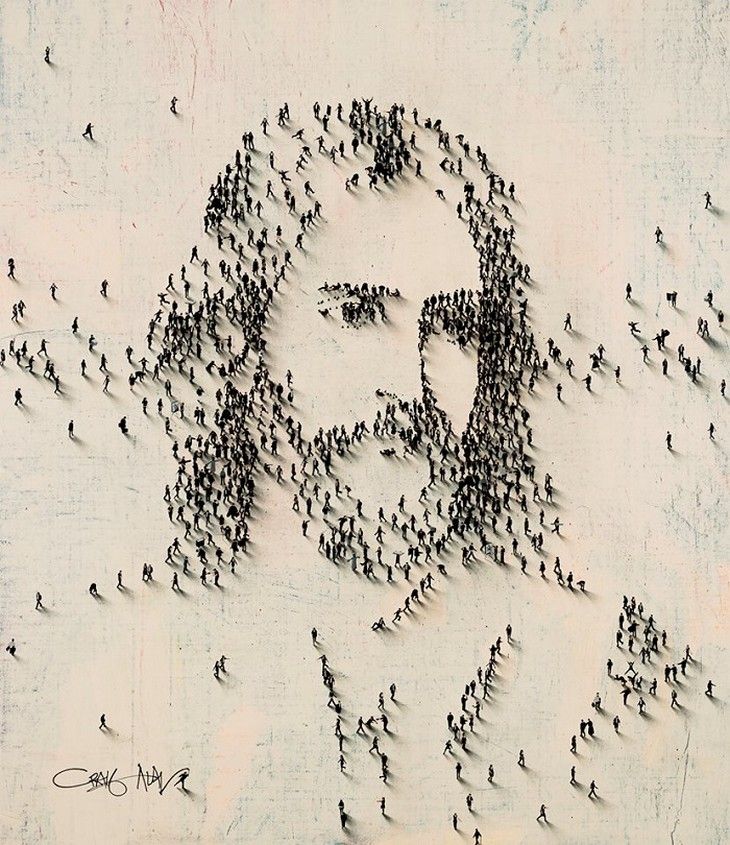
Secondly, by seeing Jesus in others. There’s a beautiful song I learnt back in the day that came to mind as I was writing this post. The chorus is something along the lines of “I see Jesus in your eyes and it makes me love you, I feel Jesus in your touch and it makes me care, I hear Jesus in your voice and it makes me listen, and I trust you with my love, because of Jesus that I see, I see in you.”*
Sure we will notice our differences, we are human after all. But they won’t be our focus when relating with others. When we truly love Jesus, and we see Jesus in someone, we are more likely to act in love towards that person. In Matthew 25:31-46, Jesus tells a story illustrating this, and it is known as ‘The Parable of the Sheep and the Goats’. The sheep are the ones who have fed the hungry, given the thirsty drink, welcomed strangers, clothed the naked, looked after the sick, visited the prisoners. They are the ones who are invited to inherit God’s Kingdom. The goats are the ones who haven’t done all these, and are to be cursed for eternity. Interestingly though, Jesus makes it personal. He doesn’t say, “well done for helping X when they were hungry” or “Thank you for visiting Y in prison”. No. He says “For I was hungry and you gave me something to eat, I was thirsty and you gave me something to drink, I was a stranger and you invited me in, I needed clothes and you clothed me, I was sick and you looked after me, I was in prison and you came to visit me.” (Verses 35-36, NIV). “Whenever you did it for any of my people, no matter how unimportant they seemed, you did it for me” (v. 40, CEV). As Luther says “The Christian is Christ”. According to Richard Wurmbrand, “I identify myself with Him, He with me. Our religion is one without pronouns”. There should be no “us” and “them”.
Galatians 3:28 (ESV) says “There is neither Jew nor Greek, there is neither slave nor free, there is no male and female, for you are all one in Christ Jesus.” This last verse covers race, status, gender – labels society uses to place people in neat little boxes, and then use as a basis to judge how they should be treated. As Christians, when we can strip people of all society’s labels, like peeling the skin of a banana, and truly see Jesus in them, then we can say we are on the path to true unity and oneness.
However, it’s not enough to be one. Unity in itself can be neutral, it can be a force for good or for evil. The expression/idiom “as thick as thieves” makes this obvious. Thieves are known to be so unified, so close knit, that they were viewed as the ideal group to be used as an idiom for closeness. A lot of evil has been committed over the course of history because people were unified in carrying out such acts. The building of the Tower of Babel in Genesis 11 shows how powerful unity can be, even when done against God’s will. And this is why the Bible doesn’t just stop at “for you are all one”, but goes further and adds “…in Christ Jesus”. Unity should be in line with God’s will. Not in line with popular opinion, or Zeitgeist, or what makes the majority happy or comfortable, but according to God’s will, as stated in the Bible.
It can be very easy, but also dangerous to jump on whatever bandwagon happens to be going by, and do what we think we should do, or what society expects us to do, without asking God what He really wants us to do in a situation. The problem with jumping on bandwagons as they pass is just that, they pass. They cause some commotion, raise some dust and get people talking while they pass by. But then they move on, the dust settles, the wheel marks are covered up, and it all goes back to the way it was. There’s no lasting change. The Bible is clear that we should “Speak up for those who cannot speak for themselves; ensure justice for those being crushed. Yes, speak up for the poor and helpless, and see that they get justice.” (Proverbs 31:8-9, NLT). But how we should do that, and who we should align ourselves with to do that, are not always obvious. And this is where prayer and waiting on God for guidance come in. We should not necessarily be led by how angry or passionate we feel about a situation without consulting God, as “man’s anger does not bring about the righteousness that God desires.” (James 1:20, BSB). God gives wisdom liberally to those who ask (James 1:5). When we are unsure of what to do, what to say, and who to partner with in order to effect changes in society, God, who understands far more than our limited human minds can grasp, who knows the end from the beginning, and who loves those we want to fight for far more than we can even attempt to love them, is the one we should go to.
As we work towards unity, I pray that we would truly understand what it means to be one in Christ. As we would not think of climbing a ladder with our legs, while leaving our hands behind, so we should know that for the church to advance, we need to move with all our members. But also, in trying to be one and show solidarity, we should not do it according to what the world expects, or what we feel, but according to what God wants. I pray that we (myself included) will see Jesus even in people that don’t look like us, act like us, or think like us. Because we are not the standard. Jesus is.
*The song is “I see Jesus in you” by Reba Rambo and Dony McGuire. You can listen to it here. The lyrics I learnt were a slightly modified version, as I recently found out, but they pass the message across regardless.
Image source here.

 LivLearns.Life
Leave a reply to A Heart Issue – livlearns Cancel reply