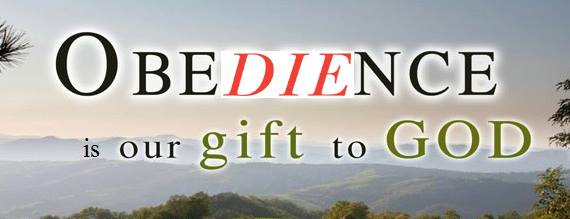
When I was a child, we used to sing “Obedience is the very best way to show that you believe, doing exactly what the Lord commands, doing it happily…”
I was thinking about this song after writing my last blog post on prayer. I thought about how there were positive outcomes for those who prayed, received instructions from God, and obeyed. On the flip side, there were negative outcomes for those who disobeyed the instructions they were given. Even partial obedience was not enough. It had to be total obedience, as we will explore shortly.
It follows therefore that a key element to receiving positive outcomes is obedience. Initially, this may seem somewhat dictatorial, “If you don’t do exactly what I ask, you won’t get any answers”. But when you think about it, it is perfectly logical. When you buy a car, assuming it is in good working condition, if you follow the manufacturer’s instructions, the car will drive smoothly. If you follow some of them, but disobey some, for instance do everything else right, but put water in the petrol tank instead of, well, petrol, chances are you won’t get the smooth ride you want, that is if the car even starts at all!
If the manufacturer says press the accelerator when you want to move, but you decide you want to hit the break instead, well, let’s just say you won’t be going anywhere. Would it then be logical for you to think, “but I’ve bought the car, it’s all paid for, the manufacturer claims to be reliable, it’s even got good reviews, I’m trying my best to drive it, why isn’t it working for me?” Could this then possibly be one of the reasons why even though we’ve prayed, we don’t get the outcomes we hope for?
Some acts of disobedience may not be obvious to start with. If you fail to follow proper safety guidelines such as not wearing a seat-belt, if the journey is smooth, you may not run into any difficulties. But, if there is a rough turn somewhere, or an accident…another car slams into your car while you are steadily going on your way, then the reason behind the manufacturer’s guidelines becomes crystal clear. Sadly, in some cases, post-realisation obedience/compliance may be too late.
Luke Chapter 5 tells a story of the disciples (who were fishermen) trying to catch fish, all night, but were unsuccessful. The fish just weren’t in the mood to get into any nets. Jesus had been doing some teaching, and afterwards, he told the disciples to let down their nets. “Simon answered, “Master, we’ve worked hard all night and haven’t caught anything. But because you say so, I will let down the nets.” When they had done so, they caught such a large number of fish that their nets began to break. So they signalled their partners in the other boat to come and help them, and they came and filled both boats so full that they began to sink.” (Verses 5-7, NIV). One act of obedience later… suddenly it was as if a Billy Graham crusade was taking place in their nets, and all the fish wanted to attend!
What about partial obedience though? In 1 Samuel 15, Saul was commanded to completely and utterly destroy Amalek. In his humanly wisdom, he decided to destroy all that was worthless and despised, but save the good stuff. It makes sense in a way, doesn’t it? I mean, why destroy what is perfectly good and useful? But the key point is, that was not what God asked him to do. Saul was putting his human logic over God’s wisdom. Suffice to say, God was not pleased. Samuel was also very angry with Saul, and said to him “What is more pleasing to the Lord: your burnt offerings and sacrifices, or your obedience to his voice? Listen! Obedience is better than sacrifice, and submission is better than offering the fat of rams. Rebellion is as sinful as witchcraft, and stubbornness as bad as worshipping idols. So because you have rejected the command of the Lord, he has rejected you as king.” (vs. 22 – 23, NLT). The MSG Bible puts this quite bluntly “Not doing what God tells you is far worse than fooling around in the occult.” Wow!
This act of disobedience, albeit partial, maybe even rational, eventually led to Saul losing his position as King, and a very sad fall from grace to grass.
Jeremiah 6:16-17 (ESV) highlights the point again. “Thus says the Lord: “Stand by the roads, and look, and ask for the ancient paths, where the good way is; and walk in it, and find rest for your souls. But they said, ‘We will not walk in it.’ I set watchmen over you, saying, ‘Pay attention to the sound of the trumpet!’ But they said, ‘We will not pay attention.’ Sadly, the outcome of this was disaster for Jerusalem. Reading further, interestingly, we can see another attempt at compensating for disobedience by sacrificing. But God says “What use to me is frankincense that comes from Sheba, or sweet cane from a distant land? Your burnt offerings are not acceptable, nor your sacrifices pleasing to me (v. 20)
I wonder if this is something we do, maybe even unconsciously? Granted, we may not exactly be offering God frankincense from Sheba, or sweet cane from far away, but do we sometimes do more good deeds while ignoring an area of our life where we are living in disobedience? Maybe hoping to compensate one for another, balance the scales a bit?
When planning to write this post, I did not initially focus on, or plan to include this aspect of sacrificing instead of obeying. However, as I was reflecting, I felt I should. It also caused me to take a closer look at my own life, and the ways in which I may be doing this. It may not necessarily be a conscious thought or act, in that I am not exactly thinking “God, I don’t want to obey you on this issue, but I will do this other good deed as an alternative”. It’s more a subconscious act, where there is a tendency to overly focus on some areas, and steadily ignore a clear directive from God. It has really made me ponder, and I’ve concluded that I definitely have some work to do in this area!
On a lighter note, I wonder where that far away land of sweet cane is? Hmmm…
Okay, so what if we disobey initially, but change course? Sometimes we may resist, or not want to obey at first, but then change our minds later. Thankfully, God is abundant in mercy, and we have the chance to do this.
Naaman, the commander of the army of the king of Aram is an example of someone in the Bible, who planned to disobey, but then changed course. In 2 Kings 5, Naaman has leprosy, and goes to Elisha for healing. But when Naaman is told what to do, consternation follows. “But Naaman went away angry and said, “I thought that he would surely come out to me and stand and call on the name of the Lord his God, wave his hand over the spot and cure me of my leprosy. Are not Abana and Pharpar, the rivers of Damascus, better than all the waters of Israel? Couldn’t I wash in them and be cleansed?” So he turned and went off in a rage.” (Vs 11-12, NIV).
For context, the River Jordan was… well let’s just say it was not exactly a river you would go to if you were looking for clean, sparkling water. Have you ever looked into a pool of murky water, brown with mud, and green with algae generously spread all over? Would you shiver with excitement if told to bath in such water, or shudder with disgust? Even if you were told it may bring healing? As such, we can understand Naaman’s “Are you seriously kidding me? No way!” reaction. I mean why not one of the beautiful azure blue oceans, you know, the kind you find in beaches on travel agent brochures, the ones you fantasise about for your next holiday, even though you are in lockdown, and are unlikely to be visiting one anytime soon?
Thank God that one of his very wise (and bold!) servants convinced him to obey the Prophet. It also highlights the need to have people around us who are not afraid to tell us the truth, and challenge us when we do wrong. Proverbs 12:15 says “the way of fools seems right to them, but the wise listen to advice”. Naaman did listen, phew! (He probably shut his eyes tight while he reluctantly stepped into the River Jordan – I know I would!). And what was the outcome? Verse 14 (NIV) says “So he went down and dipped himself in the Jordan seven times, as the man of God had told him, and his flesh was restored, and became clean like that of a young boy.” Talk about the Fountain of youth! (Or River of youth?)
Interestingly, even though at the time, to Naaman, the cleaner rivers were a more logical and preferable choice, there is actually some science behind clay minerals working as antibacterial agents and having healing properties. You can read more here. This is fascinating when you consider that leprosy is caused by a bacteria. As such, all that mud in the muddy waters may not have been a bad idea after all! There may have been some clay minerals lurking there with natural healing properties. Now mankind may or may not have had the research at that time to show the benefits, but I’ll tell you who knew…the one who made the oceans and the land – God! He spoke through His prophet, and with obedience, Naaman got his healing.
In the parable of the two sons, Jesus said “What do you think? A man had two sons. And he went to the first and said, ‘Son, go and work in the vineyard today.’ And he answered, ‘I will not,’ but afterward he changed his mind and went. And he went to the other son and said the same. And he answered, ‘I go, sir,’ but did not go. Which of the two did the will of his father?” They said, “The first.” (Matthew 21: 28-31b, ESV)
Again, this shows that reluctant or delayed obedience is better than no obedience at all, so we shouldn’t feel it’s too late. As long as there is life, there is time to do the right thing. However, we don’t want to have to go through what Jonah did before we wake up and smell the coffee. Also, some acts of disobedience can lead to such disaster, we may not get the chance to do things differently even if we would like to.
In Luke 11:28 (NIV), Jesus said “Blessed rather are those who hear the word of God and obey it.” This confirms that there is a blessing attached to obedience. Blessing follows obedience like day follows night, spring follows winter, dessert follows a main course… (well if it doesn’t, it should!). God says in Exodus 19:5, “If you listen obediently to what I say and keep my covenant, out of all peoples, you’ll be my special treasure”. As parents, don’t we find ourselves thinking how much easier, calmer, smoother everything will go, and how happy everyone will be if only our kids would just obey us? Getting ready for school on time, toys always tidied away neatly after playing, chores done without repeated requests, nobody screaming because they fell over a toy they were told ten times to tidy up… I mean the house would be a Shangri-La, and we would be walking around in a zen-like trance half the time! God probably feels the same way about us, His children. I can imagine him thinking “If only they would just listen!”
Obedience is also an act of love. Jesus says “If you love me, obey my commandments” (John 14:15, NIV). If you were ever looking for a way to show Jesus just how much you love Him, well, there you have it!
A key point to note is that obedience requires trust. It requires faith in who you are obeying. It is very difficult, almost impossible even, to willingly obey if there is no trust. If someone told me to jump, and they would catch me, if I did not trust the person, there is no way I would make that jump. It doesn’t matter what they offer as an incentive. Edwin Louis Cole said “Obedience is an act of faith; disobedience is the result of unbelief”. In John 15: 14 (CEV), Jesus says “you are my friends if you obey me”. Friendship involves mutual trust. Thankfully, God is trustworthy, wise, and reliable. He is omniscient. If He asks us to do something, He knows why. As hard as it can be, we don’t always have to know why also. If God knows why, then why do I need to know why? Maybe to be sure that He knows what He’s talking about? Or maybe there are some things He may not have considered, so we need to know to carry out some more informed and thorough analysis? Uh huh. Yeah.
As I wrote this, a verse from a popular hymn came to my mind “Trust and obey, for there’s no other way, to be happy in Jesus, but to trust and obey”. I know, it’s easier said than done, and sometimes the things we are asked to do can be oh so hard. But as we grow in Christ, hopefully the “doing” bit will get easier. It’s a journey we are all still on. It is also reassuring to know that when we fail, God forgives, and gives us another chance.
What is it that God has been asking you to do? Yes, maybe the thing that popped into your mind as you read this. Are you ready to take that leap of obedience?
This quote from Tom Perry echoes my thoughts in a succinct way, “Obedience is a choice. It is a choice between our own limited knowledge and power, and God’s unlimited wisdom and omnipotence.” I pray that we all (myself included) make the wise, omniscient-backed choice, and enjoy the “favour He shows, and the joy He bestows” on those who will trust and obey.
Image Source here.

 LivLearns.Life

Leave a reply to Location Location Location! – livlearns Cancel reply