Have you ever experienced a negative situation which, even when it was over, you struggled to move on from? Or a time when someone acted wrongly towards you and was never held accountable for it, making it difficult for you to move on from it? Perhaps a certain phase or relationship or job or tenure ended abruptly and you did not quite get the closure you wanted, and so you don’t know how to move on from it?
Sometimes it can be really challenging to move on when we face such, especially if we were unfairly treated and are yet to receive justice, or if we had high hopes for something or someone but received disappointment instead.
Samuel faced a situation like this. He had anointed Saul as the first king of Israel, but Saul disobeyed God’s command, and God rejected Saul as King of Israel.
“Then Samuel went home to Ramah, and Saul returned to his house at Gibeah of Saul. Samuel never went to meet with Saul again, but he mourned constantly for him. And the Lord was sorry he had ever made Saul king of Israel.” (1 Samuel 15:34 – 35 (NLT).
Then the next chapter begins with the following…
Now the Lord said to Samuel, “You have mourned long enough for Saul. I have rejected him as king of Israel, so fill your flask with olive oil and go to Bethlehem. Find a man named Jesse who lives there, for I have selected one of his sons to be my king.” 1 Samuel 16:1 (NLT).
The passages do not specify how long Samuel mourned, but given that God was asking Samuel “How long will you mourn?”, and God is a very patient God (Psalm 145:8, 2 Peter 3:9), we can assume it was longer that one would naturally expect. I can imagine that it was hard for Samuel to move on from Saul, possibly because Samuel was the one that anointed him, and perhaps they had developed a relationship over time. As such, his grief and disappointment are understandable.
Ultimately though, God wanted him to acknowledge the reality that Saul was not the man and king that Samuel had hoped he will be, and so Samuel needed to move on.
To do that, having acknowledged the reality of the situation, Samuel needed to carry out an action, which was to go anoint the next king. It is interesting to observe that Samuel seems to be looking for another Saul, as he is charmed by Eliab’s height and appearance. If you remember, Saul was very tall and handsome (See 1 Samuel 9:2). God had to explicitly tell Samuel not to judge by appearance or height, as the heart was what was more important to God (1 Samuel 16:6-7). Thankfully, Samuel does anoint the right person, obeying God despite his fears, worries and pre-conceived notions (1 Samuel 16:2-13).
A key point I noted in this passage was that there was an action tied to Samuel’s moving on, which was anointing the next king. Bear in mind that David did not become king immediately, he became king circa fifteen years after Samuel anointed him, so it does not seem like there was any rush. However, I feel God wanted Samuel to see that there was life and hope for Israel beyond Saul, and that God was still at work. As such, he caused Samuel to see, to be introduced to, and to anoint a new future king well in advance. That seems to have worked, as there is no record of him continuing to mourn Saul afterwards. He subsequently develops a relationship with David (1 Samuel 19:18-22). In fact, when Saul appears to call Samuel’s spirit (possibly a familiar spirit) up from the dead, Samuel doesn’t seem too pleased (1 Samuel 28). He was able to move on after that act.
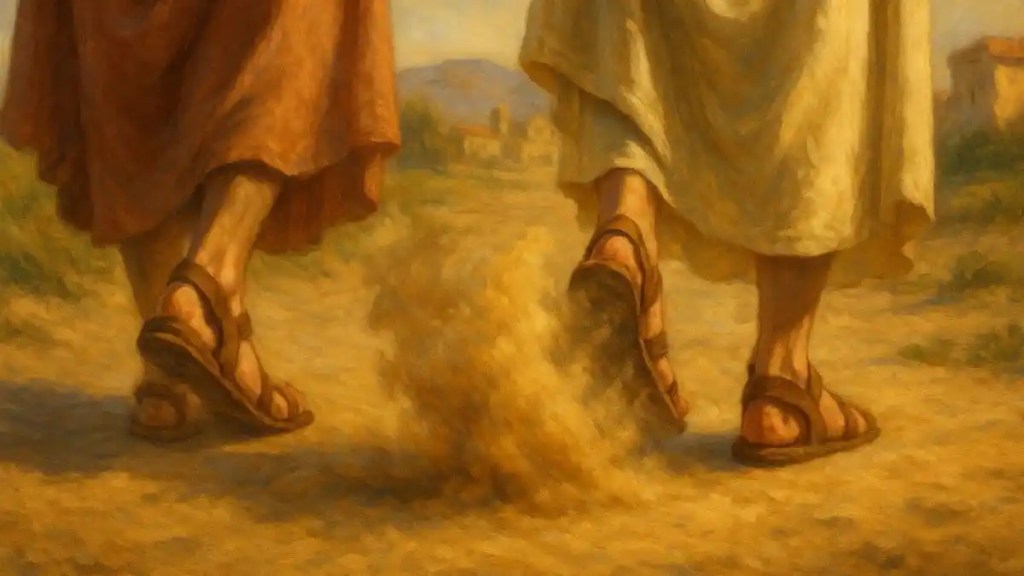
Recently, while reading the book of Acts, this passage struck me. “So the Lord’s message spread throughout that region. Then the Jews stirred up the influential religious women and the leaders of the city, and they incited a mob against Paul and Barnabas and ran them out of town. So they shook the dust from their feet as a sign of rejection and went to the town of Iconium. And the believers were filled with joy and with the Holy Spirit.” (Acts 13:49-52, NLT). This action was in response to Jesus’ teaching in Mark 6:11(NLT) where He said, “But if any place refuses to welcome you or listen to you, shake its dust from your feet as you leave to show that you have abandoned those people to their fate.”
What struck me was not just that they shook the dust from their feet, but that they moved on, “and the believers were filled with joy and with the Holy Spirit.” What a testimony!
In the passage above, the apostles were doing a good thing, they were obeying God by preaching the gospel. That did not stop them from experiencing rejection and possibly the hurt that would have come with this. Thankfully, Jesus, in His infinite wisdom, prepared them for such a scenario. This act of dusting off feet was a symbolic gesture which the Jews practiced when they came back from a Gentile region, to signify a removal of any defilement from that place, and they applied it here, in obedience to Jesus’ command.
Although this was a command given with regards to people who reject the gospel, I do believe it has lessons for us even today, with regards to dealing with negative events and moving on from them. Particularly lessons on not letting rejection or negative/unpleasant experiences fester and cause bitterness in our hearts, or cause us to wallow in self-pity. Furthermore, it makes me realise that symbolic actions that mark a line in the sand can help us move on, no matter how small.
Not too long ago, I had an experience where I was treated quite unfairly, and even though I had moved, it still grated. Especially when I realised that for issues which I had raised repeatedly, over a period of over seven years, and which they repeatedly promised to sort out but never did, they ended up fixing them shortly after I left, and they did it in record time to boot.
It worked out for my good in the end, as I ended up getting something better. However, something recently reminded me of the situation and honestly, I still felt a bit peeved. As such, I realised that I needed to acknowledge that and subsequently “shake off the dust from my feet.”
I did this by sending a measured, factual email to the people involved. I stated how I felt their actions were unjust and I ended it by saying I wished them well. After doing so, I said out loud to myself, ‘I’ve moved on, and I’m letting this go’. I did not want any bitterness about the situation to dwell in me and keep me bound. Carrying out that seemingly small action brought a sense of relief and peace to me. I can now say that I genuinely don’t feel hurt about it anymore. Even better, I can see how God used it to redirect me to my blessing, a blessing I had been praying about for years. Praise God for that.
Sometimes we carry hurts from old wounds, and even when we may have physically moved on, these hurts are still there. As such, we may need to “shake the dust from our feet.” How do we do so though? Each situation will be different, so there is no one size fits all for this. However there are some steps we can take that I believe could be helpful.
The first thing we can do is to acknowledge what has happened, reflect on how it may have affected us, and then, crucially, pray. We can pray for wisdom and direction on what action to take, because God promises us both, if we ask Him and trust Him. Psalm 37:23 (NLT) says, “The LORD directs the steps of the godly. He delights in every detail of their lives.” Every single detail. Nothing is too small or too big.
James 1:5 (NLT) tells us “If you need wisdom, ask our generous God, and He will give it to you. He will not rebuke you for asking.” There are times God may call us to fight for justice, as He loathes it when people are being oppressed (Proverbs 17:5, Proverbs 22:22-23, Zechariah 7:10). He feels our hurt, pain and weakness (Hebrews 4:15) and He is close to the broken-hearted (Psalm 34:18).
There may also be times though when God may ask us to let go without taking any action in the moment, as He did in Exodus 14:13, “But Moses told the people, “Don’t be afraid. Just stand still and watch the LORD rescue you today. The Egyptians you see today will never be seen again.”
Samuel was asked to go and anoint a new King, I felt led to write an email, you might be asked to do something else, or to not act at all (which can be really hard sometimes, in fact it might even be harder than not acting at all, depending on your personality). However I always like to hold Genesis 18:25b close in situations like these. “Shall not the Judge of all the earth do what is right?”
Saying that, we should not just pray for direction on what God might want us to do to truly move on. It is very important that we pray for God to work on our hearts, so that we can forgive any person or persons involved, and so that bitterness does not have a chance to fester. Hebrews 12:15 (NLT) says “Look after each other so that none of you fails to receive the grace of God. Watch out that no poisonous root of bitterness grows up to trouble you, corrupting many.” Bitterness can indeed grow up, and when it does, as the verse says, it is us it troubles, not necessarily the person we are bitter at.
It can be helpful to remember that in a lot of cases, the way you were treated may not be a reflection on you, but on the persons involved. Hurt people hurt people, as the saying goes (but we don’t want to keep thar cycle of hurt going!). This is worth reflecting on, especially as some situations can really impact how we see ourselves, and our self-worth. I wonder if Samuel struggled with the fact that he had anointed someone who ended up not living up to expectations, even though Samuel himself had acted in obedience to God by anointing Saul? Who knows.
A key point to remember here though is that we should not let such incidences make us forget that our identity is unshakeable in Christ (2 Corinthians 5:17, Romans 8:31-39, 11:29). We are after all, God’s own children! (John 1:12, Romans 8:14-17, Galatians 3:26).
That said, if there is anything we may have done, knowingly or unknowingly, that contributed to the negative situation, God can also reveal it to us, and if we are humble and repentant, God is always willing to show us mercy, as we show mercy to others. Isaiah 30:18 (HCSB) says “Therefore the LORD is waiting to show you mercy, and is rising up to show you compassion, for the LORD is a just God. All who wait patiently for Him are happy.” Luke 6:36 also exhorts us to be merciful, even as our Father is merciful.
When the evil one tries to remind us of old hurts, hurts that we have already dealt with, because there will indeed be times he will try to steal our joy and peace by doing so, we can continue to declare that we have left the issue at God’s feet, and God is handling it as He deems fit. We may need to do this lots of times before the devil gets the message, but eventually he will. It may also take time before we feel differently, but eventually, we will experience God’s Shalom. It is important to note though that this requires trusting God with all our hearts, and submitting fully to Him and His will (Proverbs 3:5-6).
There may also be lessons we can learn from the experience. There might even be blessings that arose out of it, which we can acknowledge and express gratitude to God for. However even if this is not the case, the most important thing to do is to keep trusting God and to keep our hearts soft and sweet not hard and bitter. In most cases, this may be challenge and a half, but God will continue to supply the grace needed, and we can keep coming back to Him again and again. For God’s grace is indeed sufficient (2 Corinthians 12:9)
As we reflect on this, I pray that God will reveal to us areas where we are yet to move on well. Areas where, like Samuel, we may still be grieving, and God is gently saying we need to move on; for this may be the key to us experiencing healing from emotional wounds linked to that situation. May God give us the wisdom to know what to do, the will to obey Him, and the grace to trust Him in the process. In doing so, as we shake off the dust from our feet, may we experience God’s peace that passes all understanding, His supernatural intervention in our affairs, and His utter and complete healing and wholeness in every aspect of our lives. Amen and Amen.
Image Source Here.

 LivLearns.Life

Leave a comment