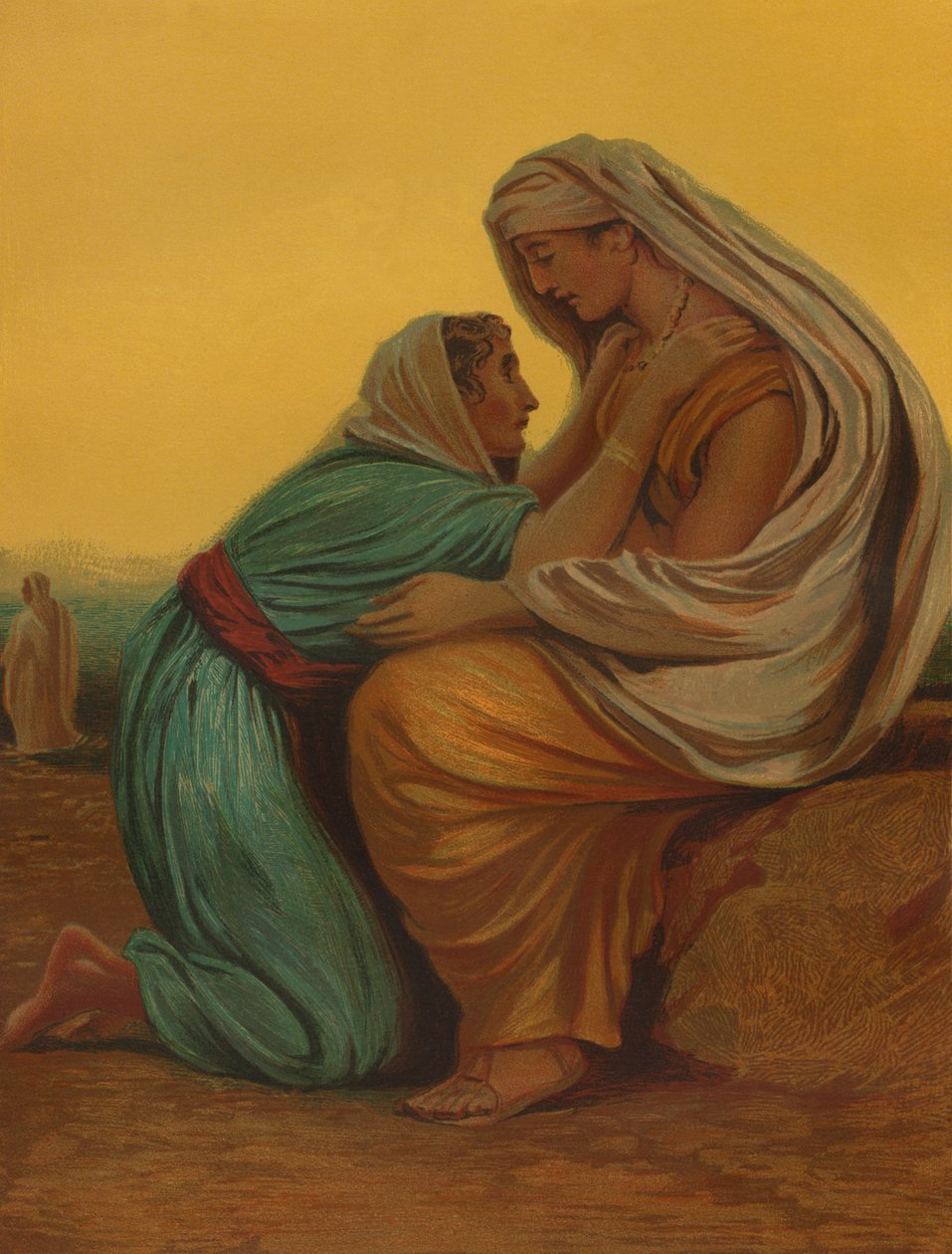
If you’ve read the story of Ruth and Naomi in the Bible, chances are you were struck by Ruth’s love for, and loyalty to Naomi. Given the notoriety surrounding mother and daughter in law relationships, the beauty of their relationship may have stood out all the more.
Ruth is praised a lot for her love for, and incredible loyalty to Naomi (Ruth 2:10-12). The women of the town even tell Naomi that Ruth has been better to her than seven sons! (Ruth 4:15). Ruth certainly deserves these accolades for her actions towards Naomi, particularly given the history between Moab and Israel (Deuteronomy 23:3, Judges 3:14, 2 Kings 3). This hostile history meant that as a Moabite, she was taking a pretty significant risk by choosing to move with Naomi to a potentially unwelcoming place, over being in her comfort zone, with her family, in her own country.
However, this story also gets me thinking, what kind of woman was Naomi? What kind of mother in law was she? We are not told much about the relationship Naomi had with Ruth and Orpah in the ten years before Naomi’s sons, Mahlon and Kilion, died. However, there are some things we can deduce about her character from the little we are told about her interaction with her daughters in law, Ruth and Orpah.
We can tell that she was grateful for her daughters in law, and was the kind of person who expressed that gratitude. Not only that, she could see beyond her own immense grief to wish her daughters in law well. Ruth 1:8-9 (NLT) notes, “But on the way, Naomi said to her two daughters-in-law, “Go back to your mothers’ homes. And may the Lord reward you for your kindness to your husbands and to me. May the Lord bless you with the security of another marriage.” Then she kissed them good-bye, and they all broke down and wept.”
But Ruth and Orpah weren’t having it. ““No,” they said. “We want to go with you to your people.”” (v. 10). She didn’t force them to come. She gave them a choice, and they were both choosing to stay with her. I strongly doubt this would have been the case if she was some kind of mean, evil woman. I mean, would you go through all this fuss if you were finally parting from someone who had been mean and nasty to you?
Even after they all wept and Orpah kissed Naomi and left, Ruth refused to leave. Instead Ruth made this bold statement, ““Do not urge me to leave you or to return from following you. For where you go I will go, and where you lodge I will lodge. Your people shall be my people, and your God my God. Where you die I will die, and there will I be buried. May the Lord do so to me and more also if anything but death parts me from you.” And when Naomi saw that she was determined to go with her, she said no more.” (Ruth 1:16-18, ESV). Wow.
Reading all this, I’m inclined to think Naomi was reaping fruits of kindness she had already sown. As Galatians 6:7 (NLT) points out “Don’t be misled—you cannot mock the justice of God. You will always harvest what you plant.” Or as other translations put it, you will reap what you sow. In other words, you cannot plant a bitter lime and reap a sweet mango.
What strikes me even more is that Naomi displays this exemplary character even in an extremely difficult and painful time in her life. Can you imagine the pain of losing all your children, after having already lost your spouse? The enormous grief and pain she is dealing with would have given her a license to be selfish, wouldn’t it? Surely she would be justified if she chose to lash out at the people around her?
Yet incredibly, she does not do that, and I will come back to this point in a bit. Instead she prioritises Ruth and Orpah’s well-being over hers, and wishes them well. Even if she would have preferred not to go back to Bethlehem alone, even if life would have been easier with someone to help her, especially as an elderly lady, she tells them not to come with her. She knew the difficulties they would face, and the life of destitution waiting for her, as a woman with no husband or sons. Not to mention the potential discrimination Ruth and Orpah may face as Moabites. She does not arrogantly insist that they owe it to her to come with her, or strong-arm them into doing what suits her. No. She prioritises their well-being and future over her own, encouraging them to move on, get married again, stay where they would be more comfortable, in the company of their family and kinspeople. Already you can begin to see these as the actions of a selfless, sacrificial, kind person.
Furthermore, the fact that Ruth is willing to take Naomi’s God as her own may also be a testament to the kind of fruit she displayed (Matthew 7:20, John 13:35). She was in effect, a witness for the God she served, so much so that despite her life seemingly looking so bleak, Ruth was willing to serve Naomi’s God! This is proof that we can glorify God and be a witness for God even when we are suffering, regardless of what some may say.
As I reflected on the life of Naomi, there were a couple of questions that came to mind. One question was, when we expect or even demand loyalty from others, what exactly do we want them to be loyal to? What characteristics do we display and act out that command loyalty? As they say, loyalty is a two-way street. What are we driving up that street? Are we rolling one thing up that street and expecting something completely different to roll back down to us? We may want our lives to be a magnet for love, loyalty, kindness, faithfulness from others, but the question is, are we the right ‘metal’?
The more I think about this, the more I think about the One who perfectly demonstrates this principle – God. In that He does not demand anything of us without first of all wholly demonstrating those qualities Himself.
He loved us first before asking us to love. 1 John 4:19 says, “We love because He first loved us.” Romans 5:8 (ESV) states, “But God shows His love for us in that while we were still sinners, Christ died for us.”
He has asked us to be faithful to Him, but only after demonstrating incredible faithfulness towards us. Psalm 117:2 (NLT) states, “For His unfailing love for us is powerful; the LORD’s faithfulness endures forever. Praise the LORD!” 2 Timothy 2:13 (NLT) says, “If we are unfaithful, He remains faithful, for He cannot deny who He is.”
He tells us to be holy, because He is holy. “For it is written: “Be holy, because I am holy.”” (1 Peter 1:16 (BSB).
He asks us to forgive others, because He has already forgiven us far more than we will ever need to forgive anyone else for, as the Parable of the unforgiving servant in Matthew 18:21-35 demonstrates. Ephesians 4:32 (ESV) states, “Be kind to one another, tender hearted, forgiving one another, as God in Christ forgave you.”
He asks us to be merciful, because He Himself is rich in mercy (Ephesians 2:4). Lamentations 3:22-23 (ESV) tells us that “The steadfast love of the LORD never ceases; His mercies never come to an end; they are new every morning; great is His faithfulness.” Luke 6:36 exhorts us to, “Be merciful, just as your Father is merciful.”
We do not serve a God who demands anything without being overly generous with such a thing towards us in the first place. As such, is it right for us to demand from others what we are not willing to demonstrate?
The other question was, how did Naomi do it? And the answer to that is found in who she turns over her pain and grief to. God. When the women in Bethlehem call her Naomi, which means ‘sweet, pleasant’, she says ““Don’t call me Naomi, ” she told them. “Call me Mara, because the Almighty has made my life very bitter. I went away full, but the Lord has brought me back empty. Why call me Naomi? The Lord has afflicted me; the Almighty has brought misfortune upon me.”” (Ruth 1:20-21, NIV).
Now, while this sounds like she is blaming God, it also reads as if she is merely stating what has happened to her in a blunt, matter-of-fact manner. In a way it also demonstrates that she believes in God’s sovereignty. And, as I read somewhere, ‘it is not atheists who wrote the Psalms of lament, but people who had faith in God’. This teaches us that the best person we can channel our anger and frustrations about life to is God, not some poor soul who just happens to be around us.
Now you could argue that it probably wasn’t God who told her to move to Moab in the first place, so why should He get the blame for the consequences of that decision. However, you could also argue that she was not the one who made the decision to move. Rather Elimelech, her husband made that decision in response to a severe famine in Israel (Ruth 1:1-2). Besides, we are not told what killed her husband or her sons, so it is probably best not to speculate or blame anyone. Either way, there is no evidence that it was her actions that led to her misfortune, which is reminiscent of the story of Job.
That aside, the point in this is that rather than blame others and lash out at her daughters in law, she demonstrated an understanding of God’s sovereignty by knowing who to raise her grievances with.
Moreover, despite feeling like God had dealt harshly with her, she still prayed to God to bless other people. In Ruth 1:9 (NLT), she says to her daughters in law, “May the Lord reward you for your kindness to your husbands and to me. May the Lord bless you with the security of another marriage.” In Ruth 2:20, she says regarding Boaz, ““May he be blessed by the Lord, whose kindness has not forsaken the living or the dead!”
And, further on, she demonstrates continued thought for Ruth’s welfare. In Ruth 3:1 (NIV) she says to Ruth, “My daughter, I must find a home for you, where you will be well provided for.”
Incidentally, we don’t have a record of her actually praying for a change in her circumstances, she seems to have merely accepted her fate. However we do ultimately see God working everything out for good, and in His mercy, making her life sweet again (Ruth 4:14-16).
Reading 1 Corinthians 13:4-7, where the characteristics of love are listed, you can observe that Naomi displays pretty much all of them. She is kind, she is not proud or irritable or resentful. She does not insist on her own way (She gave her daughters in law a choice. Even when she tried to insist with Ruth, for Ruth’s own benefit mind you, she had to relent when she saw how determined Ruth was). She demonstrated that ability of love to “bear all things, believe all things, hope all things, endure all things.”
This may seem like an incredibly tough ask, to trust God’s sovereignty even when we don’t understand, and to act in love and kindness even when we don’t feel like, or when life is tough for us. However we can only do that when we remember that we serve a God who never asks from us what He has not already given us in the first place, and given in abundance to boot.
Furthermore, He is the one who can give us the strength, grace, wisdom and all we need to live in a way that honours Him, and to navigate whatever challenges we may be facing in our lives (Isaiah 40:29, 2 Corinthians 12:9, James 1:5). Remembering this will allow us act with grace towards others even in the midst of the most difficult circumstances, and enable us sow the kind of fruits we would love to reap, no matter how tough the sowing process may be.
I pray that as we reflect on this, we will become the kind of people we would want in our lives; God-honouring, God-loving, people-loving people, who can love, not from our limited nature, but from God’s unlimited reservoir of love flowing through us. Even when this love is not reciprocated by the ones we extend it to, I pray we will learn to lean on our faith in God, knowing that because we are acting in obedience to His command to love, then it is from Him the blessing of our obedience will flow from. And who better to depend on for a blessing than our loving, gracious, generous, bountiful, trustworthy God? Hallelujah!
Image source here.

 LivLearns.Life
Leave a comment