
Have you ever seen people so in awe of a person, they seem to be practically worshipping the said person? Where they feel the person can do no wrong, or make no mistakes? So much so that they would defend this person even more than they would defend themselves. If you have, how did you respond to it? Or, have you been that person? How did it make you feel to have people in awe of you?
I was listening to a talk not too long ago where a pastor was trying to address a criticism regarding ‘pastor worship’, which is when people idolise their pastors almost to the point of worshipping them. He made a statement that sometimes people can be so grateful for what you have done for them, for the value you have added to their lives, etc, that you can’t stop them from going overboard with their adulation. As I thought about that, even though I understood where he was coming from, I still wasn’t entirely comfortable with that rationale.
It got me thinking though. How should we handle the praise of people? Thankfully, as usual, the Bible has wisdom for us in this regard. The book of the Acts of the Apostles in particular illustrates several examples which highlight how this could be handled.
In Acts 10:25-27 (NLT), we see what happened when Cornelius met Peter, following a vision in which an angel had told him to get in touch with Peter. “As Peter entered his home, Cornelius fell at his feet and worshiped him. But Peter pulled him up and said, “Stand up! I’m a human being just like you!” So they talked together and went inside, where many others were assembled.”
In Acts 14:8-18 (NLT), Paul and Barnabas had their own encounter. “While they were at Lystra, Paul and Barnabas came upon a man with crippled feet. He had been that way from birth, so he had never walked. He was sitting 9 and listening as Paul preached. Looking straight at him, Paul realized he had faith to be healed. 10 So Paul called to him in a loud voice, “Stand up!” And the man jumped to his feet and started walking.
11 When the crowd saw what Paul had done, they shouted in their local dialect, “These men are gods in human form!” 12 They decided that Barnabas was the Greek god Zeus and that Paul was Hermes, since he was the chief speaker. 13 Now the temple of Zeus was located just outside the town. So the priest of the temple and the crowd brought bulls and wreaths of flowers to the town gates, and they prepared to offer sacrifices to the apostles.
14 But when the apostles Barnabas and Paul heard what was happening, they tore their clothing in dismay and ran out among the people, shouting, 15 “Friends, why are you doing this? We are merely human beings—just like you! We have come to bring you the Good News that you should turn from these worthless things and turn to the living God, who made heaven and earth, the sea, and everything in them. 16 In the past He permitted all the nations to go their own ways, 17 but He never left them without evidence of Himself and his goodness. For instance, He sends you rain and good crops and gives you food and joyful hearts.” 18 But even with these words, Paul and Barnabas could scarcely restrain the people from sacrificing to them.”
Paul and Barnabas were so aghast at the thought of people worshipping or bringing offerings to them that they tore their clothes in dismay! This was probably the premise of Jesus’ teaching about not calling anyone teacher or rabbi or father or instructor (Matthew 23:8-11), not necessarily because there was anything inherently wrong with these titles, but because such elevations above others can very easily become stepping stones to the podium of pride. Jesus also knew how quickly humans can build that podium of pride for church leaders to climb on to, hence His teaching on that.
Moreover, it is not every praise we receive that comes from the right place. Acts 16:16-18 (NLT) records an encounter Paul and Silas had. “One day as we were going down to the place of prayer, we met a slave girl who had a spirit that enabled her to tell the future. She earned a lot of money for her masters by telling fortunes. She followed Paul and the rest of us, shouting, “These men are servants of the Most High God, and they have come to tell you how to be saved.” This went on day after day until Paul got so exasperated that he turned and said to the demon within her, “I command you in the name of Jesus Christ to come out of her.” And instantly it left her.” On the face of it, you would think that she was praising them as she was, in a sense, validating their call right? What she was saying wasn’t untrue, so why wasn’t Paul comfortable with her saying it? Well, it wasn’t coming from the right spirit or source to start with. The question is, do we have the discernment to know when to know what to accept and what not to accept, even when it appears to validate us? Or will we be blinded by such praise because it makes us feel good?
There is a lot we can learn from these examples, and from scripture in general. I will outline some of such lessons below.
Remain Humble: The apostles consistently remind others that they are human, just like them. In Matthew 23:11-12 (NLT), Jesus states that “the greatest among you will be your servant. For those who exalt themselves will be humbled, and those who humble themselves will be exalted.” Psalm 75:6-7(BSB) states, “for exaltation comes neither from east nor west, nor out of the desert, but it is God who judges; He brings down one and exalts another.” James 4:6, 10 (NLT) exhorts us thus, “And He (God) gives grace generously. As the Scriptures say, “God opposes the proud but gives grace to the humble.”… Humble yourselves before the Lord, and He will lift you up in honour.”
Daniel 4 tells us about an experience Nebuchadnezzar had, and how things went spectacularly downhill for him the moment he ignored prior warnings and proclaimed, “‘Look at this great city of Babylon! By my own mighty power, I have built this beautiful city as my royal residence to display my majestic splendour.’” (Daniel 4:30). His fall may have appeared swift, but chances are that before those words came out of his mouth, they had been brewing in his heart. As such, we all need to examine ourselves and check that our hearts are still humble before God.
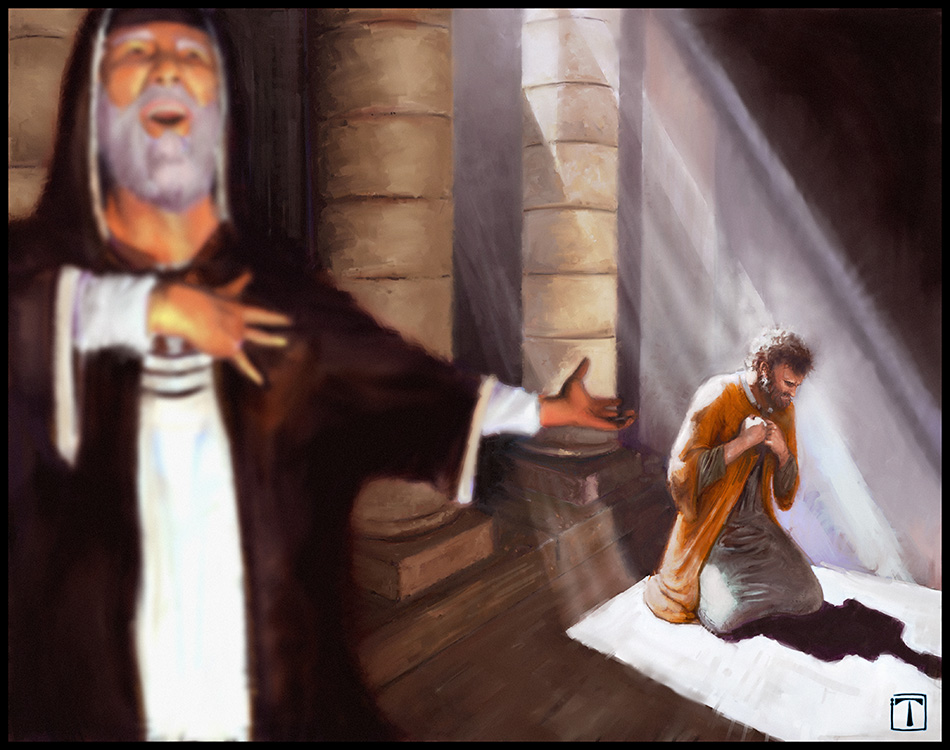
In Luke 18, 9-14 (NLT), “Jesus told this story to some who had great confidence in their own righteousness and scorned everyone else: “Two men went to the Temple to pray. One was a Pharisee, and the other was a despised tax collector. The Pharisee stood by himself and prayed this prayer: ‘I thank you, God, that I am not like other people—cheaters, sinners, adulterers. I’m certainly not like that tax collector! I fast twice a week, and I give you a tenth of my income. “But the tax collector stood at a distance and dared not even lift his eyes to heaven as he prayed. Instead, he beat his chest in sorrow, saying, ‘O God, be merciful to me, for I am a sinner.’ I tell you, this sinner, not the Pharisee, returned home justified before God. For those who exalt themselves will be humbled, and those who humble themselves will be exalted.”” As we read this, some questions to ask are ‘When we come before God, what do our prayers sound like?’ ‘What thoughts come to our hearts when we encounter others who sin differently from us?’ ‘Do we see and treat people as society sees and treats them or as God sees and treats them?’ Reflecting on these might give us a little expose as to the state of our hearts.
Remain a Signpost: Always Point Back to God. It is not about us; it is, and will always be about God (1 Corinthians 6:19-20, Galatians 2:20). We are signposts to the Saviour, not saviours. When we think of ourselves as saviours, we can be tempted to bask in the praise, but when we think of ourselves as signposts, we can swiftly do what Paul and Barnabas did and turn the conversation from ourselves to God. In Isaiah 42:8 (NLT) God says, “I am the LORD; that is my name! I will not give my glory to anyone else, nor share my praise with carved idols.”
Not only do we signpost people to God, we also signpost people’s praise to God. We don’t seek praise from people, because we know how fickle they can be. Romans 2:29b (NLT) states, “And a person with a changed heart seeks praise from God, not from people.” This God-focused mindset was why Jesus was able to stand strong even when the ‘Hosanna, Hosanna’ (John 12:12-13) turned to ‘crucify Him, crucify Him’ (Matthew 27:22-25). Sometimes when it snows where I live, even though it looks pretty for a while, it’s not long before the snow turns to muddy slush. When this happened recently, it made me think of how quickly pretty praise from humans can quickly turn into slung mud. However, what happens when mud hits a signpost? It slides right down, and when the rain comes, it washes the remnant away. I pray that we will learn to trust God to deal with the mud while we continue to signpost people to Him.
Remain Accountable: – 1 Corinthians 10:12 (NKJV) gives this sober warning, “Therefore let him who thinks he stands take heed lest he fall.” Proverbs 16:18 (ESV) states “Pride goes before destruction, and a haughty spirit before a fall.” Or as the CEV simply puts it, “too much pride will destroy you.” The truth is that we are all capable of both good and evil. As Aleksandr Solzhenitsyn puts it, “If only it were all so simple! If only there were evil people somewhere insidiously committing evil deeds, and it were necessary only to separate them from the rest of us and destroy them. But the line dividing good and evil cuts through the heart of every human being. And who is willing to destroy a piece of his own heart?”
As such, while we are ultimately accountable to God, there should also be wise, God-fearing people in our lives that we can be accountable to. Let both Heaven and Earth be our witnesses. This might have been one of the reasons why Jesus sent out the disciples in twos (Mark 6:7), and why the disciples carried on that pattern even during their early missionary journeys. In Galatians 2:11-17, we see that Paul was able to confront Peter when he felt Peter was doing something wrong. Sometimes I wonder if the solo ‘senior pastor/founder’ system a considerable number of churches have in place is the right answer. I can imagine that it may make accountability tricky. 1 Peter 5:1-5 suggests that there should be a group of elders in charge. However, the beauty of having true unity among churches and church leaders is that it also gives a space for mutual accountability among denominations.
The evil one will try to encourage us to hide our sins, but the thing with sin is that it can behave like those weeds that will worm their way through even the heavy barrier of concrete and expose themselves to the world. Hiding an infected wound without treating it is not going to do us any good. It will merely get worse. 1 John 1:8 (ESV) states, “If we say we have no sin, we deceive ourselves, and the truth is not in us.” Jesus said in Luke 8:17 (NLT), “For all that is secret will eventually be brought into the open, and everything that is concealed will be brought to light and made known to all.”
James 5:16 (NLT) exhorts us to, “Confess your sins to each other and pray for each other so that you may be healed. The earnest prayer of a righteous person has great power and produces wonderful results.” Isn’t it interesting that in this verse, James doesn’t say we should confess our sins to God, but to each other? Why? Could it be that it allows us to remain humble, and to let others who are struggling know that they are not alone? It is not always easy to be honest, as trust is key. However we can pray and ask God to show us who in our lives we can be honest with and accountable to. And when God sends us such people, may we set aside our pride and listen to them.
Remain Guileless. I was watching a Bible Project video recently, and something that was said there struck me. “Don’t use God’s reputation as a tool to manipulate people”. Although it was in relation to Jesus’ teaching in Matthew 23:16-22, it also made me think of how some people have sadly abused their positions as church leaders to manipulate people into doing all sorts of things, whether it is manipulating people to part with their money, or other more nefarious acts. Regarding the former, 2 Corinthians 9:7 (NIV) clearly states that “Each of you should give what you have decided in your heart to give, not reluctantly or under compulsion, for God loves a cheerful giver.” I have previously written a blog on this here so I won’t go on about it in this blog post. However I remember a certain music minister saying that he would not take up an offering right after ministering, even when pastors asked him to, because it would be very easy to manipulate people in such an atmosphere. I have to say, I was impressed at both his acknowledgement of the ‘power’ he could have wielded, and his decision not to abuse it.
Regarding the latter, Jesus has strong words for those who cause others to sin, “…but whoever causes one of these little ones who believe in me to sin, it would be better for him to have a great millstone fastened around his neck and to be drowned in the depth of the sea.” (Matthew 18:6, ESV). It is heart-breaking to hear some of the awful and manipulative demands placed on people, some who are vulnerable because of their desperate situations. Eli’s sons should serve as a lesson in that regards. They did all sorts, from taking and treating God’s offerings with contempt, to seducing and sleeping with women who served at the entrance to the temple (1 Samuel 2:12-25). Needless to say, it did not end well for them (1 Samuel 2:27-36, 4:17). I pray that we will heed the lesson to be learnt from them.
Remain Accessible and Relatable: Jesus made time for people, not just those higher ranked by society (Jairus, Nicodemus, the Pharisee in Luke 7:46-50), but those in its lowest ranks. He stopped on his way to heal Jairus’ daughter to acknowledge the woman who had pretty much been a societal outcast for most of her life. He called her ‘my daughter’, rather than the ‘unclean’ she was so used to hearing and even saying about herself. He was more concerned about restoring an unnamed woman’s worth than hurrying to attend to the ruler of the Synagogue (Mark 5:21-43).
Jesus worked as a artisan (Mark 6:3), went to parties (John 2:1-12), accepted invitations from people deemed unworthy by society (Luke 19:1-10), and even washed the feet of His disciples (John 13:1-17). I would hazard a guess that those feet were not exactly paragons of cleanliness, but that did not stop Him. Not only that, after doing so, He instructed us thus, “Now that I, your Lord and Teacher, have washed your feet, you also should wash one another’s feet. I have set you an example that you should do as I have done for you.” (John 13:14-15, NLT). It is worth asking, when last did we follow Jesus’ example in this regard?
I sometimes wonder how people who preach about daring examples of faith (such as the woman with the issue of blood who reached out to touch Jesus as He passed (Mark 5), and the men who broke the roof of the house Jesus was in to let down their paralysed friend (Mark 2)) would react if someone broke protocol and did something just as daring to gain access to them.
Remember that Jesus gave up His divine privileges to become a human for our sakes (Philippians 2:7), so why do we sometimes cling on to privileges that shield us from relating with other humans? It is worth asking ourselves, ‘have we encased ourselves so much that we are out of touch with the very people we are supposed to be reaching out and touching’? I say ‘we’ in this post because I know I personally still have a lot to reflect on and put into practice when it comes to some of these lessons. As always though, wisdom and discernment are key in this. Jesus hung out with sinners but didn’t become one. Also, He struck a vital balance between time alone with God and time with others.
I pray that as we reflect on this, we will remember that God is the one we worship, serve and point to. Even when we find ourselves being elevated by man, may our position at His feet never be compromised. Instead may we remember to continually point those elevating us to the One who is greater, higher, worthier of elevation than we could ever hope to be. Amen and Amen.
Image source here.

 LivLearns.Life
Leave a comment