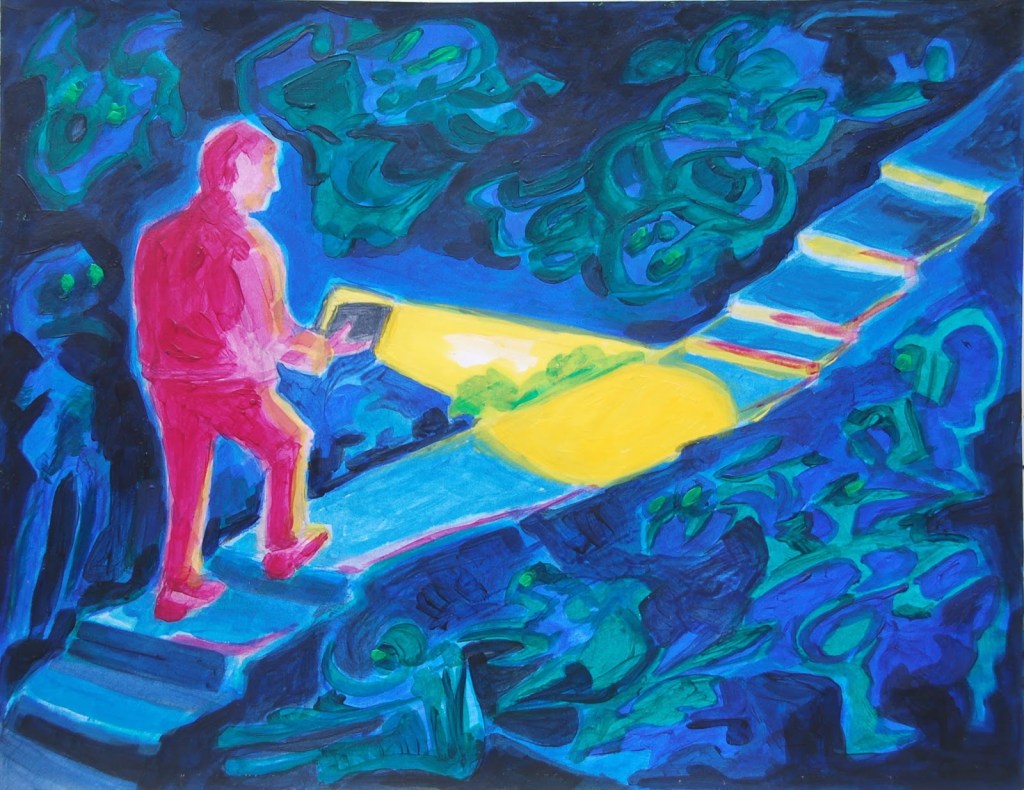
One early morning, fairly recently, I picked out what I thought was a pair of black socks from my chest of drawers, wore it and went on with my day. However, when walking on the street later that morning, a sunny morning I should add, I looked down and realised my socks were in fact navy blue (the really dark navy blue). Because the light in my room wasn’t very bright, the difference in both colours was not so obvious. While in the grand scheme of things it didn’t matter much, it got me thinking a bit more about something I had been reflecting on and praying about: discernment and the role of ‘light’ in it. Not just any light, but the right kind of light.
Around that time, I also learnt something interesting about pottery. For context, art pottery collectors and dealers want their art pottery to be as intact as possible. Which ideally means no or minimal cracks or breakages, no matter how well they’ve been repaired. I would hazard a guess that the pottery is worth much more if it is whole, than if it has been broken and repaired. However, collectors and dealers are finding that detecting repairs on types of art pottery is becoming more difficult, thanks to improvements in the quality of repairs over the years. Despite that though, it is still emphasised that the best way to identify repairs on art pottery is to visually inspect it in bright light. And for even better results, in direct sunlight. In other words, light is needed to discern what cannot be otherwise easily discerned.
As I read this about art pottery, I thought about how it can be so easy to miss things as Christians, when we don’t apply the right kind of light to situations. What kind of light are we referring to though? And what exactly is the right kind of light?
To answer that question, it would be helpful to think of the things we consult when we are assessing a situation and making a decision. In that sense, one kind of light would be our human understanding, knowledge, intellect. Another could be secular wisdom. And then there is the light of God’s Word, the light that is Jesus.
Psalm 119:105 says God’s Word is “a lamp to my feet and a light to my path”. John 1:1 notes that “In the beginning was the Word, and the Word was with God, and the Word was God.” Jesus also referred to Himself as the Light of the world. In John 8:12 (BSB), we read, “Once again, Jesus spoke to the people and said, “I am the light of the world. Whoever follows Me will never walk in the darkness, but will have the light of life”. And in John 9:5 (ESV), Jesus said “As long as I am in the world, I am the light of the world.”
The question to us is, which one is our instinctive go-to when we need light, i.e. understanding and discernment? As we go about our daily lives, which light do we reach for?
Sure, sometimes our human understanding is sufficient. For some situations like which socks to wear, it may not necessarily be a big deal. But for other decisions, it can be a pretty big deal.
I would like us to explore how the light of God’s Word can give us sight in three areas: Personal discernment, Discernment of situations and other people, and Discerning the mind of Christ. In this blog post though, I will focus on personal discernment, and hopefully discuss the other two in a subsequent blog post.
You might be wondering, why do we need discernment for ourselves? Surely we know what we want, we know our intentions, we know our innermost thoughts, so what exactly are we supposed to be discerning in ourselves? Isn’t it other people we need discernment for?
However, it can be quite eye-opening to discover just how much of our actions are influenced by previous events in our lives, and things that have been done to us and by us. Or how much of what we do puts self before God. It’s a bit like going for a medical check up feeling perfectly fine, only to discover that a hidden killer was lurking in your body while you remained blissfully unaware. As such, discerning our own thoughts, intents, our reasons for doing certain things, reasons why we act the way we do, reasons we say the things we say, reasons we are the way we are is so important.
For instance, if you are a parent, have you ever wondered why you parent the way you do? Have you ever reflected on how much feeds into your parenting style? A lot of it may probably be down to how your parents raised you, either you imitating them or actively trying not to imitate them. But what else has happened in your life which feeds into it? Is God involved in any aspect at all? If you work for a company, what governs the amount of effort you put into your job? Who do you want to please more in your work?
What about the way we relate to people? The level of trust or distrust we have for people in general? A seemingly innocuous casual comment made by a random stranger may be water off a duck’s back for one person, but be quite distressing for another. Why?
Even the good deeds we do, why do we do them? What drives us to do what we do? Do we do good because we are representing The One who is thoroughly good, or do we do it to be seen, to be talked about? Is it for God’s glory or for our own glory?
It can be quite tough to discover just how depraved the human heart can be, and consequently, just how much we need Jesus. Jeremiah 17:9-10 (NLT) says, “The human heart is the most deceitful of all things, and desperately wicked. Who really knows how bad it is? But I, the LORD, search all hearts and examine secret motives. I give all people their due rewards, according to what their actions deserve.”
Sometimes we can deceive other people as to our motives, we can even deceive ourselves, but we can never deceive God. In 1 Corinthians 4:3-5 (NLT), Paul says “As for me, it matters very little how I might be evaluated by you or by any human authority. I don’t even trust my own judgment on this point. My conscience is clear, but that doesn’t prove I’m right. It is the Lord himself who will examine me and decide. So don’t make judgments about anyone ahead of time—before the Lord returns. For he will bring our darkest secrets to light and will reveal our private motives. Then God will give to each one whatever praise is due.”
God is the one who can examine secret motives, and He has given us His Word to help us to do that for ourselves. Psalm 26:2 (NLT) says “Put me on trial, LORD, and cross-examine me. Test my motives and my heart.” Then further on, Hebrews 4:12 (ESV) states, “For the Word of God is living and active, sharper than any two-edged sword, piercing to the division of soul and of spirit, of joints and of marrow, and discerning the thoughts and intentions of the heart.”
As such, we have the tools with which to obey 2 Corinthians 13:5 (ESV), which exhorts us thus, “Examine yourselves, to see whether you are in the faith. Test yourselves. Or do you not realize this about yourselves, that Jesus Christ is in you?—unless indeed you fail to meet the test!” We can judge ourselves by the standard of God’s Word, because it is infallible, unchanging, always true, brighter than any other light we can use to examine anything.
When we were unbelievers, we could not see or even use this light. 2 Corinthians 4:4 (NLT) notes that “Satan, who is the god of this world, has blinded the minds of those who don’t believe. They are unable to see the glorious light of the Good News. They don’t understand this message about the glory of Christ, who is the exact likeness of God.”
However when we became Christians, our eyes were opened to this wonderful light. Stanza four of the hymn ‘And can it be’ by Charles Wesley illustrates this so beautifully:
“Long my imprisoned spirit lay
Fast bound in sin and nature’s night;
Thine eye diffused a quick’ning ray,
I woke, the dungeon flamed with light;
My chains fell off, my heart was free;
I rose, went forth and followed Thee.”
Hallelujah! Sadly though, we sometimes forget just how much we need this light on an ongoing basis in our daily lives. When we rise, go forth and follow Him, we still need that light to follow Him right. While justification is instant once we believe and receive Jesus into our lives as Lord and Saviour, sanctification is very much an ongoing affair, and we cannot do it without the light of God. Remember that God’s Word is not only a light for our entire path, it is also a lamp to our feet, available to guide us step by step as we walk this walk. The floodlight allows us to see the big picture, but we also need to hold the lamp closely to see the detail in the picture.
For most of us as Christians, we probably have a general idea of right and wrong, especially when it is clearly spelt out in the Bible, such as in the ten commandments. We know the things which are sins, things we shouldn’t do. However, when we think about sin as that which separates us from God, we realise that there are things in our lives which may not be seen as ‘sin’, but which separate us from God, or at the very least, don’t bring us any closer to Him! And it is those things which we need the light of God’s Word and God’s Spirit to reveal to us. Otherwise, because of the subtlety of such, we may remain blissfully unaware.
John Piper once said that “the greatest enemy of hunger for God is not poison but apple pie. It is not the banquet of the wicked that dulls our appetite for heaven, but endless nibbling at the table of the world. It is not the X-rated video, but the prime-time dribble of triviality we drink in every night.”
And as Marshall Segal notes, “For all the ill that Satan can do, when God describes what keeps us from the banquet table of his love, it is a piece of land, a yoke of oxen, and a wife (Luke 14:16-20). The greatest adversary of love to God is not his enemies but his gifts. And the most deadly appetites are not for the poison of evil, but for the simple pleasures of earth. For when these replace an appetite for God himself, the idolatry is scarcely recognisable, and almost incurable.”
Much like my illustration of the black and dark navy blue socks earlier, it is the subtle, “scarcely recognisable” idolatry that plagues us, the good things which are slowly replacing The Good One in our lives. It is the subtle ways in which we take decisions that distance us from God, or choose to see things from a human perspective rather than God’s perspective, or have other ‘gods’ before Him, or deny we are His followers that harm us.
It is the way that like Peter, we resent or disregard what Jesus is saying to us because it doesn’t fit into our humanly crafted mould of Him (Matthew 16:21-26).
It is the decision to watch one more episode of a series and pray ‘later’, purposefully ignoring the fact that the last time we did that, we were too tired afterwards and fell asleep almost straightaway. It is the choice to keep mindlessly browsing online, instead of mindfully reading our Bible and spending time in fellowship with God. It is the way we rely on our modern day ‘horses and chariots’ for help instead of God, until we realise that sorrow is what awaits if we continue on that path (Isaiah 31:1).
We may not, like Simon Peter, outrightly say “I don’t know the man!” (Matthew 26:72), but our lifestyles, words, actions belie this knowledge. Until we shine Matthew 10:32-33 and John 13:35 in our lives and reflect on whether we are acknowledgers or deniers, and whether people around us know we are His disciples by the way we live our day-to-day lives.
It is the ways religious pride creeps upon us, until Ephesians 2:8-9 reminds us that we are saved by grace not works.
Without this light, we will wake up one day and wonder why we don’t feel as close to God as we used to. But, as I once read, “if God seems far, guess who moved?”
If we want to progress in our walk with God, we cannot continue to hide in the shadows, walking in the dark because we can’t bear the thought of what we may find if we shine the light of God’s Word into our lives. That would be akin to a person thinking they are hiding from a predator in the dark, not knowing that the predator is in fact crouching close to them, waiting for the opportune time to strike. As Genesis 4:7 (BSB) tells us, “If you do what is right, will you not be accepted? But if you refuse to do what is right, sin is crouching at your door; it desires you, but you must master it.” And how will we see the sin crouching in the dark without the light of God’s Word?
Our human knowledge and intellect may not see anything wrong with some of the examples listed earlier. In such cases, it is akin to using a not-so-bright indoor bulb to look for cracks when what we need is the bright light of the sun. Watchman Nee notes thus, “How true it is that without the guidance of the Holy Spirit intellect not only is undependable but also extremely dangerous, because it often confuses the issue of right and wrong.”
1 John 1:6-7 (BSB) notes, “If we say we have fellowship with Him yet walk in the darkness, we lie and do not practice the truth. But if we walk in the light as He is in the light, we have fellowship with one another, and the blood of Jesus His Son cleanses us from all sin.” And so, when we have and utilise God’s Word as a light, we start to see the things that separate us from God with more and more clarity, as they go from being shadily subtle to glaringly obvious. Eith the help of the Holy Spirit, we may also start to become more aware of the rationale for some of our actions. Only then can we acknowledge the error of our ways, and with God’s help, take steps to close that distance. This can also have a positive impact on our relationships with others as well – our parents, children, spouses, family, friends, and many other people we relate to.
To do this though, we must first love God’s light more than any darkness, no matter how harmless that darkness appears to be. John 3:19 (NLT) states, “And the judgment is based on this fact: God’s light came into the world, but people loved the darkness more than the light, for their actions were evil.”
That love will involve sacrifice, time and dedication. It involves not just reading the Bible, but actively and intentionally putting it into practice daily, so that we don’t fool ourselves (James 1:22-25). We want the Word to go from words written on the pages of a book, to words living on the pages of our lives.
That light will shine even in the darkest corners of our lives, the corners we don’t want anyone to ever see or know about, it will penetrate rooms in our lives long since locked and bolted. The results of that light shining in our lives may lead to tough choices, even painful ‘surgery’ in some cases, letting go of things we would rather hold tightly to, holding on to our faith and the truth of God’s Word even when it cuts deep into our flesh (Matthew 5:29-30, Colossians 3:5, 1 Thessalonians 5:21-22). But, if we do so till the very end, we can rest assured that the end result will be so, so worth it (Hebrews 12:2, James 1:12, Revelation 22).
As we reflect on this, I pray that we will love the light far more than the darkness. May we continue to walk in that light and remain willing to let that light shine brightly into our lives. As it lights up our paths, I pray that we open our eyes to see all the stumbling blocks on that path, from the huge boulders to the little pebbles. May God help us as we victoriously crush these and continue to follow Him, walking in the light as He is in the light. Amen!
Image source here.

 LivLearns.Life
Leave a comment