When reading the Bible, it never ceases to amaze me how a particular passage can just jump at you and reveal a very timely lesson. You might have read that passage several times beforehand and never spotted it. And then one day, you read it and do a double take. For me, when that happens, more often than not it is a lesson I really need to remember to put into practice, or to explore on a deeper level.
Recently, I was reading the book of Jeremiah, and I got to Chapter 26. For context, a lot of Jeremiah’s prophecies up to this point relate to God’s punishment for Israel’s sin. God is greatly grieved by Israel’s sin – they have turned their back on God and gone after idols. In so doing, they have also turned away from their covenant with God, from His teachings and His will. The land is now filled with injustice, cruelty, brazen sin of all sorts. Jeremiah is therefore sent by God to prophecy their destruction and that of their leaders, unless they repent. Now for most people, it is not easy to ‘speak the truth to power’. It is much easier to prophecy blessings and good things, isn’t it? Alas, that is not exactly Jeremiah’s assignment here.
Back to this particular passage… I’ve quoted it below, highlighting some key sections in bold font.
“ 7The priests, the prophets, and all the people listened to Jeremiah as he spoke in front of the Lord’s Temple. 8 But when Jeremiah had finished his message, saying everything the Lord had told him to say, the priests and prophets and all the people at the Temple mobbed him. “Kill him!” they shouted. 9 “What right do you have to prophesy in the Lord’s name that this Temple will be destroyed like Shiloh? What do you mean, saying that Jerusalem will be destroyed and left with no inhabitants?” And all the people threatened him as he stood in front of the Temple.
10 When the officials of Judah heard what was happening, they rushed over from the palace and sat down at the New Gate of the Temple to hold court. 11 The priests and prophets presented their accusations to the officials and the people. “This man should die!” they said. “You have heard with your own ears what a traitor he is, for he has prophesied against this city.”
12 Then Jeremiah spoke to the officials and the people in his own defense. “The Lord sent me to prophesy against this Temple and this city,” he said. “The Lord gave me every word that I have spoken. 13 But if you stop your sinning and begin to obey the Lord your God, he will change his mind about this disaster that he has announced against you. 14 As for me, I am in your hands—do with me as you think best. 15 But if you kill me, rest assured that you will be killing an innocent man! The responsibility for such a deed will lie on you, on this city, and on every person living in it. For it is absolutely true that the Lord sent me to speak every word you have heard.”
16 Then the officials and the people said to the priests and prophets, “This man does not deserve the death sentence, for he has spoken to us in the name of the Lord our God.”
17 Then some of the wise old men stood and spoke to all the people assembled there. 18 They said, “Remember when Micah of Moresheth prophesied during the reign of King Hezekiah of Judah. He told the people of Judah,
‘This is what the Lord of Heaven’s Armies says:
Mount Zion will be plowed like an open field;
Jerusalem will be reduced to ruins!
A thicket will grow on the heights
where the Temple now stands.’
19 But did King Hezekiah and the people kill him for saying this? No, they turned from their sins and worshiped the Lord. They begged him for mercy. Then the Lord changed his mind about the terrible disaster he had pronounced against them. So we are about to do ourselves great harm.”
20 At this time Uriah son of Shemaiah from Kiriath-jearim was also prophesying for the Lord. And he predicted the same terrible disaster against the city and nation as Jeremiah did. 21 When King Jehoiakim and the army officers and officials heard what he was saying, the king sent someone to kill him. But Uriah heard about the plan and escaped in fear to Egypt. 22 Then King Jehoiakim sent Elnathan son of Acbor to Egypt along with several other men to capture Uriah. 23 They took him prisoner and brought him back to King Jehoiakim. The king then killed Uriah with a sword and had him buried in an unmarked grave.
24 Nevertheless, Ahikam son of Shaphan stood up for Jeremiah and persuaded the court not to turn him over to the mob to be killed.” (Jeremiah 26:7-24, NLT).
What struck me in this passage is the contrast between two prophets reactions to the similar threats, and the results that followed. Uriah also prophesied for the Lord, and his prophecy was similar to that of Jeremiah’s. However, when faced with the very real threat of death, verse 21 records that Uriah “heard about the plan escaped in fear to Egypt.” Sadly, his escape plan did not work out, as King Jehoiakim sent someone all the way to Egypt to hunt him down. He was found, brought back, killed with a sword and buried in an unmarked grave. In other words, almost like a nobody. What a sad outcome, for him, for his family, for his loved ones. And today, while most Christians know about Prophet Jeremiah, how many know about Prophet Uriah?
As I reflected on the reactions of the two prophets, it struck me that at the heart of it, one allowed fear to guide his decision making, while the other allowed faith in God to guide his decision making.
It is worth bearing in mind that there was nothing inherently wrong with escaping to Egypt. Afterall, God Himself had told Joseph to take Jesus and Mary and escape to Egypt (Matthew 2:13). So the problem was not necessarily his action, but the motivation, the rationale behind it. I should also add a caveat that it is entirely possible that Uriah would have been killed regardless. But what if not? What if he had run to God in faith, instead of running to Egypt in fear? Might the outcome have been different?
In contrast, Jeremiah reiterated what God said and gave the people a way out (repentance). In turn, God raised other people to speak for Jeremiah and to advocate for him. As a result, His life was spared. Was it that Jeremiah was somehow holier or better? There is no evidence of either. However we can tell from his messages that he struggled a lot with his assignment, and so it would have been very easy for him to give in to fear. Have you ever felt like you are doing so much for God and He barely even notices? Or that the life you are living is not exactly the one you thought you signed up for when you became a Christian?
If you have, then you can relate with Jeremiah. In Jeremiah 20:7-8 (NLT), he says, “O Lord, you misled me, and I allowed myself to be misled. You are stronger than I am, and you overpowered me. Now I am mocked every day; everyone laughs at me. When I speak, the words burst out. “Violence and destruction!” I shout. So these messages from the Lord have made me a household joke. But if I say I’ll never mention the Lord or speak in his name, His word burns in my heart like a fire. It’s like a fire in my bones! I am worn out trying to hold it in! I can’t do it!”
He actually says that God misled him! What an accusation. But to be honest, that is actually one of the things I like about Jeremiah – his honesty and in a sense, his relatability. Have you ever felt like asking, ‘seriously God, is this how you reward the ones who serve you? Is this it?’ However, even in the midst of all that anguish, Jeremiah still recognises the truth about God, “But the Lord stands beside me like a great warrior. Before him my persecutors will stumble. They cannot defeat me. They will fail and be thoroughly humiliated. Their dishonour will never be forgotten” (Jeremiah 20:11). He continues to hold on to his faith in God, knowing that God will stand by him. And it is this faith that encourages him to keep going even when faced with such a challenging assignment.
How many times has the fear of being mocked or laughed at stopped us from taking a stand for God? How many times has the fear of danger caused us to walk away from the path God is calling us to take? How many times have we made a decision with fear as the root of that decision tree? I pray that God will help us to keep faith close and fear at a distance. May we not let fear cause us to run when faith is telling us to stand still, or let fear root us to a spot when faith is telling us to move. Ultimately, the truth is that the safest place to be is in the centre of God’s will.
Not only can fear cause us to take decisions that may be against God’s plan for us, or decisions that can endanger us, it can also lead to outrightly foolish or wicked actions. When the new Pharoah who came to power long after Joseph’s death decided to make the Israelites slaves of the Egyptians, he did so from a place of fear. Fear of how much, of how quickly the Israelites had multiplied. Fear that if a war broke out, they might join the enemies of the Egyptians and fight against them (Exodus 1:7-10). Incidentally, there does not seem to be any evidence that this was the case at all. If anything, it looked like the Israelites were pretty comfortable and settled in Egypt around that time. What happened next, when the new Pharoah let fear rule him? He ended up acting with such unimaginable cruelty – killing innocent babies, oppressing the Israelites with hard labour, setting almost impossible tasks for them, being plain ruthless (Exodus 1-5).
Looking back now, we can see that God wanted to take the Israelites to their promised land, but it was highly unlikely they would have been willing to go anywhere if they were still comfortable in Egypt. Even with all the suffering they experienced, they were still waxing lyrical about Egypt on their way to the promised land, saying “we remember the fish which we ate freely in Egypt, the cucumbers, the melons, the leeks, the onions, and the garlic; but now our whole being is dried up; there is nothing at all except this manna before our eyes!” (Numbers 11:5-6). At the end of the day, it was to Pharoah’s loss that he let fear drive his decision making. That did not stop God from using the situation though. Fear sees threats everywhere. Faith sees opportunities everywhere, opportunities for God to work.
It was also fear that, many years later, led Herod to kill all the boys under the age of two in Bethlehem. Matthew 2:3 notes that when King Herod heard that a king had been born, he was troubled, aka deeply disturbed, worried, afraid. It seems crazy, doesn’t it, to be afraid of a baby taking your throne. But then, fear can be irrational. Herod ended up dying while Jesus was still young. If only Herod knew that Jesus was not the kind of king he was. Alas, fear can blind us to God’s true nature. Faith on the other hand opens our eyes to God’s true nature.
As I write this, I am reminded of a book I once came across called ‘The gift of fear’. It discussed how fear can lead us to make the right decisions to protect ourselves from danger, and offered some useful tips on navigating certain situations. However on reading it, it occurred to me that it was not necessarily fear per se, but intuition and cultivating awareness of one’s environment that can help.
Sadly, the challenge we face is that we cannot always be aware of all the dangers lurking around us. Devils rarely have horns on their head or a pitch fork in their hand. For many people, assailants look like perfectly ordinary people, and their ordinariness does not inspire us to deem them worthy of suspicion. And for some people, their ‘intuition’ is inadvertently cultivated by their biases or past experiences. Besides, living in a way where you become suspicious of almost everything is not a healthy way to live either.
There is a reason why the Bible is peppered with the phrase “Fear not”. I saw this quote recently, “fear can keep us up all night long, but faith makes one fine pillow”, and I thought, ‘how true!’ And as Stephen King stated, “fear can hold you prisoner. Hope can set you free.” Knowing this therefore, what can we do to stop fear from taking its position as our pilot?
Personally, I know that anytime I feel fear creeping up inside me, it is because I have shifted my focus from God to the problem. I realise in such times that I am not trusting God, and I need to “turn my eyes upon Jesus and look full in His wonderful face,” as the hymn writer notes. This is what happened to Peter when he was walking on water towards Jesus, in the midst of the boisterous wind. He demonstrated incredibly bravery and faith by even getting out of the boat and into the water to start with. How many of us can demonstrate that level of faith? And as long as he looked to Jesus, he was fine. It was only when he turned and focused on the wind that he began to sink. But the beauty of this story is that, even in the midst of that, Jesus still reached out and saved him instantly (Matthew 14:25-33).
I had this picture today, of God looking at us in a crowded room, trying to make eye contact to communicate with us, but sometimes we are so busy looking around at all the cares and worries surrounding us that we don’t even catch His eye. Have you ever been there? Trying to get someone’s attention in a crowded and noisy room, and hoping desperately that they will just look at you, if only for a few seconds, because you know that with all the noise, even if you shout, they won’t hear you, but they are not even looking in your direction? Look to Jesus. Catch His loving gaze. Look and live. Look to His Word. Look and live. Look to His promises. Look and live.
The truth is that Jesus is even more real than whatever is causing you to fear. You might not be able to physically look to Him as Peter did, but you can look to His Word, and you can look to Him in the place of prayer. Trusting God to direct us and to give us discernment is key (Proverbs 3:5-6). Tim Ferrara defines discernment as “spirit-infused decision making.” There is far too much that our natural senses cannot see or perceive. As such, we need the Holy Spirit to drive our decision making and help us walk in faith rather than fear. As 2 Timothy 1:7 (KJV) says, “For God hath not given us the spirit of fear; but of power, and of love, and of a sound mind.”
Bob Proctor notes, “faith and fear both demand you believe in something you cannot see. You choose!” At the end of the day, faith and fear are two competing forces, and the one we feed is the one that will grow and grow and grow, until it squeezes out the other. The books, magazines, news articles and reports, movies, documentaries etc which we read and watch, and the people we associate with and listen to all feed one or the other. Ephesians 5:7-10 (ESV) says, “Therefore do not become partners with them (deceivers and the disobedient); for at one time you were darkness, but now you are light in the Lord. Walk as children of light (for the fruit of light is found in all that is good and right and true), and try to discern what is pleasing to the Lord.” The question is, which one is getting fed more? Which one is growing fatter in your life? Faith or fear? And if it is the latter, are you ready to cut it down to size? Are you ready to bulk up faith instead?
I pray that as we reflect on this, we will be moved to put fear on a starvation diet, give faith a feast of fat things and exercise our faith muscles. I pray that we will lay out a lavish table of God’s word, feast on it, and allow it give us the wherewithal to act in faith. May we not let fear cripple us when faith is yearning to give us feet that outrun chariots. And when we step out in faith, may our God honour that faith by doing far more than we can ever ask or imagine, making Himself known in our lives in a way that undeniably shows that He is indeed for us, with us, and at work in us. Amen.
Image Source here.
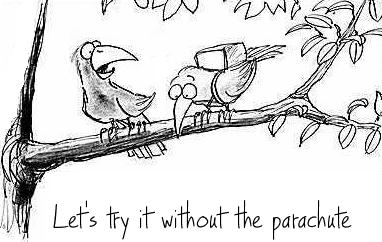
And a cartoon treat from Mike Waters… 🙂


 LivLearns.Life

Leave a comment