The book of Jonah is an intriguing one. Needless to say, there is a lot to learn from the life of Jonah – the importance of obedience, God’s merciful nature, God’s omnipresence and consequently the futility of trying to hide from Him, and so much more. However in this post, I am going to touch on lessons we can learn from the sailors who were on board the ship with Jonah, with a particular focus on their reaction to the dreadful storm that hit as they sailed across the sea.
As we know, God gave Jonah an assignment to go to Nineveh. However he went in the opposite direction, boarding a ship leaving for Tarshish, because he did not want to carry out the assignment. Thinking he had escaped, he went to sleep in the hold, below deck. The Bible tells the story better, so I’ll just quote it directly, highlighting some sentences in bold font.
“But the Lord hurled a powerful wind over the sea, causing a violent storm that threatened to break the ship apart. Fearing for their lives, the desperate sailors shouted to their gods for help and threw the cargo overboard to lighten the ship.
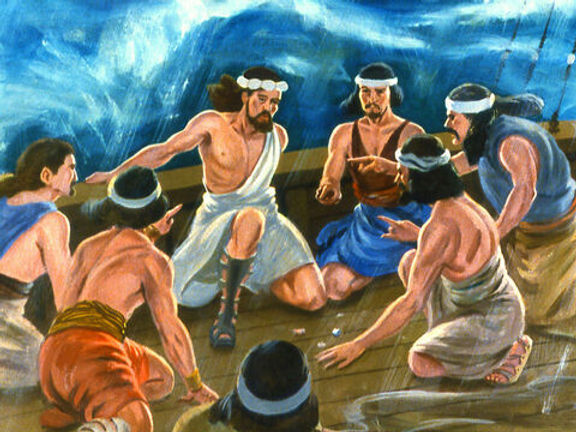
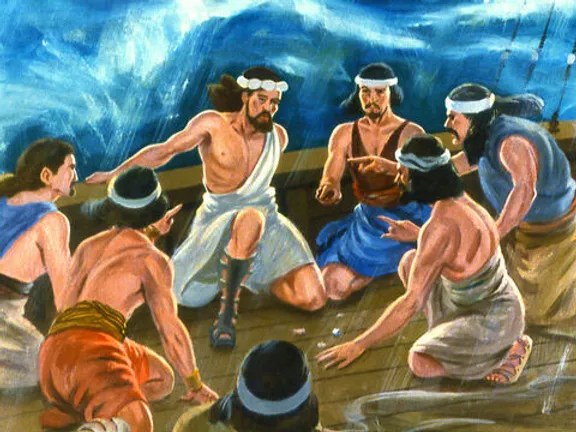
But all this time Jonah was sound asleep down in the hold. So the captain went down after him. “How can you sleep at a time like this?” he shouted. “Get up and pray to your god! Maybe he will pay attention to us and spare our lives.” Then the crew cast lots to see which of them had offended the gods and caused the terrible storm. When they did this, the lots identified Jonah as the culprit. 8 “Why has this awful storm come down on us?” they demanded. “Who are you? What is your line of work? What country are you from? What is your nationality?”
9 Jonah answered, “I am a Hebrew, and I worship the Lord, the God of heaven, who made the sea and the land.” 10 The sailors were terrified when they heard this, for he had already told them he was running away from the Lord. “Oh, why did you do it?” they groaned. 11 And since the storm was getting worse all the time, they asked him, “What should we do to you to stop this storm?” 12 “Throw me into the sea,” Jonah said, “and it will become calm again. I know that this terrible storm is all my fault.”
13 Instead, the sailors rowed even harder to get the ship to the land. But the stormy sea was too violent for them, and they couldn’t make it. 14 Then they cried out to the Lord, Jonah’s God. “O Lord,” they pleaded, “don’t make us die for this man’s sin. And don’t hold us responsible for his death. O Lord, you have sent this storm upon him for your own good reasons.”
15 Then the sailors picked Jonah up and threw him into the raging sea, and the storm stopped at once! 16 The sailors were awestruck by the Lord’s great power, and they offered him a sacrifice and vowed to serve him.” Jonah 1:4-16 (NLT).
There are a number of interesting points made in this passage, and I will outline and discuss five of such points and what I learnt from these.
One of the many things I find interesting is that the sailors, who were not exactly known as paragons of virtue in those days, but who would obviously have been skilled in their craft, realised that during such a storm, the first and best thing to do was to pray. Sure, they also took action, but they prayed. As I write this, the question that immediately springs to mind is, “What is your first reaction when faced with a storm?” The answer to that question reveals a lot about our heart and what we truly believe. Angus Buchan notes, “There is power in prayer. When men work, they work. but when men pray, God works.” It is worth noting that further on, they very quickly realised the futility of trying to work in opposition to what God wanted. They rowed even harder to get to land, but it was hopeless. Now trying to keep Jonah on board might have seemed like the more merciful option. But, that was not God’s plan. Which is a lesson that not everything that seems good is actually what God wants us to do. His ways are not always our ways (Isaiah 55:8-9). Discernment is key. Eventually, the sailors obeyed and and threw Jonah overboard, and it was only then that their prayers were answered.
There is another reason why this first action of prayer was so important, and that reason leads me to the second interesting point: The sailors realised there was a spiritual element to the storm. “Then the crew cast lots to see which of them had offended the gods and caused the terrible storm.” In my blogpost ‘Does God do random coincidences?, I wrote that there is so much in life that is beyond the physical, so much that we may not understand, but prayer is far more powerful than we can imagine. Pierre Teilhard de Chardin, S.J. once stated that “We are not human beings having a spiritual experience. We are spiritual beings having a human experience.” Regardless of whether one agrees with the quote, it remains true that life is spiritual. What’s more, our level of realisation and understanding of this truth will inform and determine our response to so many situations we face in life.
Knowing this also has the potential to change how we interact with people, and it can give us more compassionate hearts. I have watched and read testimonies of people who were miraculously set free from addictions they had battled for years, people who had done all that was within their human power to do with little to no lasting results. Yet in an instant, after a word from God, they completely lost a desire to do the very thing that they could not do a day without, even to the point of finding it disgusting. Such testimonies are indeed quite eye-opening.
Ephesians 6:12 (ESV) tells us that “we do not wrestle against flesh and blood, but against the rulers, against the authorities, against the cosmic powers over this present darkness, against the spiritual forces of evil in the heavenly places.” This is something I am trying to be more conscious of, as I find that when I remember it, it completely changes my response to a situation. When I don’t on the other hand, I respond in very fleshly ways. Writing this drives home the realisation that I need to dwell more on this verse and act like I actually believe it.
Sometimes we are not conscious of the spirituality in our world because it is not always tangibly obvious. People from certain regions of the world may be more aware of the existence of these spiritual forces than others, either because they have personally witnessed the effects, or because they have been brought up in cultures where such things are regularly discussed and showcased in popular media.
However, on some level, even in popular culture in the West, there is still an awareness of forces beyond our natural world. I find it interesting that quite a number of mainstream newspapers include zodiac readings every day. Moreover, just as we see the hand of God in great acts of mercy and forgiveness (hence the saying “to err is human, to forgive is divine”), we also see the hand of the devil in the evil we hear about or even witness (hence a popular idiom referring to a person who has committed heinous acts as ‘the spawn of Satan’). Roméo Dallaire, who was on a UN Assistance Mission for Rwanda around the time of the Rwandan Genocide said, “I know there is a God because in Rwanda I shook hands with the devil. I have seen him, I have smelled him and I have touched him. I know the devil exists and therefore I know there is a God.”
It is worth noting though that the power of evil may not always be so blatantly obvious, as in the case of a genocide. It can be present in the seemingly harmless things. Again this is why discernment is so key for us as Christians. It is also important to add that this knowledge should not provoke fear in a Christian, thanks to Christ who has given us power over the enemy (Luke 10:17-20, Mark 16:15-18).
The third point was that their casting of lots, which in theory should be completely random, actually revealed the ‘culprit’. Coincidence? I think not, but you can read the blog I linked earlier for more on that subject. That said, it was just as well that casting lots revealed the real culprit because Jonah did not confess until the lot fell on him. In fact, he was busy sleeping while the others were praying and throwing cargo overboard to lighten the ship.
This leads to another interesting question; Is it ever a good idea to sleep during a storm? One would think that during a storm, you should intensify your prayers. But then, didn’t Jesus Himself sleep through a fierce storm, so deeply in fact that the disciples had to wake Him up, despite all the noise and chaos? (Mark 4: 35-41).
What made it okay for Jesus but not Jonah? I believe that the difference between both was a matter of the heart. Jesus had total trust in His Father, and demonstrated that trust by obeying God and knowing and walking in line with God’s will. He knew and lived out His identity as the Son of God. Which was why even a storm could not shake Him. Jonah on the other hand was not exactly demonstrating trust for God, given that he was expressly disobeying God. Neither was he acting in line with His identity as God’s chosen prophet.
A lesson I learnt from this is that there is a certain confidence we have in God when we are walking in obedience to Him that can allow us to be at peace during a storm, to the point where we are able to sleep despite the noise and chaos the storm throws around. As such, if we are not sure we are walking in line with God’s will, we should not attempt to sleep during a storm! Even if we are sure, it won’t hurt to pray. At the end of the day, Jesus still woke up and spoke to the storm. It was only then that it calmed down. They would have probably gotten to the other side despite the storm, thanks to the presence of Jesus in their boat, but who doesn’t prefer to sail in calm seas? It is also interesting to note that the presence of Jesus in one’s boat does not exempt the person from storms.
The fourth point is two-fold. One, the sailors exhibited more fear of the Lord than Jonah, who was a Jew and a worshipper and prophet of God, and so should have known better. The sailors were terrified when they realised that Jonah worshipped The Lord, The God of Heaven. Two, even in the midst of the storm, they were able to acknowledge that God sent the storm for His own good reasons. “O Lord, you have sent this storm upon him for your own good reasons.” Given that they were not exactly people who worshipped God, it is intriguing that they grasped two key aspects of worshipping God – the fear of God, i.e. a deep reverence for God; and an acknowledgement that His ways are good and just (Deuteronomy 10:12, 32:4).
It can be quite humbling when non-believers understand worship of God better than we do. When this happens, rather than having our noses in the air, or our heads buried in the sand, it is a call to reflect on the possibility that our familiarity with the gospel may perhaps be breeding contempt, and to step up in areas where we have become complacent.
A.W. Tozer notes that “without doubt the emphasis in Christian teaching today should be on worship. There is little danger that we shall become merely worshipers and neglect the practical implications of the gospel. No one can long worship God in spirit and in truth before the obligation to holy service becomes too strong to resist. Fellowship with God leads straight to obedience and good works. That is the divine order and it can never be reversed.”
May our reverence for God not merely be something that only exists in our minds. Rather may it shine through in our thoughts, words and deeds, and in our interactions with others. In so doing, may we learn to acknowledge that God has His ‘own good reasons’ for what He allows to happen here on Earth.
The fifth point is that even Jonah’s disobedience ended up being a witness for God, proof that all things indeed work together for good. “The sailors were awestruck by the Lord’s great power, and they offered Him a sacrifice and vowed to serve Him.” May we never lose our awe for God’s greatness, His power, wisdom, creativity and love, and not wait till we are rescued from storms to regain our awe. May we continue to serve Him all the days of our lives, no matter what it costs. There is a saying that ‘we cannot outgive God’. The sacrifice is always, always worth it. May we have discerning hearts to serve Him in the ways He wants us to rather than in the ways we think we should.
I pray that as we reflect on these points, we will continue to pray, trust, obey, reverence, praise, worship and serve our awesome God in humility. For He is, and will always remain, worthy to be trusted, obeyed, reverenced, revered, praised, worshipped, and served. Amen and Amen.
Image Source Here.

 LivLearns.Life
Leave a comment