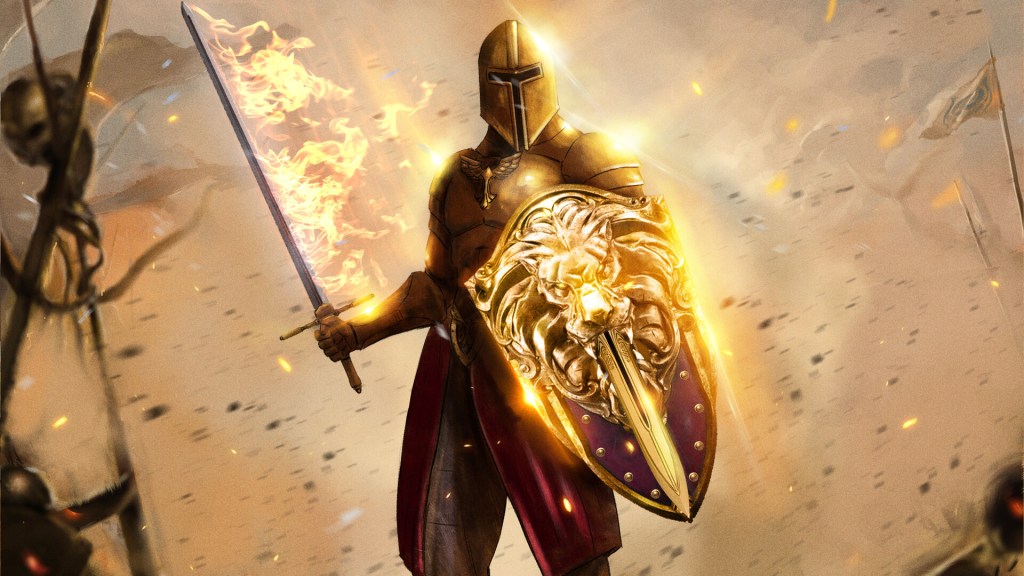
Imagine you were called up to fight in a war, would you be willing to go to the frontline without any weapons? Probably not. Similarly, you would not want to ‘bring a knife to a gunfight’ either. Chances are, you want to go to a battleground fully equipped for battle. As such, if the lieutenant in charge of your platoon ordered you go to into the thick of a battle wearing just a t-shirt, shorts and flipflops, you would probably question his sense or sanity.
Alas, this is how some of us go out to fight spiritual battles, completely unprepared. It is unsurprising therefore, albeit saddening, that we sometimes end up with more injuries than victories.
Why does this happen though? 1 Samuel 13:19-22 (NLT) tells a very interesting story that occurred during Saul’s reign as King of Israel. “There were no blacksmiths in the land of Israel in those days. The Philistines would not allow them for fear they would make swords and spears for the Hebrews. So whenever the Israelites needed to sharpen their ploughshares, picks, axes, or sickles, they had to take them to a Philistine blacksmith. The charges were as follows: a quarter of an ounce of silver for sharpening a ploughshare or a pick, and an eighth of an ounce for sharpening an axe or making the point of an ox goad. So on the day of the battle none of the people of Israel had a sword or spear, except for Saul and Jonathan.”
A few key points to unpick from this passage are as follows:
- The enemy did not allow blacksmiths (the people who made weapons) in the land of Israel, because they were afraid of what would happen if there were blacksmiths in Israel (In other words, they were afraid of the existence of weapon makers and weapon sharpeners). This automatically translates to a fear of what would happen if the Israelites made and possessed their own weapons.
- The enemy made them go to an enemy blacksmith to sharpen all their instruments needed for normal day-to-day life, and they had to pay for this.
- Conversely, this meant that on the day of battle, only two people in the entire army had a sword, the King and the Prince.
Now we know that “we are not fighting against flesh-and-blood enemies, but against evil rulers and authorities of the unseen world, against mighty powers in this dark world, and against evil spirits in the heavenly places.” (Ephesians 6:12 NLT).
We also know that “We use God’s mighty weapons, not worldly weapons, to knock down the strongholds of human reasoning and to destroy false arguments.” (2 Corinthians 10:4, NLT). Or as the KJV puts it, “For the weapons of our warfare are not carnal, but mighty through God to the pulling down of strong holds.”
As such, how can we apply this passage and the lessons from it today?
Ephesians 6:10-18 details the armour of God we need to stand against the devil’s schemes. It also instructs us to put on the full armour, not just part of it, “so that when the day of evil comes, you may be able to stand your ground, and after you have done everything, to stand.” This armour consists of the belt of truth around our waist, the breastplate of righteousness, the gospel of peace fitted on our feet, the shield of faith, the helmet of salvation and the sword of the Spirit, which is the Word of God.
The Philistines stopped the Israelites from having swords so that they would not be able to defend themselves against the enemy. They did not just stop sword ownership though, they stopped the people who could provide the swords. In a sense, the enemy wanted to tackle their problem of an armed, well-equipped army right from the source. This is still a tactic the enemy uses even till this day. The enemy tries to stop people from having access to the Word of God. This can take various forms, from physically preventing the distribution of Bibles and other Christian literature, to more subtle forms of denying the power and wisdom in the Word of God. The devil can also hinder us from listening to true teachers of the Word of God, i.e. those that God has called to help us sharpen the weapons of our warfare.
What does the enemy want us to do instead? To go to the world to source for wisdom instead of the Word of God, just like the Philistines made the Israelites go to their own blacksmiths. It is worth reflecting on this and asking ourselves this question, ‘when we need wisdom, what is our first port of call?’ As we reflect on this, remember that the Word of God, which is God Himself, is the source of true wisdom (Proverbs 2:1-6, John 1:1, James 1:5). 1 Corinthians 3:19 (BSB) states that “the wisdom of this world is foolishness in God’s sight. As it is written: “He catches the wise in their craftiness.”
It is amazing how many times I have come across an article or book giving advice and thought, ‘that is actually in the Bible’. There is so much wisdom for life in the Bible, especially in, but not limited to, the book of Proverbs and the words of Christ in the New Testament. Even people of the world borrow from it, sometimes unwittingly. Sadly though, in their hands, such Word can be like cut flowers arranged in fancy vases, lacking any deep roots. Whereas as Christians, we are like the garden itself where the flowers are plucked from. We can therefore have the confidence that this Word is rooted in, and backed up by God Himself. The question is, which flowers do you reckon will bloom for longer? The ones cut away from their source and put in pretty flower vases, or the ones left in the garden which are still connected to the plant and the roots, i.e. their source? No prizes for guessing.
Sometimes, we do have free access to this Word, we know there is power and wisdom in the Word, and yet we do not take the time to study it and to utilise it fully. Why? Perhaps because we think such in depth study of the Word of God should be left to pastors and teachers. Possibly in the hope that they can be the ones to fight for us in the day of battle? However, is it really realistic to expect two or three people to defend an entire army? Do we not know that we have the capacity to wear and utilise the armour of God? After all, the instruction to put on the armour of God was not restricted to a few people in the church.
Now this does not mean that we cannot ask for prayer from our pastors and church leaders, far from it. Verse 18 of Ephesians 10 itself says “And pray in the Spirit on all occasions with all kinds of prayers and requests. With this in mind, be alert and always keep on praying for all the Lord’s people.” As such we know that intercessory prayer on behalf of other people is encouraged.
What it does mean though is that we are joining forces to fight battles, rather than constantly delegating the battle fighting. Afterall we won’t outsource the eating of our physical food, so why would we outsource the eating of our spiritual food? There might come a time when we are face to face with the enemy, and if we don’t have our own sword and shield at that point in time, brethren and sisthren, we might not survive to tell the tale. Or, we might escape so badly wounded that we will regret not being prepared personally.
Now we know, as Jonathan said in 1 Samuel 14:6b (NLT), that “nothing can hinder the Lord. He can win a battle whether he has many warriors or only a few!” However, why shouldn’t you and I be one of the few? Besides, what then happens when ‘Saul and Jonathan’ are not available and you need to defend yourself? What happens when the devil confronts you in the wildnerness and you have no “It is written” to counter his temptations? (Matthew 4:1-11). Beyond that, being part of an army means that we protect others and are protected by others. It should not be a one way street.
In Acts 17:11, we read that the Berean Christians were commended for their personal study of God’s Word. “Now the Berean Jews were of more noble character than those in Thessalonica, for they received the message with great eagerness and examined the Scriptures every day to see if what Paul said was true.” (NIV).
Why is the Word of God so important, this Word upon which God has caused us to hope? You might have heard it said before that the sword is the only part of the armour of God that is both an offensive and defensive weapon. (I suppose one could use a shield or helmet to bash or ram into someone, but that’s not necessarily the primary purpose of those parts of the armour). In other words, we can defend ourselves with the Word of God, and we can also advance against the Kingdom of darkness with that same Word.
There are many other reasons why the Word of God is important (you can read more about that in my earlier post on ‘A Sweet Word’), but I will reference a few passages to remind us of the power and value in the Word of God. Psalm 119:49-52 reminds us that the Word of God gives life, hope, comfort, strength. 2 Timothy 3:16-17 notes that “All Scripture is God-breathed and is useful for instruction, for conviction, for correction, and for training in righteousness, so that the man of God may be complete, fully equipped for every good work.” Hebrews 4:12 (NLT) states that “the word of God is alive and powerful. It is sharper than the sharpest two-edged sword, cutting between soul and spirit, between joint and marrow. It exposes [judges] our innermost thoughts and desires.” Jeremiah likens the word of God to fire and a hammer which shatters a rock! (Jeremiah 23:29). Can you imagine the kind of power that is required to shatter a rock? And we have that power available to us in the Word of God! So why shouldn’t we maximise this powerful blessing available to us?
It is worth noting though that everything we can use in this battle comes from God Himself. As such, even if this is an area we are strong in, we cannot boast in our ability to study God’s Word or to quote it or to use it. The Word of God has power because it is God’s. John 1:1 tells us that the Word is God Himself. As William Gurnall notes, “we must not confide in the armour of God, but in the God of this armour, because all our weapons are only mighty through God.” Our ability to study God’s word is a channel through which the power can flow, not the source. However we can do all we can to make sure that our channel is effective and free from obstructions, by making it a habit to study God’s Word, with the help of the Holy Spirit. Then we can rightly divide the Word of truth, and know the right word to use, in the right way, at the right time and season (2 Timothy 2:15, Isaiah 50:4, Proverbs 25:11).
I love these prayers from the Bible Project with regards to studying God’s Word: “Holy God, Word made flesh, let me come to this Word open to being surprised. As I turn to your Word, Spirit of God, do not let my desire for information dominate my need for transformation. Silence my agendas; banish my assumptions; cast out my casual detachment. Confound my expectations; clear the cobwebs from my ears; penetrate the corners of my heart with this Word. I know that you can, I pray that you will, and I wait with great anticipation. Amen.”
As we pray and reflect on this, may we be spurred on to prayerfully delve into the treasure that is the Word of God. May God open the eyes of our heart to see Him in His Word, to fall in love with Him through His Word, and to know the immense power made available to us through the unity of His Spirit and His Word. Amen.
Image source here.

 LivLearns.Life
Leave a comment