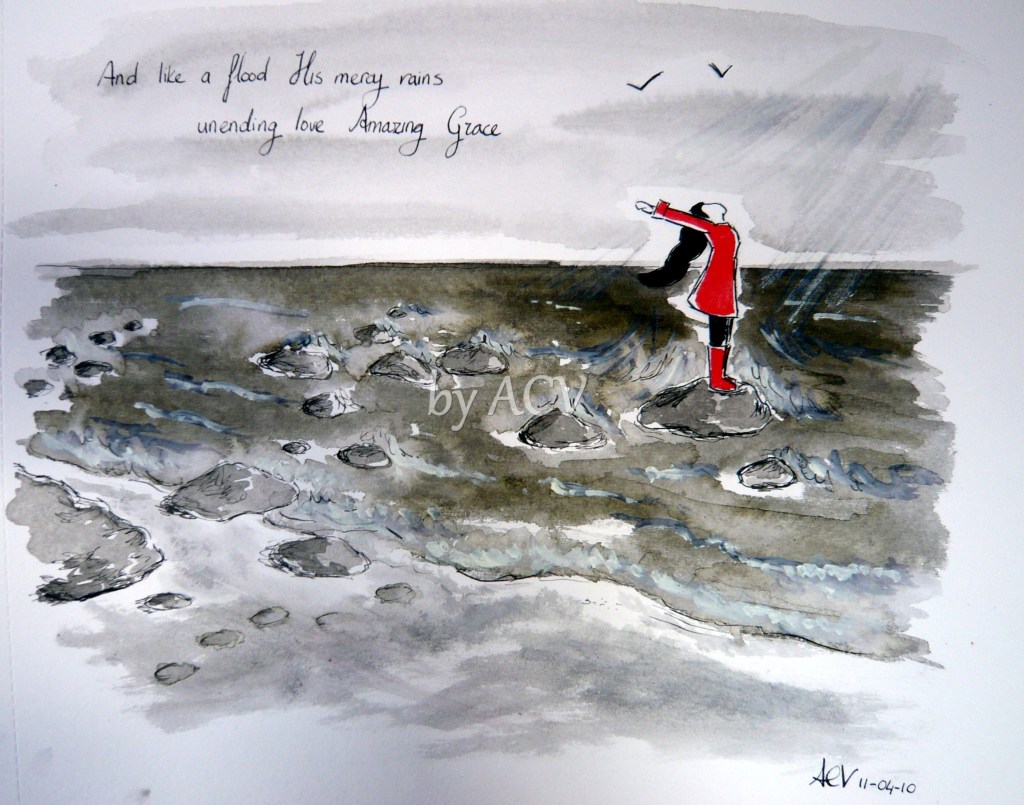
Once in a while, events in our lives send us simple but amazing reminders of just how merciful God is. Admittedly, we should be continually conscious of God’s mercy. However there are specific moments when situations, events, people, stories, testimonies, new-found knowledge can drive that consciousness into our very core.
As Christians, we know that God is rich in mercy (Ephesians 2:4) and because we are part of His works, His tender mercy rests on us (Psalm 145:9). A line from the Lord’s prayer says “Surely goodness and mercy shall follow me all the days of my life, and I shall dwell in the house of the LORD forever” (Psalm 23:6). Are you in a place where you are conscious of God’s mercy? Or are there situations you are facing, uncertainties surrounding your plans for the year ahead, or news pronouncements threatening your peace? Beloved, I want to reassure you of one constant: God’s mercy.
In this post, I would like to illustrate the truth of God’s mercy from the story of the flood. From time to time, as the Spirit leads, I hope to continue providing scriptural and perhaps personal examples of God’s mercy on my blog. Today’s example will begin with a question: What do you know about Methuselah?
Chances are you know that he is the oldest man that ever lived. Methuselah lived for 969 years, over 13 times the current life expectancy in our world today. You may possibly know that his father was Enoch (Genesis 5:21-27). Enoch was recorded as someone who walked “in close fellowship with God. Then one day he disappeared, because God took him” (verse 24). You might also know that he was Noah’s grandfather (verses 25-29).
My guess is, you are wondering what all this has to do with God’s mercy. Well, the connection came when I looked up the meaning of the name Methuselah. It is an interesting name, with some uncertainty around its actual meaning. However, some of the meanings I came across are “When he dies, judgement”, “When he dies, it shall be sent”, and other similar meanings that speak of pending judgement following Methuselah’s death. As I reflected on the meaning of his name, with the consciousness of how close his father walked with God, I realised that his name was actually prophetic. Not only was His name prophetic, the length of his life is an illustration of God’s merciful nature.
Why? In Genesis 6:5-6 (NLT) we read that, “The Lord observed the extent of human wickedness on the earth, and He saw that everything they thought or imagined was consistently and totally evil. So the Lord was sorry He had ever made them and put them on the earth. It broke His heart.” In other words, God was sorrowful and heartbroken at what humans had turned His beautiful world into. Verse 7 goes on to say that He decided to wipe away the human race. God wanted to wash away the filth that man had caused over time. It is worth noting though that the evil, corruption, wickedness on earth had been going on for a long, long time.
Another interesting record, thanks to a bit of Maths, is that the year Methuselah died was the year of the flood. Methuselah was 187 years when he became the father of Lamech. Lamech was 182 years when he became the father of Noah. Noah was 600 years when the flood happened. 187 + 182 + 600 = 969, which was Methuselah’s age when he died (Genesis 5: 25, 27, 28; Genesis 7:11). Following his death, the prophecy of His name came to pass. It is fascinating to realise that God possibly revealed this to Enoch when Enoch had his son, Methuselah. A whole 969 years before it actually happened.
This also means that God waited and waited and waited. 1 Peter 3:20 (CEV) says, “They had disobeyed God while Noah was building the boat, but God had been patient with them.” The Amplified Bible notes that God was waiting with ‘great patience’. This really brings to mind the verse, 2 Peter 3:9 (NLT), “The Lord isn’t really being slow about His promise, as some people think. No, He is being patient for your sake. He does not want anyone to be destroyed, but wants everyone to repent.” The length of Methuselah’s life, the longest ever recorded, is indeed factual evidence of God’s rich mercy – the kind of mercy that causes Him to put up with humans, to give us chance after chance after chance, and to exhibit great patience in His dealings with us. God waited so long that a man ended up living longer than anyone else had ever done.
Eventually, God did destroy everything in the flood, except the ark and those in it. A video from The Bible Project makes a very important point, that the flood was not necessarily a sign of God’s anger as some mistakenly believe. It was as a result of His sadness and grief at the state of the world, and His passion to preserve the goodness of the world He created. However, even after the flood, God made a promise to himself, saying “I will never again curse the ground because of the human race, even though everything they think or imagine is bent toward evil from childhood. I will never again destroy all living things. As long as the earth remains, there will be planting and harvest, cold and heat, summer and winter, day and night.” (Genesis 8:21b-22, NLT). He made this promise despite knowing human’s tendency towards evil, but He also made it with a plan in mind, a plan to send His own Son to save humankind (John 3:16). We also note that shortly after the flood, God blessed Noah and his sons (Genesis 9). And in verses 12-17, we read that God placed a rainbow in the clouds as a sign of the eternal covenant between Him and every living creature on Earth.
What a truly beautiful picture of God’s mercy! There is so much to learn from this, but I want to draw out seven key lessons:
1) God is merciful.
2) God is patient, not slow.
3) If we walk closely with God, we open ourselves up to receiving divine insight into His plans.
4) God fulfils His prophecies, and He will do everything to make them come to pass, even if it means making someone live beyond a normal human lifespan.
5) This therefore means that we can trust God, because as Matthew 5:18 (NLT) notes, “Until heaven and earth disappear, not even the smallest detail of God’s law will disappear until its purpose is achieved.” See also Joshua 21:45, Ezekiel 12:28, Philippians 1:6.
6) We are called to emulate God in showing others mercy and patience. Matthew 5:7 reminds us that God will bless the merciful with mercy. Furthermore, Matthew 7 tells us that the blessing of mercy is measure for measure. In other words, the more mercy we show, the more mercy we will receive. Primarily from God, but also from people. We also learn from God that part of showing mercy involves being patient with people. May God help us to emulate Him in this regard.
7) Even in the seemingly little details of the Bible, there are many lessons to be learnt!
I pray that as we reflect on this, we will start and continue this year and every day of our lives with the consciousness that God’s mercy dwells in us, surrounds us and follows us. I pray that the consciousness of God’s mercy will not make us think we can continue in sin, but instead it will spur us to be people who showcase His mercy to those around us. I pray that even during those dark moments when we feel like we have failed God, the bright light of His mercy will shine through and destroy the darkness. May we bask in God’s rich, lavish, never-ending, new-every-morning mercy today, tomorrow and every day! Amen.
Image source here.

 LivLearns.Life

Leave a comment