“Birds sing not because they have answers, but because they have songs.”
I came across this proverb a while ago. As I thought about it, it made me reflect on the reason(s) why we sing, on why singing is important, and why we should do it more often.
Miguel de Cervantes notes that “he who sings scares away his woes.” While that is a good enough reason to sing, there is an even better one: The Bible exhorts us to. Singing to God is such a powerful expression of worship. While it is not the only expression of worship, it is a very important one. The Bible is full of verses and passages urging us to sing. Especially the Psalms, which is unsurprising given that King David, who authored many of the Psalms, was also a musician.
Psalm 105:1-2 (ESV) implores, “Oh give thanks to the LORD; call upon his name; make known his deeds among the peoples! Sing to him, sing praises to him; tell of all his wondrous works!”
Psalm 98:1 (NLT) tells us to “Sing a new song to the LORD, for he has done wonderful deeds. His right hand has won a mighty victory; His holy arm has shown His saving power!”
Psalm 96:1-2 (NLT) exhorts us to “Sing a new song to the Lord! Let the whole earth sing to the Lord! Sing to the Lord; Praise His Name. Each day proclaim the good news that He saves.”
Isaiah 12:5 (BSB) says “Sing to the LORD, for He has done glorious things. Let this be known in all the earth.”
Indeed, there are moments when we may want to go all out, dancing, singing with the loudest of voices, rejoicing. Imagine the joy that a long awaited answer to prayer or an unexpected pleasant surprise can bring. Such moments can prompt us to burst forth into singing, to celebrate and be merry.
It is truly a thing of joy to celebrate God’s glorious works. In doing so though, Ephesians 5:18-19 (NLT) exhorts us to not “be drunk with wine, because that will ruin your life. Instead, be filled with the Holy Spirit, singing psalms and hymns and spiritual songs among yourselves, and making music to the Lord in your hearts.” This verse encourages us to celebrate not merely by drinking wine in excess, but by singing to God. While the verse talks about wine, this can also include other things we may be inclined to do in excess when celebrating – eating, partying, drinking, shopping, you name it. A key word here is ‘excess’, and a key point made is that singing to God is a far better way to celebrate.
However, all this may apply to times when we do feel like celebrating. What about the times when we don’t feel that way? When songs seem to be stuck in our throats? When we don’t feel like God is showing His right hand or holy arm or glorious works in our lives just yet? The times of suffering when “the cheerful sound of tambourines is stilled; the happy cries of celebration are heard no more; the melodious chords of the harp are silent”? (Isaiah 24:8, NLT).
What do we do then? Hebrews 13:15 (ESV) encourages us to, through Jesus, “continually offer up a sacrifice of praise to God, that is, the fruit of lips that acknowledge His name.” This is a vital reminder that sometimes praising God will be a sacrifice. In other words, it may not be something that we will naturally want to do, but that is not a sufficient reason why we should not do it.
In Psalm 42:4-5 (NLT), the Psalmist writes, “My heart is breaking as I remember how it used to be: I walked among the crowds of worshipers, leading a great procession to the house of God, singing for joy and giving thanks amid the sound of a great celebration! Why am I discouraged? Why is my heart so sad? I will put my hope in God! I will praise Him again— my Savior and my God.” The Psalmist recalled the good times, acknowledged his sadness, but even in the midst of that sadness and discouragement, resolved to praise and hope in God again.
Psalm 13 echoes a similar sentiment as well. At the start of the Psalm, David laments that God has forgotten him, but then he ends with the words, “But I trust in your unfailing love. I will rejoice because you have rescued me. I will sing to the Lord because He is good to me.”
As I think about reasons why we should sing, a popular hymn comes to mind: “I sing because I’m happy, I sing because I’m free; For His eye is on the sparrow, and I know He watches over me.”*
Even though we may not always feel happy, as Christians we know for certain that the other two things are true. We are free indeed (John 8:36), and God watches over us (Matthew 10:29-31, Psalm 121:4-5). The question is this, is our knowledge of the freedom and salvation Christ’s sacrifice wrought for us enough to make us sing, even in the difficult and painful seasons of life? Is knowing that we have a loving Father who watches over us enough to make us burst forth into song?
A Swedish proverb says that “those who wish to sing always find a song.” If we have a desire in our heart to please Our Father in Heaven, then is it possible that no matter what happens, we can find a song?
When David was in the wilderness of Judah, he wrote Psalm 63, where he talks about searching for God. He says “My soul thirsts for you; my whole body longs for you, in this parched and weary land where there is no water” (v. 1b). Then he goes on to say in verses 2-5 (NLT), “I have seen you in your sanctuary and gazed upon your power and glory. Your unfailing love is better than life itself; how I praise you! I will praise you as long as I live, lifting up my hands to you in prayer. You satisfy me more than the richest feast. I will praise you with songs of joy.”
This Psalm captures David’s longing for God, and his realisation that God is more than enough to satisfy him. This is a crucial moment of awakening, one that we all need to arrive at as Christians. That posture where we can rejoice in God Himself, in who He is, in His very existence, rather than merely waiting for God’s rewards before we do so.
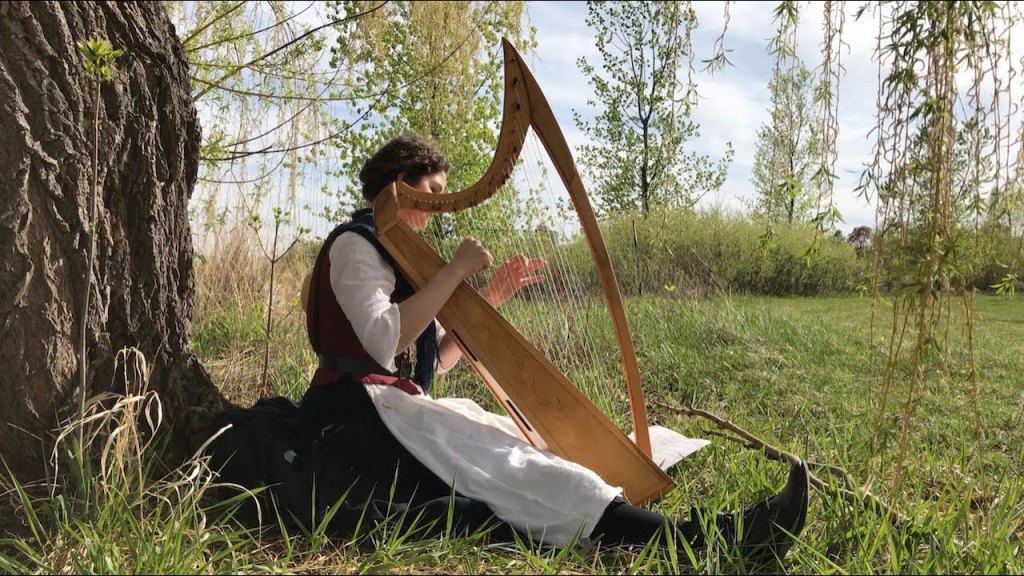
In Psalm 137, the Israelites did not want to sing the Lord’s song in a strange land, so they wept instead, and hung their harps on the willows, or poplars, beside them. Reading commentaries about this passage suggests that they did not want to sing God’s songs in a strange land because of the reason why their captors, or tormentors, wanted them to sing. Their captors wanted to mock them, they wanted to use God’s songs as a source of entertainment, because those songs would have been a novelty, something unusual for the Babylonians. Their captors could have also used those songs as a reason for ridicule. Picture the Babylonians mocking them and asking, why is this great God of yours allowing you to suffer captivity?
Do we feel that way sometimes? That our situations mock the songs of praise and worship we sing to God? Maybe that also makes us want to hang our harps on willows and instead wallow in self-pity.
What I find interesting though is how large harps can be, and how flimsy willow tree branches are. Yet this is the image that is presented to us. In a sense, thinking about this image helps me realise that sometimes, my excuses for not worshipping God, for hanging up my harp, are flimsier than willow tree branches. Like the weak branches of willow trees, they are not strong enough to hold my worship. Also, I really do not want to hinge my worship of God on things that are here today and gone tomorrow. As such, I need to pick up my harp again and sing songs of worship to God.
During Jesus’ Triumphant Entry into Jerusalem, “when He reached the place where the road started down the Mount of Olives, all of his followers began to shout and sing as they walked along, praising God for all the wonderful miracles they had seen. “Blessings on the King who comes in the name of the Lord! Peace in heaven, and glory in highest heaven!” But some of the Pharisees among the crowd said, “Teacher, rebuke your followers for saying things like that!”He replied, “If they kept quiet, the stones along the road would burst into cheers!”” (Luke 19:37-40, NLT). In a way, this passage shows the importance of singing praises to God, so much so that silencing the people meant the stones would have to do it instead.
Can you imagine rough, jagged stones praising God? Yet God will be willing to accept that praise. In a way, this illustrates to us that we do not have to have the perfect pitch and our voices do not have to be silky smooth either. We just have to have a heart of worship. As Henry van Dyke notes, “the woods would be quiet if no bird sang but the one that sang best.” And as I read somewhere, “just because I can’t sing doesn’t mean I won’t sing.” If you have a voice, sing out, and if you don’t, sing in your heart. But by all means, sing!
Even as we sing though, may we continually remember that both our hearts and lips need to be aligned in honouring God (Isaiah 29:13, Matthew 15:18). God requires us to not only sing with our lips but with our actions, through living a lifestyle characterised by righteousness and justice (Amos 5:23-24). For that is what makes our singing truly melodious to Him, like a harmonious orchestra.
One of the most beautiful things about the act of singing is that we are not the only ones in on it. God sings over us too! Zephaniah 3:17 (BSB) says “The LORD your God is among you; He is mighty to save. He will rejoice over you with gladness; He will quiet you with His love; He will rejoice over you with singing.” God rejoices over you, His precious child, with singing. How heartening is that!
I pray that as we reflect on this, we will never forget that as long as we know God, we have a reason to sing. May we continuously remember that having God as our Father, a Father who loves us, who watches over us, who sacrificed His only Son for us, is more than enough reason to consistently and faithfully sing for joy!
* His Eye is on the Sparrow by Civilla D. Martin

 LivLearns.Life

Leave a comment