
Can the Word of God be ineffective?
Is it possible for the extremely powerful substance to be rendered completely futile? For the most powerful substance on earth to be accorded the usefulness of a chocolate teapot? Hebrews 4:12 states that “the word of God is living and active. Sharper than any double-edged sword, it pierces even to dividing soul and spirit, joints and marrow. It judges the thoughts and intentions of the heart” (BSB). Surely nothing can immobilise it?
Picture yourself watching a movie where a powerful bomb is due to go off, one which could destroy an entire city. Cue the frenzied race to disable the bomb in time. Who will say ‘mission accomplished’ at the end – the protagonist or the bomber? The suspense pushes you to the edge of your seat. Then with just three seconds to spare, the protagonist gets to the bomb, disables it and saves the day… Voila! A powerful bomb which took hours to build, expertly designed for significant impact, becomes a mere relic, perhaps moved to some war museum to be admired from afar.
Okay, so that’s a movie, but surely this can’t happen with the word of God? Alas, the Bible says it can. In this post, I’ll write about three things that can cause this ineffectiveness: the soil/heart, traditions, and reasonings.
The Soil i.e. The Heart
In Luke 8, Jesus was telling the Parable of the Sower to illustrate why the seed, the Word of God, could be made ineffective or unfruitful in someone’s life. In verse 6, Jesus said, “Other seed fell among rocks. It began to grow, but the plant soon wilted and died for lack of moisture.” Jesus tells us that the Word of God can wilt and die, i.e. it can be completely unfruitful in someone’s life due to lack of moisture in the rocky soil. He further explains this in verse 13, “The seeds on the rocky soil represent those who hear the message and receive it with joy. But since they don’t have deep roots, they believe for a while, then they fall away when they face temptation” (NLT).
The problem was not that they did not hear the word. They did, as in they even received it with joy. They probably shouted ‘Hallelujah! Preach on Pastor! Word! Rhema! Deep! Glory!’ In fact, the word began to grow. But what was missing? Moisture. What does moisture represent? Water. Something that is moist has had contact with water or something with water in it. Interestingly, the Bible uses water to symbolise the new birth by the Holy Spirit. This is also the symbol baptism aims to represent. In John 3:5 (ESV), Jesus’ response to a question about the obvious presence of God in His life, as evidenced by the signs he performed was this: “Truly, truly, I say to you, unless one is born of water and the Spirit, he cannot enter the kingdom of God.” In Isaiah 44:3-4, God says, “For I will pour water upon him that is thirsty, and floods upon the dry ground: I will pour my spirit upon thy seed, and my blessing upon thine offspring: And they shall spring up as among the grass, as willows by the water courses.”
Water purifies. There is a particular busy road I use. Unfortunately the air there is polluted by lots of traffic. However, just after rain has fallen, the difference in the air quality there is remarkable…it feels so fresh and clean. That is the difference water can make. Clean, pure hearts. In Ezekiel 36:25-27, God says, “Then I will sprinkle clean water on you, and you will be clean. Your filth will be washed away, and you will no longer worship idols. And I will give you a new heart, and I will put a new spirit in you. I will take out your stony, stubborn heart and give you a tender, responsive heart. And I will put my Spirit in you so that you will follow my decrees and be careful to obey my regulations.”
What this means is that just as you don’t put new wine into old wineskins (Mark 2:22), God does not just merely fix our depraved hearts, He has to give us new ones. Otherwise, no matter how much seed is poured into those hearts, i.e. no matter how much of the Word of God those hearts read or hear, it will be completely useless. Our hearts therefore have to be renewed, rock has to be replaced with malleable soil, soil that can absorb water, rivers of living water. Jesus said in John 7: 37-39, “On the last and greatest day of the feast, Jesus stood up and called out in a loud voice, “If anyone is thirsty, let him come to Me and drink. Whoever believes in Me, as the Scripture has said: ‘Streams of living water will flow from within him.’” He was speaking about the Spirit, whom those who believed in Him were later to receive. For the Spirit had not yet been given, because Jesus had not yet been glorified.” Thankfully the Holy Spirit has now been given. Without the work of the Holy Spirit, the Word of God cannot be fruitful in our lives. We can read it, hear it, speak it even, but if the Holy Spirit is not moistening it, there is no point. We need the Spirit to confirm the Word (Jesus) with His testimony (1 John 5:6). Thankfully receiving the Holy Spirit simply requires asking and faith (Luke 11:9-13).
Traditions:
In Mark 7, Jesus talks about how the Pharisees “skilfully sidestep God’s law in order to hold on to their tradition” (v. 9, NLT) Then in verse 13, He actually goes on to tell them this: You are “making the word of God of no effect through your tradition which you have handed down. And many such things you do (NKJV).” The NLT says these traditions “cancel the word of God”. Isn’t it sad that when Jesus healed a woman who had suffered with a bent back for eighteen years, instead of joining her to praise God, the synagogue leader was angry that her healing had taken place on the Sabbath day (Luke 13:10-17). Are there traditions which we are holding on to so dearly, things we do because “this is the way we have always done it”, that are rendering God’s word ineffective in our lives? The way we have always done it may be an ‘old wineskin’ and we may need new ones. If unsure, we can pray the daring prayer in Psalm 139:23 – 24, “Search me God, and know my heart, try me… see if there be any grievous way in me, and lead me in the way everlasting!”
I should add that this does not mean that we throw away all our traditions, as some serve valuable purposes. What it means is that we do not allow traditions to limit how God chooses to move in our lives and ministries. It also means that we take the time to prayerfully review our traditions. Was there a reason why that tradition was put in place that is no longer applicable? Are we perhaps focusing on the letter, which kills, rather than the Spirit, which gives life? (2 Corinthians 3:6). It’s really fascinating how great moves of the Spirit sometimes happen when we don’t confine ourselves to our strict formulas – whether that be time spent in church, or in our private prayer, worship, study of God’s word. The 2023 Asbury revival started when a group of students stayed on after a scheduled service to continue praying and worshipping. May we not limit God with our traditions. There’s a children’s song which serves as a helpful reminder for me: “Don’t put God in a box, don’t shove Him in a corner, don’t you limit what He can do.” 2 Corinthians 3:17 states, “Now the Lord is the Spirit, and where the Spirit of the Lord is, there is freedom.” May we be set free from ineffective, limiting traditions, and instead replace them with the powerful and truly effective Word of God.
Reasonings that exalt themselves:
Have you ever tried to humanly explain some of God’s actions in the Bible? Telling Gideon to reduce the number of soldiers in his army to 300 men, against an army with thousands of soldiers? (Judges 7); Instructing the Israelites to walk round the walls of Jericho 7 times? (Joshua 6); Telling Jehoshaphat that the singers/musicians should go ahead of the army during a war? (2 Chronicles 20:21-23); Asking Abraham to sacrifice his son to test his faith? (Genesis 22); Sacrificing His own Son, His only begotten Son, for our sins? (John 3:16); Jesus using a mixture of spit and mud to heal a blind man? (John 9:6). Sometimes trying to rationalise the Word of God with our limited human understanding is like the average three year old trying to rationalise a quadratic equation. You know the old Maths joke below 🙂 –
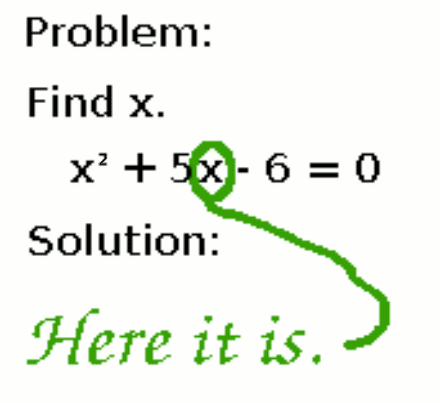
It is not that God is not rational, far from it. He is rational and perfect in all His ways, a God of order (Psalm 18:30; 1 Corinthians 14:33). In a world that doesn’t make sense, God makes perfect sense. The problem is the instrument we use to measure rationality. It is like using a 15cm pocket ruler to measure the depth of the ocean. Except that in our pride, we think that our pocket ruler is a sophisticated instrument. 2 Corinthians 10:5 (AMP) “We are destroying sophisticated arguments and every exalted and proud thing that sets itself up against the [true] knowledge of God, and we are taking every thought and purpose captive to the obedience of Christ.” The Aramaic Bible says “And we pull down reasonings and every high thing that is exalted against the knowledge of God.” The GWT calls such reasonings “intellectual arrogance.”
For instance, some ‘sophisticated arguments’ posit that certain miracles are not possible because medical science says so, when the Bible clearly says that nothing is impossible with God. People doubt the virgin birth, because it seems incomprehensible. Interestingly with advances in medical science such as IVF, virgin births can now happen. God got there first, but people doubted the possibility for years, because how can a small mind comprehend a great God?
On a more personal level, we can construct grand theories in our minds, exalting them so much that they become walls which block us from truly knowing God and what He is like. We try to use human wisdom to interpret and preach the gospel, and it may sound nice, but it is empty of power. Of what use is a beautiful, gold-plated, diamond-engraved, empty bottle to a thirsty man in the desert? Paul writes about this in detail in 1 Corinthians 1:17-31, noting that Jesus sent him to preach the gospel, not with wisdom and eloquence, lest the cross of Christ lose its power (v. 17). As such, it is possible to preach the gospel in a way that empties Christ’s cross of its power and renders it ineffective. Remember though that God makes the wisdom of this world foolish (v. 20), and that the “foolishness of God is wiser than men” (v.25). “But God hath chosen the foolish things of the world to confound the wise; and God hath chosen the weak things of the world to confound the things which are mighty (v.27). God says that He takes “human wisdom and turns it into nonsense” (Isaiah 44:25, CEV).
It also means that we approach God’s word like children, not like intellectuals primed for argument. Jesus did not get along with the teachers of religious law, not because of their questioning nature, but because they assumed they already knew the answers, and usually just wanted to prove themselves right or trap him. Children usually have guileless, teachable hearts, with more questions than answers! “At that same time Jesus was filled with the joy of the Holy Spirit, and He said, “O Father, Lord of Heaven and Earth, thank you for hiding these things from those who think themselves wise and clever, and for revealing them to the childlike. Yes, Father, it pleased you to do it this way.” – Luke 10:21 (NLT).
This is one reason why James 1:19 tells us to be “quick to listen, slow to speak and slow to wrath”. Our flesh is like a 100-meter sprinter. Once the starter pistol goes off, it jumps out of the block to respond with a sophisticated argument in order to win and be deemed wise. There is a problem with this ‘off the block’ approach though. In a rash state, do we pause to listen to the Holy Spirit, or do we rely on what we already know, on human wisdom? Romans 8:6-8 (DRA) tells us that “the wisdom of the flesh is death; but the wisdom of the spirit is life and peace. Because the wisdom of the flesh is an enemy to God; for it is not subject to the law of God, neither can it be. And they who are in the flesh, cannot please God.”
We cannot know who God truly is from a fleshly perspective (Matthew 16:17). As Dane Ortlund notes, “The Christian life, from one angle, is the long journey of letting our natural assumption about who God is, over many decades, fall away, being slowly replaced with God’s own insistence on who He is.” However this can only happen through the Spirit of God (1 Corinthians 2:10-11). We therefore need to “set our sights on the realities of Heaven”, to set our minds on heavenly things and not earthly things (Colossians 3:1-2, NLT). When we pray in the Spirit, we start to move from our earthly perspectives to heavenly ones. This is a practice that we need to intentionally and consistently devote ourselves to (Acts 2:42, Deuteronomy 17:18-19). Because it won’t come naturally to our flesh at all (Galatians 5:17). Doing this allows Jesus to become more important, while we become less important (John 3:30, CEV). Personally, I am trying to consciously practice pausing to pray before I say or do anything. Honestly, it is not easy to unlearn my innate way of giving a quick response, and I sometimes forget. However, I am encouraged by the knowledge that I may not be where I want to be yet, but by God’s grace, I am not where I used to be either. I’m getting there one step at a time.
I pray that as we reflect on this, the Word of God won’t be a mere blunt instrument in our lives, dulled by a stony heart, traditions or reasonings. May these things not choke the Word of God in our lives. Instead may God’s Word function in us as it was designed to – quick, sharp, alive, piercing, powerful. I pray that we maintain childlike trust in its immense life-giving, transformative power, even when tempted to doubt its efficacy. Curious about, yet confident in God’s word. May we have the humility to acknowledge our weaknesses, coupled with boldness to ask God for divine wisdom, grace and strength to overcome them. I pray that we learn to trust God’s Spirit more and more and our flesh less and less. And, as Habakkuk prophesied, may we experience the mighty revelation of knowledge of the glory of the LORD, as the waters cover the sea.
Image 1 source here.
Image 2 source here.


 LivLearns.Life

Leave a comment