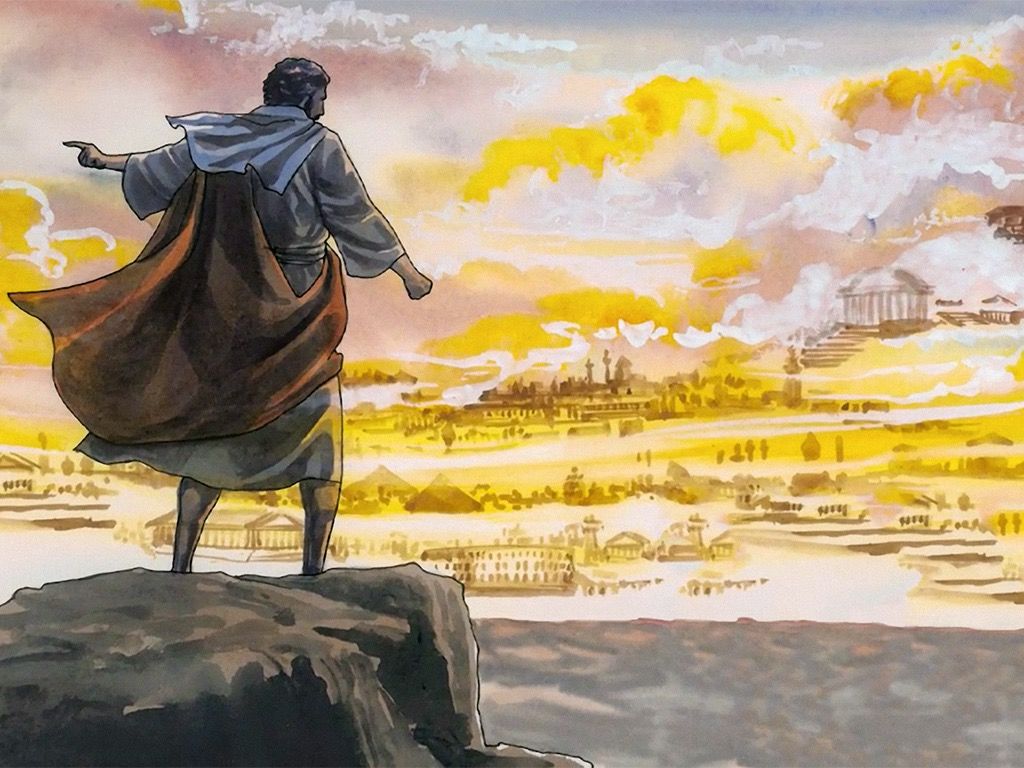
With all the furore around the elections in Nigeria, I’ve been reflecting on Jesus’ time on Earth as a man, and how he responded to civil unrest and the politics of His time.
The Jews were under Roman rule and they expected that the Messiah would deliver them from oppressive rulers. This was not an unnatural expectation, given that there are various verses that talk about a day of vengeance. One of them is Isaiah 61:1-2 (KJV), “The Spirit of the Lord God is upon me; because the Lord hath anointed me to preach good tidings unto the meek; he hath sent me to bind up the broken-hearted, to proclaim liberty to the captives, and the opening of the prison to them that are bound; To proclaim the acceptable year of the Lord, and the day of vengeance of our God; to comfort all that mourn.” Jesus Himself read this scripture as recorded in Luke 4:16-22. At the time, there were various ‘political parties’ in existence. Not unlike today, they interpreted the scriptures differently. The Zealots were one such party. According to Britannica, “The Zealots were an aggressive political party whose concern for the national and religious life of the Jewish people led them to despise even Jews who sought peace and conciliation with the Roman authorities.” They were the revolutionaries. They even physically trained for warfare, in preparation for the coming of the Messiah.
Other parties were The Pharisees, The Sadducees, The Essenes, The Herodians. On paper, The Pharisees and The Sadducees would have seemed like the most logical parties for Jesus to include in His team of disciples. Yet they were the ones He clashed with the most (Matthew 23, Mark 8:11, Mark 12, Luke 11:37-54, Luke 20). Interestingly, when Jesus chose the twelve disciples, He chose Simon, who was a Zealot (not to be confused with Simon Peter), and Matthew, who collected tax for Rome. One strongly against the Roman empire, one for the Roman empire, helping them in the area of finances. That’s like having a far left person and a far right person in your team. Tensions anyone? Personally though, I think it showed that Jesus calling of His disciples was not an endorsement of, or agreement with their political views. His focus was on the person. (I should add that not all Pharisees clashed with Jesus. Nicodemus was a Pharisee and he had an open mind, a willingness to learn more about Jesus. This openness led to his discussion with Jesus as documented in John 3, a discussion which resulted in one of the most famous Bible verses, John 3:16. He also spoke up against the Pharisees plan to convict Jesus illegally (John 7:50-52, NLT) and contributed to Jesus’ burial (John 19: 38-40).)
It is intriguing therefore that Jesus did not primarily focus on what people assumed were the ‘big issues’ such as the injustices against the Jews at the time and the poverty (not helped by high taxes from Romans). He did not overthrow human political systems like the Zealots expected. In summary, people had been continuously anticipating this Messiah that would come to take all their suffering away, especially the suffering caused by foreign rule. They were waiting for a Messiah that would avenge them and punish their oppressors. Today’s equivalent would be expecting Jesus to be the anointed and clear election winner. The One who will automatically transform a nation, making life better for everyone, while also imprisoning previous oppressors for life.
However Jesus did not act like people expected. Instead He focused on people, on relationships, on changing hearts, on healing people. His emphasis on people rather than political allegiance can be seen from scriptures. One example being that He granted a Roman officer’s request for his young child’s healing and proceeded to commend the officer for His faith (Matthew 8:5-13)! Remember that the Romans were not exactly the Jews’ favourite people. Why did Jesus act differently? As John 18:36 notes, “Jesus answered, “My Kingdom is not an earthly kingdom. If it were, my followers would fight to keep me from being handed over to the Jewish leaders. But my Kingdom is not of this world.” In other words, there were bigger fish to fry. ‘Bigger issues’ that Jesus focused on: His Father’s Kingdom and His Father’s will (John 6:38), on Earth as it is in Heaven (Matthew 6:10). He knew the necessity of prioritising the eternal over the temporal. He knew that emphasising the temporal above the eternal would be like focusing on pain in one’s fingernail when the rest of the body is covered with infected wounds. He had a far better view of ‘the big picture’ than humans did.
Does that mean that we should just sit around on Earth, suffering and smiling while waiting for eternity? Not at all. Jesus gave people a taste of God’s kingdom here on Earth through ways such as healing and setting people free, bringing joy to many (Luke 9:11, Acts 10:38 and so many more). He provided people with both spiritual and physical food, but He knew that spiritual satisfaction was superior because it was eternal. Physical satisfaction on the other hand was temporal (Mark 6:30-44; John 4:14). He came to bring abundant life, life to the full (John 10:10).
Jesus knew and understood His Father’s will for Him. He knew His priorities and did not allow Himself get distracted by the temporary glory of world domination (Matthew 4:8-11). This did not stop Jesus from being incredibly politically savvy though. He respected authority, but was unafraid of it. He said render unto Caesar the things that are Caesar’s and to God the things that are God’s (Mark 12:14-17). Jesus and His family performed their civic duties – They went for Caesar’s census around His birth (Luke 2:1-5) and Jesus Himself paid taxes (Matthew 17:24-27). Yet when told to leave a place because Herod wanted to kill Him, He called Herod a fox (Luke 13:31-33). He did not preach against the government then, as oppressive for some as it may have been, instead He preached against hypocrisy from the Pharisees. Because it was a matter of the heart, and His focus was His Father’s will.
So many empires had tried and failed – Egypt, Assyria, Babylon, Greece, Rome. With the abundance of humanly wisdom at their disposal – philosophers, great army generals, architects and construction engineers, historians, various other learned and skilled people in high places – these empires still collapsed and were overthrown in the end. Sometimes we are so desperate for a Messiah that we look for one in the wrong place. We almost deify mere humans. We ask for what can destroy us and we don’t even know it, a problem as old as time (1 Samuel 8).
God knew that change has to come from the human heart, from God’s transformational work in a person’s heart. Then it flows to the outside. “He that believeth on me, as the scripture hath said, out of his belly shall flow rivers of living water” (John 7:38, KJV). Good leadership is vital, but sometimes we focus so much on the leaders and forget the role of the citizen. We forget that corruption doesn’t just happen at the top, but trickles into every area of life. Good leaders AND good citizens are needed to bring about the change we desire. I remember listening to a sermon once where the speaker said something along these lines, ‘we say we are good people and it is bad leadership that is our problem. Yet our leaders are not plucked from neighbouring countries, they are fellow countrypeople of the country of good people.’ Election riggers are also fellow countrypeople. One leader on their own cannot rig an election. It takes a whole chain of people. However, when someone repents and is truly living for God, they will not participate in corrupt activities. It is then that change begins.
Daniel is a classic example of someone who stood out for distinct living in the government of His day, and He wasn’t the emperor. In modern terms, he would be best described as a civil servant. He spent a lot of time praying and studying God’s Word and the words of the prophets. In doing so, he realised what needed to be done for God’s word to come to pass. “For I know the plans I have for you,” says the Lord. “They are plans for good and not for disaster, to give you a future and a hope. In those days when you pray, I will listen. If you look for me wholeheartedly, you will find me. I will be found by you,” says the Lord. “I will end your captivity and restore your fortunes. I will gather you out of the nations where I sent you and will bring you home again to your own land.” (Jeremiah 29:11-14: Daniel 9).
Many influential people in history that we still remember today were not rulers of nations. They may not necessarily have effected change from a throne in a palace, but from a chair in their corner of the world. The change may not have come from declarations made standing on a podium, but from time spent on their knees.
If we can spread and live out the message of God’s Kingdom with the zeal we use to campaign for our favoured political parties, we will have a far better nation. In the meantime, we can prayerfully perform our civic duties like Jesus did, while doing what God calls us to do. 2 Chronicles 7:14 (NLT) notes “Then if my people who are called by my name will humble themselves and pray and seek my face and turn from their wicked ways, I will hear from heaven and will forgive their sins and restore their land.” Isaiah 1:17 (ESV) tells us to “learn to do good; seek justice, correct oppression; bring justice to the fatherless, plead the widow’s cause.” Micah 6:8 (NKJV) notes “He has shown you, O man, what is good; And what does the LORD require of you But to do justly, To love mercy, And to walk humbly with your God?” We can continue to pray against the works of the evil one in our lives and in our nation, remembering that “the weapons we fight with are not the weapons of the world. On the contrary, they have divine power to demolish strongholds” (2 Corinthians 10:4, NIV). “For we wrestle not against flesh and blood, but against principalities, against powers, against the rulers of the darkness of this world, against spiritual wickedness in high places” (Ephesians 6:12, KJV).
As we go about our daily lives, may we be the kind of leaders we want. True representatives of the Kingdom of God, even in the face of pressure to be otherwise. At the end of the day, my prayer is for God’s will be done, in our lives and in our nations. As learnt from the coming of Jesus, God’s will may not mirror ours. To the human eye, it may not be what looks good on paper, but it will be infinitely superior, eclipsing anything humans could have ever envisioned.
Image source here.

 LivLearns.Life
Leave a comment