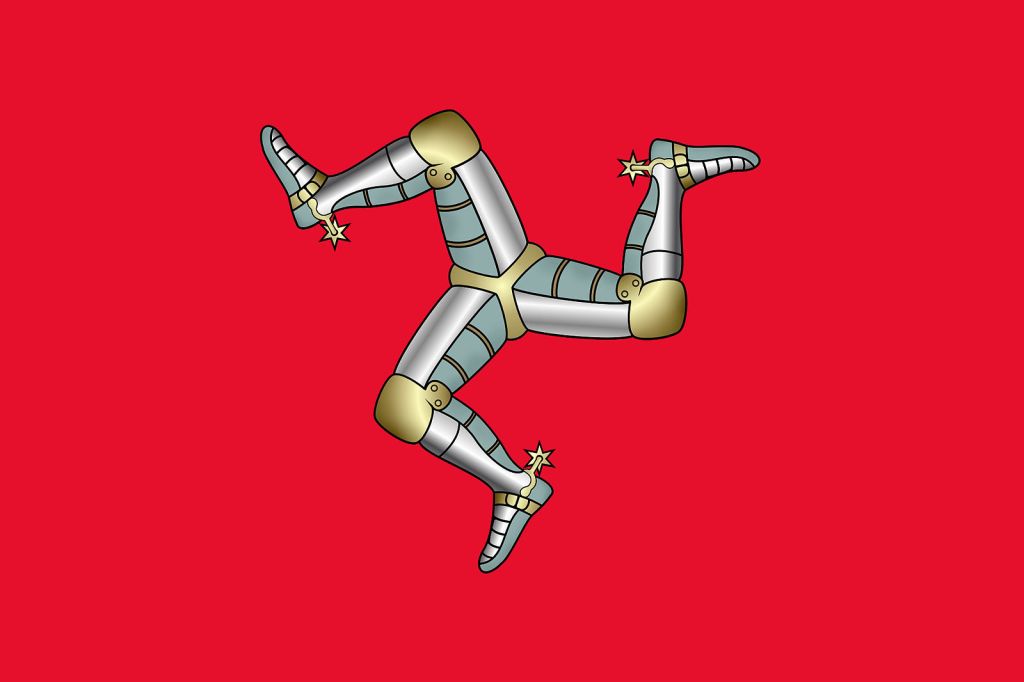
A while ago, my kids and I travelled to the Isle of Man, which is a lovely island in the Irish Sea nestled roughly in the middle of England, Ireland and Scotland. We enjoyed our time there, and one of the things that struck me about this self-governing British Crown dependency is its motto. In Latin, it is “Quocunque Jeceris Stabit”. The literal English translation is “whithersoever you throw it, it will stand”, but it is generally given as “’whichever way I am thrown I will stand”. Its flag (the image above) is a triskelion with three armoured legs to illustrate this. The more I reflected on it, the more I thought ‘What a brilliant motto!’ If I could summarise it in one word, it would be ‘resilience’.
Resilience is not a new or unfamiliar word for most people, it is “the capacity to recover quickly from difficulties”, or “the ability to withstand adversity and bounce back from difficult life events”. I prefer the latter definition, as recovery may not necessarily be quick, depending on the difficulty in question, and the context in which it happens. Although not new, it is a word I seem to hear more often these days given the world events in our day, particularly in the context of teaching children resilience, so that as they grow up, they are able to better handle life’s inevitable challenges. However, the thing is, though we want our kids to learn resilience, sometimes as parents we end up doing all we can to avoid them experiencing challenging and difficult situations which could incidentally serve to build their resilience.
We do this to protect our children, which is part of our role as parents. We naturally don’t want our kids to suffer because we love them. However, the issue is that if we do not let our children experience age-appropriate challenges, and let them have some input into how they handle such challenges, as well as give them room to make their own mistakes (within reasonable limits) and hopefully learn and bounce back from them, they are unlikely to learn and demonstrate resilience.
Alas resilience is one of those attributes where we are more likely to learn from actual experience than any classroom learning. Jumping in immediately to solve every problem for them limits what they can learn and their ability to build resilience. As such, our desire to help can sometimes be counterproductive. This does not mean we just let them suffer, or that there is no place for learning skills and tips for building resilience, because there is. It means that even when they suffer, we can be there with them as they navigate life’s challenges, reassuring them of our unconditional love, offering advice when needed/asked for, and riding the storm with them until they get to calmer seas.
Thinking about this in the context of God as my Father, and me as His child gives me a different perspective, and reminds me that there is usually a method to the ‘madness’, even though I may not see it.
Like most people, I have had my fair share of tough times. I am also aware that I am far from the only one going through or who has gone through challenging times and that there are others who may be in worse situations than I am. 1 Peter 5:9 (NLT) states “Stand firm against him, and be strong in your faith. Remember that your family of believers all over the world is going through the same kind of suffering you are.” However, I don’t necessarily like to compare troubles, and don’t always find it a particularly helpful coping mechanism. Nevertheless, that being said, there is some comfort that can be drawn from the fact that other people have gone through, or are going through similar challenges, and they have survived or are coping relatively well.
What does the Bible say about resilience? 2 Corinthians 4:8-9 is a story of resilience in itself: “We are pressed on every side by troubles, but we are not crushed. We are perplexed, but not driven to despair. We are hunted down, but never abandoned by God. We get knocked down, but we are not destroyed” (NLT). Or, as The Message puts it: “We’ve been surrounded and battered by troubles, but we’re not demoralized; we’re not sure what to do, but we know that God knows what to do; we’ve been spiritually terrorized, but God hasn’t left our side; we’ve been thrown down, but we haven’t broken.”
Proverbs 24:16 says “…For the righteous falls seven times and rises again, but the wicked stumble in times of calamity.” There are so many examples of people who suffered hard times and got back up, from Job to Jesus, and other popular Biblical examples including Ruth, David, Paul. I have learnt a couple of things regarding resilience from each of them, as well as others, and would like to share these.
It is okay to say how we feel. The Psalms and the books written by the prophets are full of expressions of emotions – pain, grief, anger, frustration, sadness, depression, weariness, hurt, you name it. As such, we don’t need to pretend or to bottle up emotions and hope they go away, meanwhile the fizz just keeps escaping from them until a final trigger causes the inevitable explosion. Talking to God, trusted friends, trusted members of our church family, trained counsellors can be a massive help. It is okay to acknowledge our feelings, to vocalise or write them down, to ride them out without repeatedly dwelling on them.
However, it is also important to recognise that in some cases (not always though), what we feel may not necessarily be based on reality, but on our worries. Or it may be the effect of going so far down a rabbit hole that we work ourselves into a state, so we can’t always go by our feelings. I recently read a very apt illustration where the author mentioned the experience of watching a horror movie. You might be very scared, and that fear might feel very real to you, to the point where even a car driving past your house or the sound of rustling leaves may make you jump, and yet it is not based on reality at all! That is why 1 Corinthians 5:7 says “for we walk by faith, not by sight”.
Having an action plan based on solid guidance can be very helpful in standing again and moving forward. Vocalising what we can potentially do if our worries and concerns become a reality can be a powerful way of dealing with such concerns and the accompanying anxiety. When we are tempted to go down rabbit holes, at each step, where possible, we can pause and say “and if this happens, this is what I can do”. If we feel there is nothing we can humanly do, as David says in Psalm 53:3, “What time I am afraid, I will trust in Thee.”
1 Samuel 30 tells the story of David arriving at Ziklag where he was living at the time, to find the Amalekites had burnt down his entire village and kidnapped the family members of David and his men – wives, sons, daughters. The men were so angry they even wanted to stone David. But verse 6 says “David found strength in the Lord his God”. Next he asked God what to do, and God gave him an action plan/battle strategy – Pursue and Overtake, which resulted in a successful recovery of everything the Amalekites had taken. A really key point here is David asking God what to do first and not just rushing ahead to do what he felt like. And what guidance can possibly be more solid than what God gives us? We won’t always be asked to launch a big attack (thankfully). Ruth for instance got advice from her Mother in law and followed it. As such, her story, which had started off in quite a depressing way, had a happy ending (you can find out the full story in the book of Ruth). Sometimes all we can do is take small steps towards whatever it is we need to do, especially when it feels overwhelming, even if that step is just getting out of bed.
God does not just stop at giving the guidance or battle strategy though. If we ask for help in implementing it, He will help us. And with God’s help, we can advance against a troop and scale a wall! (Psalm 18:29, though the entire Psalm is a powerful read). If we want to follow God’s battle strategy though, we need to first be equipped with His armour (Ephesians 6:13-18). As verse 13 says, “Therefore, put on every piece of God’s armour so you will be able to resist the enemy in the time of evil. Then after the battle you will still be standing firm.” (NLT)
A lot of times we focus on wanting to know why something has happened, and sometimes that is useful, as it can mean we learn and take steps to mitigate the likelihood of such an incident happening again. However, the truth is that sometimes things happen for which there are no apparent “whys”, and that can make such incidents really hard to swallow. It can also make it difficult for us to ‘stand again when we are thrown’. However we can take comfort in the fact that Jesus is WITH us, and that He intercedes for us (Matthew 28:20, Romans 8:34). As John Wimber said “the good news is that Jesus is praying for us. The bad news is that we are going to need it!”. Deuteronomy 31:8 reassures us that “The LORD Himself goes before you; He will be with you. He will never leave you nor forsake you. Do not be afraid or discouraged.” The afflictions of the righteous are many, but the LORD delivers us out of them ALL (Psalm 34:19).
This might be a simplistic illustration about understanding the why, but I hope it helps: When administering a vaccine, a baby will not understand why their parent will sit by and watch them being pierced with a sharp injection that causes them pain. As a parent it is hard to watch, but it can potentially be life-saving. However, it will be almost impossible for the parent to explain to the baby at that point in time. In the fullness of time though, as the baby grows, they will eventually understand. But right then, they just need to trust their parent. In the same vein, there are times when we really just need to trust God.
In addition to trust, hope and patience are key in standing again and taking steps forward. To attempt to get back up again, we need to have hope that we can stand when we try to get up, and be patient enough to keep trying and hoping even if we fall down again in the process. Hebrews 12:2-3 says “Let us fix our eyes on Jesus, the author and perfecter of our faith, who for the joy set before him endured the cross, scorning its shame, and sat down at the right hand of the throne of God. Consider him who endured such hostility from sinners, so that you will not grow weary and lose heart.” (BSB). Hope is such a powerful motivator to get back up again and keep going, the belief that one day “e go better”.
I hope to write a blog post on hope one day, but in the meantime, I will leave you with the popular quote, “as long as there is life, there is hope”. That hope may take a while to materialise though, and that is why we need patience. Patience is not merely passive waiting, but maintaining the right attitude while doing so, and actively acknowledging that there is a process involved in the journey to getting to where we want to be. As the fairy godmother in Cinderella says “even miracles take a little time”.
I pray that as we go through life and deal with all the challenges life throws at us, we will acknowledge our feelings, pray and trust God for a plan, patiently wait with hope, and above all, we will remember that Jesus is with us, surrounding us on every side. He is beside us on the floor when we don’t even want to ever get up again. He is there when tears flood our eyes and we think no one sees or cares. He has His arms stretched out to support us as we attempt to stand again. He will walk with us even when we walk through the valley of the shadow of death. For He has promised that He will never ever leave us nor forsake us.

 LivLearns.Life
Leave a comment