“Once upon a time, there lived a farmer and a baker. The farmer sold a pound of butter to the baker every day and the baker sold a pound of bread loaf to the farmer. Soon, they had a good bond and became friends.
One day, the baker somehow decided to weigh the butter to see if he was getting a pound. When he measured the butter, he found that he was not getting the right amount of butter from the farmer. This made him very angry and he decided to take the poor farmer to the court. The judge asked the farmer if he was using any measure to weigh the products. The farmer replied, “Your Honour, I am primitive! I do not have a proper measure but I do have a scale.” The judge asked, “Then how do you weigh the butter?”
The farmer replied, “Your Honour, long before the baker started buying butter from me, I have been buying a pound loaf of bread from him. Every day when the baker brings the bread, I put it on the scale and give him the same weight in butter.” If anyone is to be blamed, it is the baker.”*
This story simply but brilliantly illustrates the concept of measure for measure.
A recent discussion reminded me that I had planned to write a blog post on this topic last year. I had a conversation on the subject of mercy with someone, and the conversation led me to do a lot of thinking and some studying on the subject, which I thought would be worth sharing.
The premise is simple, if we want mercy, we need to show mercy to others. The mercy we get from God and others depends on how much mercy we show. If we are liberal when we dish mercy to others, we will find that the helpings of mercy we receive will be liberal as well. If our offerings of mercy are paltry, then when we are in need of mercy, we will be recipients of paltry servings. In summary, the simple concept of reaping what we sow also applies to mercy.
This post is based mainly on these scriptures:
“For in the same way you judge others, you will be judged, and with the measure you use, it will be measured to you.” – Matthew 7:2.
“Blessed are the merciful, for they will be shown mercy.” – Matthew 5:7 (NIV).
“With the merciful thou wilt show thyself merciful.” – Psalm 18:25
I have heard these scriptures so many times before, but for some reason, I saw them differently in the light of this topic.
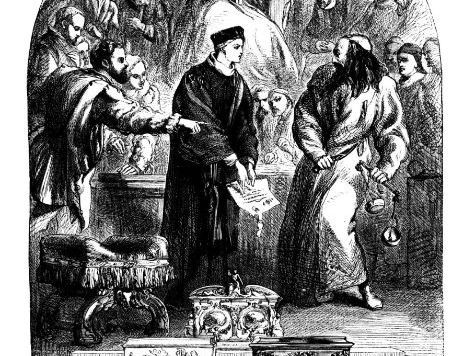
What is Mercy? Compassion shown to an offender, or someone you have the power to punish or harm. I’ve also heard people say mercy is when God doesn’t give us what we deserve. Jesus lists mercy as one of the weightier matters of the law (Matthew 23:23). In the Merchant of Venice, Portia says “The quality of mercy is not strained; It droppeth as the gentle rain from heaven, Upon the place beneath. It is twice blest; It blesseth him that gives and him that takes.”
This monologue strikes me for a number of reasons. Mercy is not strained, i.e. not forced. One cannot be forced to show mercy. The mercy giver has a choice regarding whether to show mercy or not. God also has that choice (“For I will have mercy on whom I will have mercy” – Exodus 33:19; Romans 9:15).
The monologue also alludes to the fact that mercy comes from Heaven. This is reassuring for me, as I know that it is not entirely by my power that I show mercy. God is merciful to us, and in so doing, He has given us the power to be merciful. According to Charles Spurgeon, “God’s mercy is so great that you may sooner drain the sea of its water, or deprive the sun of its light, or make space too narrow, than diminish the great mercy of God”. As such, even when an offence is great, and showing mercy is tough, I can tap from God’s overflowing wells of mercy.
I love the last line. It blesses both the giver of mercy and the one who receives it. Just as Matthew 5:7 promises. Mercy bears bountiful fruit, and as Abraham Lincoln said, “I have always found that mercy bears richer fruits than strict justice.”
By its very nature, mercy is not deserved. And to show mercy, we must have power to act in a given situation. An action is not really merciful if it is deserved.
Most of us may not have a problem with showing mercy to first offenders. But what happens when we keep showing someone mercy, and they keep abusing it and using us? Should we just continue to show mercy again and again?
This leads to the question most of us have: “Where do you draw the line?” One answer to that is to say ‘we can draw the line where we also want God to draw the line with us’. However, we are human, and it’s not always easy. We want to protect ourselves from continuous hurt, from the pain of having our hearts trampled on again and again.
I saw this quote recently, “Givers should learn to set limits, because takers don’t have any.” In a way, it makes sense, and I was inclined to agree with it initially. But on reflection, I wondered if I should let ‘takers’ or God define my limits. And when it comes to mercy, God is merciful, He is my Father, and I want to be more like Him each day. Luke 6:36 says “Be merciful, just as your Father is merciful.” Again, in practical terms, it is hard. I feel a bit like the disciples when they said in John 6:60, “This is a hard saying! Who can listen to it?”
How can we show mercy? Sometimes, it is obvious to us what mercy looks like. Forgiving someone who hurts us, letting go when we have the chance to revenge, doing a good deed to someone who we feel doesn’t ‘deserve’ it. However sometimes the greater act of mercy might not look like mercy in the now, and that is why it is so important to be guided by God, even in our acts of mercy. He is far more merciful than we are, and He knows what mercy looks like in every situation we are in.
But does showing mercy mean we won’t be angry at wrongdoing or that we should merely swallow our hurts? No. As a quote I came across recently states, “Indignation against evil is an essential element of goodness.” However, it is a different issue when we allow that indignation fester and become bitterness, especially against people who are ‘repeat offenders’.
So how can we act mercifully, especially against repeat offenders? How can we rise above the human instinct to shut our mercy tap when we feel it is being used and abused?
In Matthew 5:44, Jesus says “bless them that curse you, do good to them that hate you, and pray for them which despitefully use you, and persecute you”. So this is not just someone who uses you, that’s painful enough, but “despitefully uses you”. In other words, uses you with contempt, with disdain. Like someone using an elegant silk shirt as a rag, to clean oil and dirt. Wow.
Jesus knew there would be people like this in our lives. This is why he has given us a life hack for dealing with such people: pray for them, and bless them. The truth is, it is not just for the sake of the offender that we need to do this, but for our sake as well. It is hard to remain bitter at someone when you are blessing them. There is also something in this process of praying for and blessing such people that changes us, that transforms us and makes us more like Jesus, who literally died for people who spat on him and mocked him.
We can also view mercy as our gift to God. God says He desires mercy not sacrifice (Hosea 6:6, Matthew 9:13). He prefers and desires mercy far more than any sacrifice we can ever give Him. We know that this refers to mercy towards people, for God has done us no wrong that He should require us to show Him mercy. As humans, if someone wants to give us a gift, we would rather they give us something we prefer. So shouldn’t we do that for God? As such, the next time we feel like giving a sacrificial offering, but we are withholding mercy from someone, it may be worth giving the gift of mercy instead.
Personally, something that has helped me is to do my best to release people from any expectations at all when I show kindness or mercy to them. I see it as something done for God (Colossians 3:23). I’m human, and I don’t always get it right, but I try, and when I do so, it helps tremendously.
However, sometimes, relating with some certain people in our lives can lead us to become bitter, envious, or foster/harbour negative emotions or sins. This could be because of the way they treat us, their behaviour, actions, our circumstances etc. In such cases, it may be wise to limit contact for a season and work on ourselves, until we are at a point where we can move forward in that relationship without falling into sin, in a sense like a time out. As Matthew 5:29 says, “if your right eye causes you to sin, pluck it out and throw it away”.
However, the ‘why’ is so important here. God sees the heart, and knows our motives for doing what we do. Not talking to someone because of malice is different from the scenario above. One is merciful, the other is not. As such, it is useful to carry out a heart check-up, and ensure that we have a conscience void of offense. Acts 24:16 (ESV): “So I always take pains to have a clear conscience toward both God and man.” We know, and God knows the motives behind our actions, and God cannot be mocked or deceived.
I love this quote from Mason Cooley – “think carefully before asking for justice. Mercy might be safer.” And as Nelson Mandela said, “You will achieve more in this world through acts of mercy than you will through acts of retribution.” I pray that as we receive God’s never-ending mercy every day, repeat offenders that we are, we will also give God’s mercy every day. May we give as freely as we have received. May our acts of mercy not be constrained to those who we feel deserve it, for we ourselves are undeserving of the blessings and mercy God lavishes on us. I pray that we never forget how merciful God has been to us, and that we are not like clogged pipes – receiving but not transmitting onwards. May we be like clear, freely flowing pipe systems, receiving God’s mercy, allowing it wash over us and transform us, and letting it flow out to others in turn. As mercy is one of God’s gifts to us, may it, in turn, be one of our gifts to Him.
Image source here – Court Scene from Merchant of Venice (Act 4, Scene 1)
* Author unknown.

 LivLearns.Life
Leave a comment