
Some time ago, I was upset about something. I can’t even remember what it was now, but I was not smiling. My older son decided to take matters into his hands. He did not want to see me unhappy, so he held my cheeks with his tiny hands and pulled them upwards, to literally make me smile. Dubious methods aside, his action did make me smile.
But, it also made me think. About how we can sometimes focus on externals, and blatantly ignore internals. While I was thinking about writing this post a while ago, a suggested article appeared on a webpage I was visiting (interestingly, the webpage was not even related to this topic). The headline was “huge mansion being sold for £200k seems like an amazing bargain – until you see what’s inside”. I don’t usually click on such links, but this time curiosity got the better of me, and I decided to view the article. You can do so here. The first picture was of the outside of the mansion, and it looked huge and beautiful, and indeed like a bargain…until you kept scrolling and saw pictures of the inside. A toilet so dilapidated, even if you were so pressed that you were hopping around with one leg, any desire to relieve your self would probably evaporate fast once you saw the state of the toilet. The ceilings, walls and floors in the rooms were in various states of collapse. It was completely uninhabitable. Even rats would turn their noses up at living there. Yet you could not tell from the outside at all. It raises the question, if you had to choose one, which would you rather live in – a house that looks grand outside, but is in an awful state of disrepair, or one that looks shabby outside, but is in fantastic condition inside?
Jesus spoke about this unreservedly in Matthew 23. His use of very strong language when talking about hypocrites demonstrates how he felt about façades. Verses 25 – 28 (NLT) describe what God thinks about focusing on the outside, while the inside still leaves a lot to be desired. “What sorrow awaits you teachers of religious law and you Pharisees. Hypocrites! For you are so careful to clean the outside of the cup and the dish, but inside you are filthy—full of greed and self-indulgence! You blind Pharisee! First wash the inside of the cup and the dish, and then the outside will become clean, too. What sorrow awaits you teachers of religious law and you Pharisees. Hypocrites! For you are like whitewashed tombs—beautiful on the outside but filled on the inside with dead people’s bones and all sorts of impurity. Outwardly you look like righteous people, but inwardly your hearts are filled with hypocrisy and lawlessness.”
The Message Bible is a somewhat harsher more descriptive. “You’re hopeless, you religion scholars and Pharisees! Frauds! You burnish the surface of your cups and bowls so they sparkle in the sun, while the insides are maggoty with your greed and gluttony. Stupid Pharisee! Scour the insides, and then the gleaming surface will mean something. You’re hopeless, you religion scholars and Pharisees! Frauds! You’re like manicured grave plots, grass clipped and the flowers bright, but six feet down it’s all rotting bones and worm-eaten flesh. People look at you and think you’re saints, but beneath the skin you’re total frauds.” Ouch!
I aim to cover this topic using a two-pronged approach. One is for us to examine ourselves, to ensure that we are not like “whitewashed tombs”, which I will cover in this post. The other focuses on discernment – Sometimes when all we can see is the outside, especially when dealing with people we don’t know very well, what can we do? By God’s grace, this will be the subject of my next blog post.
First, examining ourselves. Most of us have heard this quote by Margaret Wolfe Hungerford “Beauty is in the eye of the beholder”. We normally quote that to imply that perception of beauty varies according to the observer. However, what if we blur out all the other “beholders”, and let our sharp focus be on God, ensuring that he is the main beholder that matters? How will that influence our standard of beauty? How will that influence how much time we spend on enhancing our beauty in ways that matter to God? This does not mean we should not care at all about our outward appearance. It is not inherently wrong to look good, or to want to look good. But, when that becomes our main focus, then maybe, just maybe, there might be a problem. If we are quick to look at physical mirrors and carry out some deep assessments, but not as quick to examine ourselves using the word of God, our spiritual mirror, we may need to step back and reflect.
This can also be reassuring though. In a world where there is so much pressure to defy the ageing process – with products to make the face, eyes, mouth, hands, feet, hair, tummy, etc., look younger – and the global anti-ageing market reaching a value of US$ 54.2 billion in 2019, 2 Corinthians 4:16 says “So we do not lose heart. Though our outer self is wasting away, our inner self is being renewed day by day.” This daily renewal means that our inner self doesn’t have age lines, wrinkles, or loose skin!
1 Peter 3:3-4 (CEV) talks more about what makes us really beautiful – “Don’t depend on things like fancy hairdos or gold jewellery or expensive clothes to make you look beautiful. Be beautiful in your heart by being gentle and quiet. This kind of beauty will last, and God considers it very special.” As the song by Nick Jackson goes “Shine from the inside out; That the world will see you live in me.” Like a glow worm, our glow should come from within! Proverbs 27:19 says “As in water face reflects face, so the heart of man reflects the man” (Proverbs 27:19).
There is a popular passage in a book by Roald Dahl that portrays this so well:
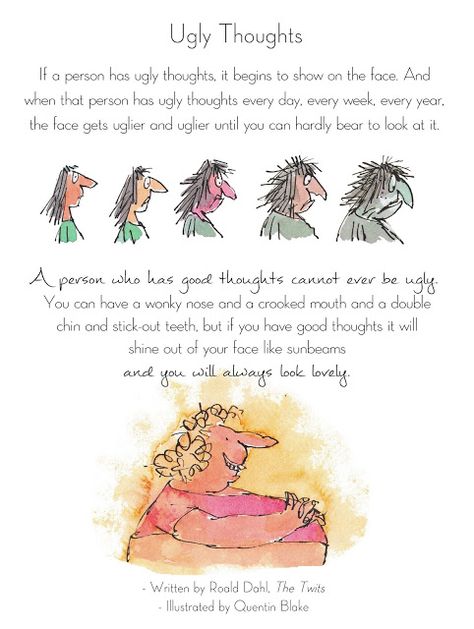
There truly is something very beautiful about a person whose heart is pure, who as we say, has a ‘heart of gold’. Outer beauty can attract others to us, but if it is not matched by inner beauty, those people leave just as quickly as they came. Shallow people may stay, but do we really want shallow people around us for long?
How can we get that inner beauty then? That glow, that radiance that comes from within? As Psalm 34:5 says, “Those who look to him are radiant, and their faces shall never be ashamed.” When our focus is on God, when we make Him the centre of our lives, He lights up our lives. It’s not even about the circumstances we find ourselves in anymore. His joy becomes our joy, and our strength (Nehemiah 8:10). When we trust and hope in Him, He gives us joy and peace (Romans 15:13). Psalm 94:19 (NIV) says “when anxiety was great within me, your consolation brought me joy.”
According to Proverbs 15:13 (BST), “When the heart rejoices, the countenance is cheerful; but when it is in sorrow, the countenance is sad.” If this is the case, then why do we try to solve our problems from the outside in? We can cover the weary lines on our faces and the bags under our eyes with make-up or fake smiles, but what happens to the weariness in our hearts? Does that also mean that if we are facing sorrowful situations, we will always be sad? Speaking from personal experience, I have gone through some challenging times, through the “refiner’s fire”, and I have found that it didn’t help to keep things bottled up or to ignore them, and I didn’t have to have a sad countenance all the time either. This did not, and does not mean telling the whole world about my problems, because that’s not something I would feel comfortable doing. What it meant for me was having a group of trusted people I could talk to, and I am blessed that I have such people in my life. Praying and talking with such people significantly helped lift my countenance, and because it was from the inside-out, I didn’t need to pretend. It was like an internal makeover. The challenges didn’t always go away, but I could genuinely say I was still joyful. I could smile and mean it, because my heart was also smiling, despite all. Like Habakkuk, I could, and can turn “cartwheels of joy to my Saviour God”, even though “the cherry trees don’t blossom, the strawberries don’t ripen, the apples are worm-eaten… the cattle barns are empty.” (Habakkuk 3:17-19, MSG).
There is also the question of ‘eye service’, doing things so that others can see just how good we are, or doing things to please others. And without discernment, others may indeed be taken in. However, it will only be a matter of time before the mask starts slipping. Being conscious of our motives is therefore vital. A great way to test our motives is to ask ourselves if we would still do something if nobody else knew, except God. Joel 2:13a says “…and rend your hearts and not your garments”. Why? Well, for starters, everyone can see the garments, but only God can see the heart. Ephesians 6:6 says “Not by the way of eye-service, as people-pleasers, but as servants of Christ, doing the will of God from the heart.” It can be very easy to fall into the trap of being esteemed highly by people, but it is a trap that, once we fall into it, can be very difficult to climb out of. As Lao Tzu said, “Care about what other people think, and you will always be their prisoner”. There is the popular Aesop’s fable of the man, the boy and the donkey that illustrates this.

I would amend this to say we should trust God, not even ourselves. We all have our failings, not one human being alive on earth today is perfect, certainly not me. As long as we are on this earth, we will struggle with the temptation to sin. The sins I struggle with may be different from the ones you struggle with, but ultimately, in God’s eyes, sin is sin. The problem with being deceptive is that despite our best efforts, there is still someone we cannot deceive – God. Psalm 44:21 (NLT) says “God would surely have known it, for he knows the secrets of every heart”. As such, there is no need to pretend. Again, this doesn’t mean the whole world has to know our failings. However, it can be very helpful to have people we are accountable to, people who are not afraid to challenge us, to tell us “you were wrong”. It may not seem like it always, but having such people in our lives is one of the greatest gifts we can give ourselves. There is something deeply saddening when we have no such people in our lives. We become like blind men strutting confidently towards a deep muddy ditch, with nobody to shout “Stop! You are about to fall!”
As such, it is worth having trustworthy Christians who will not only shout “stop!”, but who can, if possible, drag us away from the wrong path before we fall. It is much easier to prevent someone from falling into a ditch, than to pull them out when they fall.
A question I find myself asking is ‘why is it easier to focus on the externals rather than the internals?’ From a physical stand point for instance, why is it easier to wear shapewear and use layers of make-up, rather than exercise and live and eat healthy? Why is using steroids easier than working out regularly? We know that these things are temporary. We know that even if to everyone else, it all looks perfect, when the ‘mask’ has been stripped away, it is far from perfect. Yet, it is hard, oh so hard, to implement the slow and steady change. The quick fix beckons us, and we respond to its call. It is faster after all, and far less painful. But true change has to come from the inside out, rather than the outside in. We can cover an infected wound so that no one else can see it, but if we don’t deal with it, eventually, it will deal with us. The longer we leave it, the worse it gets. There are some infections that got so bad, limbs had to be amputated because nothing else could be done. Temporary solutions have their limits. In some cases, they can even be harmful, not only because they mask the problem and make it easier for us to ignore it, but because they can have harmful side effects. While I have tried to illustrate this using the physical, it is worth looking at these from a spiritual point of view. The truth is that it no matter how long we hide things for, or how long we ignore them, at some point, we will have to face reality. While it is true that despite whatever state we may be in, God can rescue us, it is also true that by the time we get to some ‘states’, the people we have hurt (sometimes including ourselves), and the scars that will be left, cannot be undone.
God called David “a man after my own heart”, not because David was perfect, but because he obeyed God, and even when he didn’t, he bared his heart before God and repented. He did not try to minimise his wrong. When he did try to cover up his wrong in the case of Uriah the Hittite, it backfired spectacularly, and God’s punishment for this shows us just what God thought about David’s actions. Thankfully, David repented.
There is a lot we can learn from David’s example. Psalm after Psalm shows how raw, how brutally honest David was before God. His honesty, even in the deepest pain, is refreshing. Be honest with God. Be honest with your trusted circle. Time eventually lifts up any cover ups, like a strong wind blowing away a blanket. We may try to cover up spectacularly, but the backfiring will be spectacular as well. The reformation process may be long, it may be painful, but it is true. More importantly, God is pleased. Smiles don’t have to be fake if God is the source of your joy, rather than circumstances. My prayer for us is that pleasing God, rather than man, becomes our goal, our focus, our passion. May our beauty shine from the inside out, reflecting not our own superficial glory, but God’s eternal, supreme, dazzling glory.
Image sources:
Cover image here.
Roald Dahl Quote here.
The man, his son and his donkey here.

 LivLearns.Life
Leave a comment